Design and Expert Validation of AI-Supported Collaborative Digital Learning Model for Introductory Multimedia Course SPADA Indonesia
DOI:
https://doi.org/10.12928/mf.v8i1.15407Keywords:
Collaborative Learning , Multimedia Education, Design-Based Research, LMS, SPADAAbstract
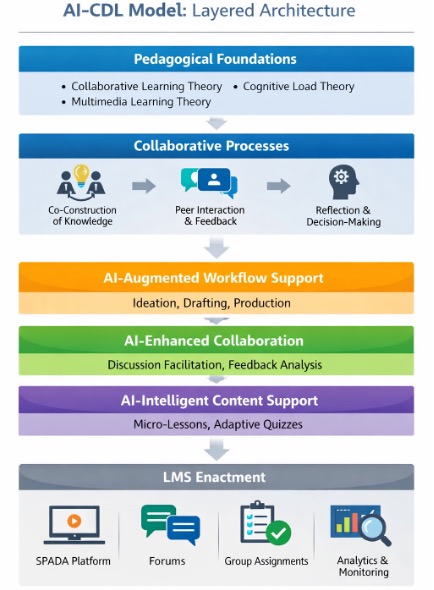
This study develops and conceptually validates an AI-Supported Collaborative Digital Learning (AI-CDL) model for an Introduction to Multimedia course delivered through the national LMS, SPADA Indonesia. Using a Design and Development Research approach aligned with early-stage Design-Based Research, the study followed four phases: (1) contextual and needs analysis of course outcomes, commonly referred to as CPL (Capaian Pembelajaran Lulusan) and CPMK (Capaian Pembelajaran Mata Kuliah), existing learning activities, and available LMS affordances; (2) conceptual model design grounded in collaborative learning theory and multimedia learning principles; (3) development of project-based collaborative scenarios and supporting artefacts (learning paths, assessment rubrics, and responsible AI-use guidelines); and (4) conceptual validation through expert review and alignment with recent evidence syntheses on AI-supported collaboration in higher education. The resulting AI-CDL model operationalizes AI support across three layers intelligent content support, AI-supported collaboration, and AI-augmented production workflows mapped to key multimedia topics and implemented through SPADA activities. Expert feedback informed iterative refinements, particularly in task orchestration, assessment transparency, and ethical safeguards. This study contributes a validated design blueprint and transferable design principles for integrating AI into collaborative multimedia learning within a national-scale LMS. Future work will empirically evaluate learning processes and outcomes through classroom implementation and learning analytics.
References
Y. Qiu, “Techno-optimism in the face of the digital divide: A systematic review on using mobile technologies for children’s environmental learning in the Global South,” International Journal of Child-Computer Interaction, vol. 46, p. 100786, Dec. 2025, doi: 10.1016/j.ijcci.2025.100786.
M. Z. Shoukat, Z. Su, and J. Ali, “Security analysis of digital image watermarking using deep learning inspired LSB and chaotic S-Box in cyber security,” Journal of Information Security and Applications, vol. 94, p. 104209, Nov. 2025, doi: 10.1016/j.jisa.2025.104209.
Y. Zhang, “Impact of digital literacy on college students’ English proficiency: The mediating role of learning motivation and the moderating effect of technological self-efficacy,” Acta Psychologica, vol. 259, p. 105452, Sep. 2025, doi: 10.1016/j.actpsy.2025.105452.
H. Ge and J. Shin, “University students’ learning intention towards generative art in higher education: A SEM–ANN study of human–AI co-creation factors,” Acta Psychologica, vol. 262, p. 106041, Feb. 2026, doi: 10.1016/j.actpsy.2025.106041.
R. Baltà-Salvador, E. Brasó-Vives, and M. Peña, “Evaluating AI-assisted creative ideation: A crossover study in higher education,” Thinking Skills and Creativity, vol. 59, p. 101958, Mar. 2026, doi: 10.1016/j.tsc.2025.101958.
A. Fošner and B. Aver, “AI chatbots in higher education: Students’ beliefs and concerns,” Sustainable Futures, vol. 9, p. 100734, Jun. 2025, doi: 10.1016/j.sftr.2025.100734.
X. Li and A. G. Bus, “Efficacy of digital picture book enhancements grounded in multimedia learning principles: Dependent on age?,” Learning and Instruction, vol. 85, p. 101749, Jun. 2023, doi: 10.1016/j.learninstruc.2023.101749.
M. M. Ayyash and O. H. Salah, “AI adoption in higher education: Advancing sustainable energy management in palestinian universities,” Journal of Open Innovation: Technology, Market, and Complexity, vol. 11, no. 2, p. 100534, Jun. 2025, doi: 10.1016/j.joitmc.2025.100534.
P. Gong, “Investigation and Analysis on the Application of Multimedia Digital Transmission Technology in Art Design:,” Journal of Cases on Information Technology, vol. 27, no. 1, pp. 1–21, Apr. 2025, doi: 10.4018/JCIT.372211.
I. L. Nnaji et al., “Enhancing governance and performance in Nigerian higher education through AI-driven digital transformation: Insights from stakeholder perspectives,” Social Sciences & Humanities Open, vol. 13, p. 102348, Jun. 2026, doi: 10.1016/j.ssaho.2025.102348.
S. Syahruddin, M. S. Saleh, M. Mailizar, M. S. Saleh, A. Habibi, and T. M. Alqahtani, “Responsible AI in Indonesian higher education: A survey in sports education and public health programs,” Social Sciences & Humanities Open, vol. 11, p. 101445, 2025, doi: 10.1016/j.ssaho.2025.101445.
M. K. Rahman, M. A. Hossain, N. A. Ismail, M. S. Hossen, and M. Sultana, “Determinants of students’ adoption of AI chatbots in higher education: the moderating role of tech readiness,” Interactive Technology and Smart Education, vol. 22, no. 3, pp. 448–480, Sep. 2025, doi: 10.1108/ITSE-12-2024-0312.
M. Núñez-Canal, M. D. L. M. De Obesso Arias, C. A. Pérez-Rivero, and I. Álvarez-de-Mon, “Stakeholder engagement and strategic innovation in higher education through AI competency,” Journal of Innovation & Knowledge, vol. 13, p. 100920, May 2026, doi: 10.1016/j.jik.2025.100920.
M. Pikhart and L. H. Al-Obaydi, “Reporting the potential risk of using AI in higher Education: Subjective perspectives of educators,” Computers in Human Behavior Reports, vol. 18, p. 100693, May 2025, doi: 10.1016/j.chbr.2025.100693.
X. Tan, G. Cheng, and M. H. Ling, “Investigating the mediating role of TPACK on teachers’ AI competency and their teaching performance in higher education,” Computers and Education: Artificial Intelligence, vol. 9, p. 100461, Dec. 2025, doi: 10.1016/j.caeai.2025.100461.
H. Li, J. Zhang, W. A. Khan, and H. Lamsali, “Teacher responsibility, AI integration, and student well-being: The role of peer collaboration in higher education,” Acta Psychologica, vol. 260, p. 105532, Oct. 2025, doi: 10.1016/j.actpsy.2025.105532.
S. M. Azmir and Md. Atikuzzaman, “Students’ use of AI tools and attitudes towards using ChatGPT in higher education: a developing country perspective,” The Electronic Library, vol. 43, no. 6, pp. 937–954, Dec. 2025, doi: 10.1108/EL-01-2025-0038.
A. Lachheb, J. Leung, V. Abramenka-Lachheb, and R. Sankaranarayanan, “AI in higher education: A bibliometric analysis, synthesis, and a critique of research,” The Internet and Higher Education, vol. 67, p. 101021, Oct. 2025, doi: 10.1016/j.iheduc.2025.101021.
E. Negm, “Developing enrollment intentions for work-based learning that uses artificial intelligence (AI): aspects for marketing interventions for higher education institutions,” Higher Education, Skills and Work-Based Learning, vol. 15, no. 5, pp. 968–989, Sep. 2025, doi: 10.1108/HESWBL-10-2024-0315.
M. P. Low, M. Soliman, M. K. Al Balushi, and C.-M. Leong, “Beyond conventional adoption: new insights into AI facilitators in Higher Education Institutions,” Sustainable Futures, vol. 9, p. 100781, Jun. 2025, doi: 10.1016/j.sftr.2025.100781.
C. Mambile and A. Mwogosi, “Transforming higher education in Tanzania: unleashing the true potential of AI as a transformative learning tool,” TECHS, vol. 4, no. 1, pp. 51–76, Jan. 2025, doi: 10.1108/TECHS-03-2024-0014.
A. Shapiyeva, K. Baigissova, G. Altybayev, Y. Daineko, S. Nurakhmetova, and G. Abdramanova, “Using Blended Learning and AI in Teaching Physics in Higher Education Institutions,” Procedia Computer Science, vol. 272, pp. 439–444, 2025, doi: 10.1016/j.procs.2025.10.228.
C. He et al., “AI-assisted assessment of higher education quality: A visual analytical approach,” Visual Informatics, p. 100306, Jan. 2026, doi: 10.1016/j.visinf.2026.100306.
A. Z. Syed, Z. H. Memon, K. Khan, I. Hameed, and M. Nadeem, “Examining the behavioral determinants of AI adoption in higher education: a focus on perceptional factors and demographic differences,” On the Horizon: The International Journal of Learning Futures, vol. 33, no. 2, pp. 245–264, Jun. 2025, doi: 10.1108/OTH-02-2025-0019.
J. Weidlich et al., “Teacher, peer, or AI? Comparing effects of feedback sources in higher education,” Computers and Education Open, vol. 9, p. 100300, Dec. 2025, doi: 10.1016/j.caeo.2025.100300.
N. Drydakis, “The formation of AI Capital in higher education: Enhancing students’ academic performance and employment rates,” Computers and Education: Artificial Intelligence, vol. 9, p. 100476, Dec. 2025, doi: 10.1016/j.caeai.2025.100476.
L. Parker, A. J. Loper, C. W. Carter, J. Hayes, and A. Karakas, “Longitudinal insights into AI in education: Usage, ethics, and policy development in higher education,” Computers and Education Open, vol. 10, p. 100329, Jun. 2026, doi: 10.1016/j.caeo.2025.100329.
K. Dai, Y. Liu, and X. Zhang, “Generative AI in higher education: A bibliometric review of emerging trends, power dynamics, and global research landscapes,” Computers and Education: Artificial Intelligence, vol. 10, p. 100544, Jun. 2026, doi: 10.1016/j.caeai.2026.100544.
E. Negm, “Artificial intelligence (AI) usage in higher education: technology integration into curriculums to attain UN sustainable development goals,” Journal of Applied Research in Higher Education, vol. 18, no. 2, pp. 616–631, Jan. 2026, doi: 10.1108/JARHE-04-2025-0275.
Downloads
Published
Issue
Section
License
Copyright (c) 2025 Muh. Al Amin, Ahmad Fatoni Dwi Putra

This work is licensed under a Creative Commons Attribution-ShareAlike 4.0 International License.
Start from 2019 issues, authors who publish with JURNAL MOBILE AND FORENSICS agree to the following terms:
- Authors retain copyright and grant the journal right of first publication with the work simultaneously licensed under a Creative Commons Attribution License (CC BY-SA 4.0) that allows others to share the work with an acknowledgment of the work's authorship and initial publication in this journal.
- Authors are able to enter into separate, additional contractual arrangements for the non-exclusive distribution of the journal's published version of the work (e.g., post it to an institutional repository or publish it in a book), with an acknowledgment of its initial publication in this journal.
- Authors are permitted and encouraged to post their work online (e.g., in institutional repositories or on their website) prior to and during the submission process, as it can lead to productive exchanges, as well as earlier and greater citation of published work.

This work is licensed under a Creative Commons Attribution-ShareAlike 4.0 International License.