Integration of Landscape Analysis, Mobile GIS and Ant Algorithm for Early Warning and Coastal Security Systems
DOI:
https://doi.org/10.12928/mf.v7i2.13176Keywords:
Early Warning System, Mobile GIS, Ant Colony Optimization, Coastal Hazard, Landscape AnalysisAbstract
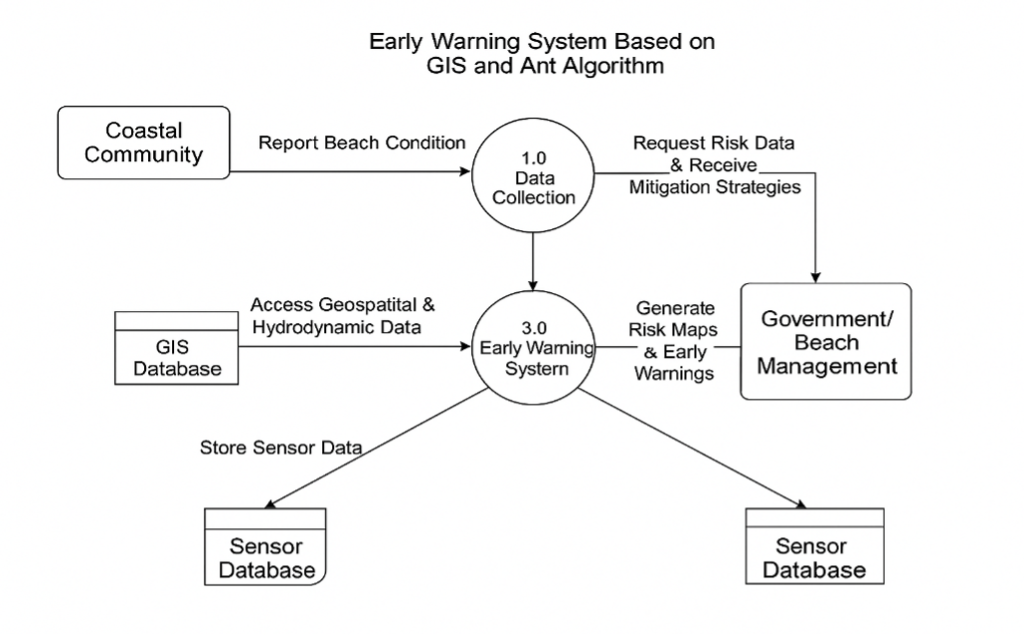
Coastal areas are increasingly vulnerable to abrasion, flash floods, and seawater intrusion due to climate change and human activities. Addressing these hazards requires an integrated early warning system that enables timely and adaptive disaster mitigation. This study integrates landscape analysis, Mobile GIS technology, and the Ant algorithm into a unified early warning framework. Landscape analysis identifies geomorphological patterns and coastline changes. Mobile GIS supports real-time spatial data acquisition, while the Ant algorithm optimizes evacuation routes, sensor placement, and hazard prediction through agent-based modeling. The system incorporates spatial, topographic, oceanographic, and socio-economic data processed through spatial and computational methods. Validation using historical records and field data shows enhanced hazard detection, more efficient evacuation planning, and quicker response times. The Ant algorithm adapts routes in real time based on environmental changes. Sensor deployment is optimized for high-risk zones. Mobile GIS ensures continuous updates and spatial visualization. Real-time processing supports rapid decision-making and threat modeling. These integrated components demonstrate a strong potential to build a resilient, data-driven early warning system for coastal communities. In conclusion, the proposed system offers a precise, adaptive, and scalable approach to improve disaster preparedness in vulnerable coastal regions.
Keywords: early warning system, Mobile GIS, ant algorithm, landscape analysis, coastal disaster mitigation
References
B. Rajan, V. M. Varghese, and P. Anakkathil Purushothaman, ‘Beach Carrying Capacity Analysis for Sustainable Tourism Development in the South West Coast of India’, Environ. Res. Eng. Manag., vol. 63, no. 1, 2013, doi: 10.5755/j01.erem.63.1.2648.
F. Guzzetti et al., ‘Geographical landslide early warning systems’, Earth-Science Reviews, vol. 200. 2020, doi: 10.1016/j.earscirev.2019.102973.
M. Dorigo, G. Di Caro, and L. M. Gambardella, ‘Ant algorithms for discrete optimization’, Artif. Life, vol. 5, no. 2, 1999, doi: 10.1162/106454699568728.
Y. Wang et al., ‘Dynamic optimisation of evacuation route in the fire scenarios of offshore drilling platforms’, Ocean Eng., vol. 247, 2022, doi: 10.1016/j.oceaneng.2022.110564.
K. E. L. Smith, J. F. Terrano, J. L. Pitchford, and M. J. Archer, ‘Coastal wetland shoreline change monitoring: A comparison of shorelines from high‐resolution worldview satellite imagery, aerial imagery, and field surveys’, Remote Sens., vol. 13, no. 15, 2021, doi: 10.3390/rs13153030.
Q. Lu, B. George, and S. Shekhar, ‘Capacity Constrained Routing algorithms for evacuation planning: A summary of results’, in Lecture Notes in Computer Science, 2005, vol. 3633, doi: 10.1007/11535331_17.
L. Xu, K. Huang, J. Liu, D. Li, and Y. F. Chen, ‘Intelligent planning of fire evacuation routes using an improved ant colony optimization algorithm’, J. Build. Eng., vol. 61, p. 105208, Dec. 2022, doi: 10.1016/j.jobe.2022.105208.
A. K. M. Al-Nasrawi, U. A. Al-Hamdany, S. M. Hamylton, B. G. Jones, and Y. M. Alyazichi, ‘Surface Elevation Dynamics Assessment Using Digital Elevation Models, Light Detection and Ranging, GPS and Geospatial Information Science Analysis: Ecosystem Modelling Approach’, Int. J. Environ. Ecol. Eng., 2017.
J. J. Kerski, A. Demirci, and A. J. Milson, ‘The Global Landscape of GIS in Secondary Education’, J. Geog., vol. 112, no. 6, 2013, doi: 10.1080/00221341.2013.801506.
X. P. Li and Y. A. Li, ‘Design of GIS-based monitoring and early-warning system of landslide hazard in Diao Zhongba’, in Energy Procedia, 2012, vol. 16, no. PART B, doi: 10.1016/j.egypro.2012.01.187.
Q. Qin, H. Ma, and J. Li, ‘Damage detection and assessment system of roads for decision support for disaster’, in Key Engineering Materials, 2011, vol. 467–469, doi: 10.4028/www.scientific.net/KEM.467-469.1144.
S. Li et al., ‘How microplastic loads relate to natural conditions and anthropogenic activities in the Yangtze river basin’, Chemosphere, vol. 342, 2023, doi: 10.1016/j.chemosphere.2023.140146.
D. E. Shean, S. Bhushan, P. Montesano, D. R. Rounce, A. Arendt, and B. Osmanoglu, ‘A Systematic, Regional Assessment of High Mountain Asia Glacier Mass Balance’, Front. Earth Sci., vol. 7, 2020, doi: 10.3389/feart.2019.00363.
J. Li and A. D. Heap, ‘Spatial interpolation methods applied in the environmental sciences: A review’, Environmental Modelling and Software, vol. 53. 2014, doi: 10.1016/j.envsoft.2013.12.008.
Y. Chen, ‘Flood hazard zone mapping incorporating geographic information system (GIS) and multi-criteria analysis (MCA) techniques’, J. Hydrol., vol. 612, 2022, doi: 10.1016/j.jhydrol.2022.128268.
P. Chen, L. Wang, A. Wang, Y. Wu, and J. Yu, ‘Development of an Improved Heuristic Algorithm for Inverse Lighting Design Based on Efficacy Evaluation’, Tianjin Daxue Xuebao (Ziran Kexue yu Gongcheng Jishu Ban)/Journal Tianjin Univ. Sci. Technol., vol. 56, no. 10, 2023, doi: 10.11784/tdxbz202207011.
J. Hu, L. Zhang, L. Ma, and W. Liang, ‘An integrated safety prognosis model for complex system based on dynamic Bayesian network and ant colony algorithm’, Expert Syst. Appl., vol. 38, no. 3, 2011, doi: 10.1016/j.eswa.2010.07.050.
C. Liu et al., ‘An improved heuristic mechanism ant colony optimization algorithm for solving path planning’, Knowledge-Based Syst., vol. 271, 2023, doi: 10.1016/j.knosys.2023.110540.
H. Togia, O. P. Francis, K. Kim, and G. Zhang, ‘Segment-Based Approach for Assessing Hazard Risk of Coastal Highways in Hawai‘i’, Transp. Res. Rec., vol. 2673, no. 1, 2019, doi: 10.1177/0361198118821679.
Y. Kambayashi, K. Konishi, R. Sato, K. Azechi, and M. Takimoto, ‘A prototype of evacuation support systems based on the ant colony optimization algorithm’, in Advances in Intelligent Systems and Computing, 2019, vol. 852, doi: 10.1007/978-3-319-99981-4_30.
V. Henao-Céspedes, Y. A. Garcés-Gómez, and M. N. Marín Olaya, ‘Landslide early warning systems: a perspective from the internet of things’, Int. J. Electr. Comput. Eng., vol. 13, no. 2, 2023, doi: 10.11591/ijece.v13i2.pp2214-2222.
D. S. Hur, W. D. Lee, W. C. Cho, Y. H. Jeong, and Y. M. Jeong, ‘Rip current reduction at the open inlet between double submerged breakwaters by installing a drainage channel’, Ocean Eng., vol. 193, 2019, doi: 10.1016/j.oceaneng.2019.106580.
J. Wang, ‘Bidirectional ACO intelligent fire evacuation route optimization’, J. Ambient Intell. Smart Environ., vol. 14, no. 2, 2022, doi: 10.3233/AIS-220620.
Y. Tang, ‘Discrete Dynamic Modeling Analysis of Rural Revitalization and Ecotourism Sustainable Prediction Based on Big Data’, Discrete Dynamics in Nature and Society, vol. 2022. 2022, doi: 10.1155/2022/9158905.
K. Yamamoto and X. Li, ‘Safety Evaluation of Evacuation Routes in Central Tokyo Assuming a Large-Scale Evacuation in Case of Earthquake Disasters’, J. Risk Financ. Manag., vol. 10, no. 3, 2017, doi: 10.3390/jrfm10030014.
N. Saleem, M. Enamul Huq, N. Y. D. Twumasi, A. Javed, and A. Sajjad, ‘Parameters derived from and/or used with digital elevation models (DEMs) for landslide susceptibility mapping and landslide risk assessment: A review’, ISPRS International Journal of Geo-Information, vol. 8, no. 12. 2019, doi: 10.3390/ijgi8120545.
Z. Li et al., ‘Route CHoice Behaviour by Travel Time’, Transp. Res. Part C Emerg. Technol., vol. 18, no. 3, 2015.
L. Zhu and J. F. Huang, ‘GIS-based logistic regression method for landslide susceptibility mapping in regional scale’, J. Zhejiang Univ. Sci., vol. 7, no. 12, 2006, doi: 10.1631/jzus.2006.A2007.
Y. Ortakci, U. Atila, E. Demiral, K. Ozacar, and ..., ‘Comparison of a smart mobile application-supported evacuation system and traditional evacuation systems’, 1st IAG Work. …, 2017.
A. M. Alberti et al., ‘Platforms for Smart Environments and Future Internet Design: A Survey’, IEEE Access, vol. 7. 2019, doi: 10.1109/ACCESS.2019.2950656.
Downloads
Published
Issue
Section
License
Copyright (c) 2025 Muhammad Aziz

This work is licensed under a Creative Commons Attribution-ShareAlike 4.0 International License.
Start from 2019 issues, authors who publish with JURNAL MOBILE AND FORENSICS agree to the following terms:
- Authors retain copyright and grant the journal right of first publication with the work simultaneously licensed under a Creative Commons Attribution License (CC BY-SA 4.0) that allows others to share the work with an acknowledgment of the work's authorship and initial publication in this journal.
- Authors are able to enter into separate, additional contractual arrangements for the non-exclusive distribution of the journal's published version of the work (e.g., post it to an institutional repository or publish it in a book), with an acknowledgment of its initial publication in this journal.
- Authors are permitted and encouraged to post their work online (e.g., in institutional repositories or on their website) prior to and during the submission process, as it can lead to productive exchanges, as well as earlier and greater citation of published work.

This work is licensed under a Creative Commons Attribution-ShareAlike 4.0 International License.