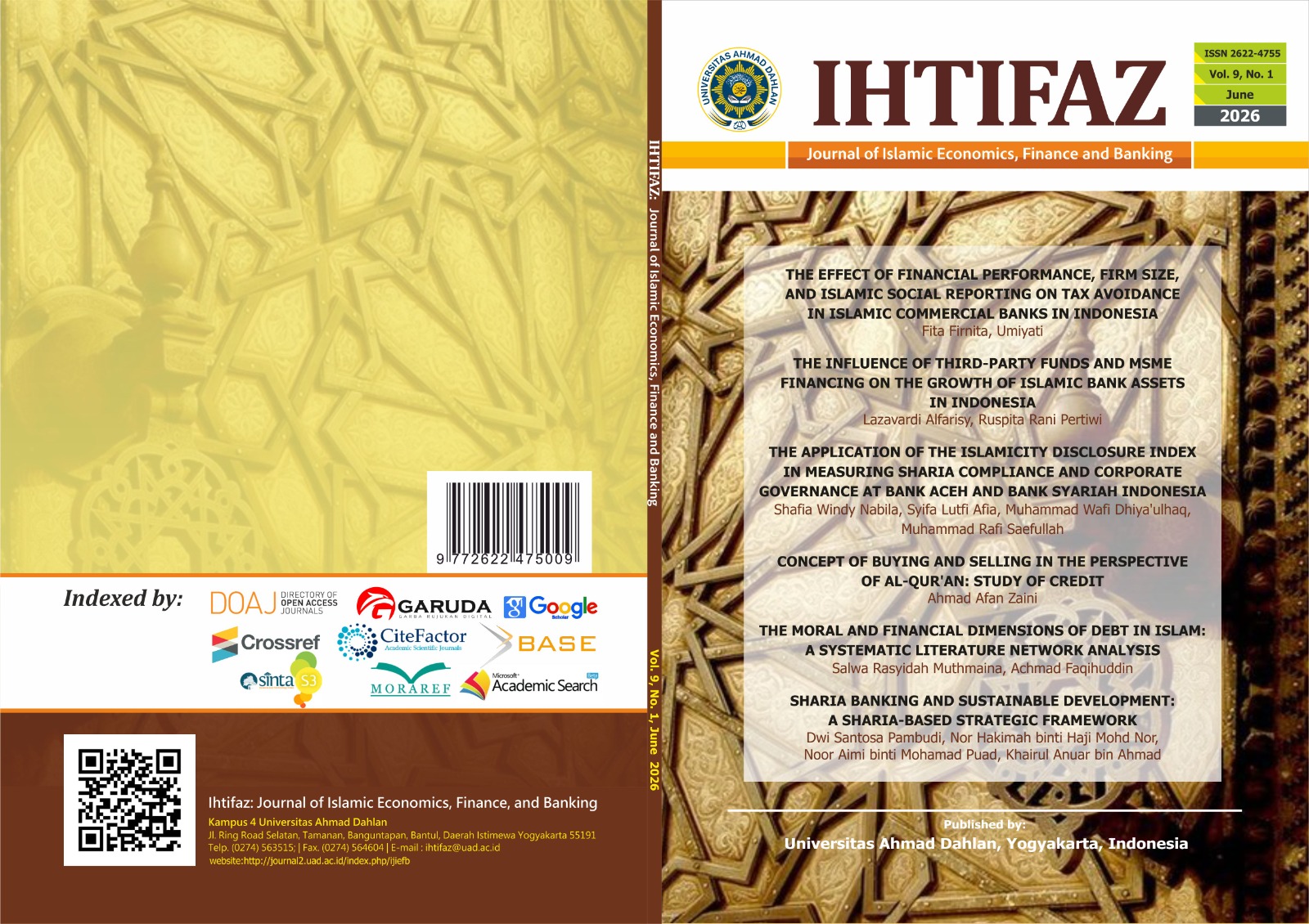
The Effect of Financial Performance, Firm Size, and Islamic Social Reporting on Tax Avoidance in Islamic Commercial Banks in Indonesia
DOI:
https://doi.org/10.12928/ijiefb.v9i1.16221Keywords:
Profitability, Leverage, Firm Size, Islamic Social Reporting, Tax AvoidanceAbstract
Introduction to The Problem: This study analyzed the effects of financial performance proxied by profitability (ROA) and leverage (DER), firm size, and Islamic Social Reporting (ISR) on tax avoidance (ETR) in Islamic Commercial Banks in Indonesia. As corporate entities, Islamic commercial banks in Indonesia are obligated to comply with taxation regulations while simultaneously adhering to the ethical principles of Islamic business conduct.
Purpose/Objective of the Study: The objective of this study is to examine Islamic Commercial Banks in Indonesia. Specifically, the research seeks to determine whether financial performance significantly affects the level of tax avoidance, whether larger Islamic banks exhibit different tax avoidance behavior compared to smaller institutions, and whether greater disclosure of Islamic Social Reporting reduces the tendency to engage in tax avoidance.
Design/Methodology/Approach: This research employs a quantitative approach using secondary data derived from the annual reports of Islamic Commercial Banks for the period 2018–2024. The sampling technique applied is purposive sampling, resulting in a sample of eight banks. The data were analyzed using panel data regression with the assistance of EViews 12.0 and Microsoft Excel.
Findings: The results of the study indicate that, simultaneously, profitability (ROA), leverage (DER), firm size, and Islamic Social Reporting (ISR) have a significant effect on tax avoidance. Partially, firm size and Islamic Social Reporting are found to influence tax avoidance, whereas profitability and solvency do not have a significant effect on tax avoidance in Islamic Commercial Banks.
References
Amri, Z., & Sovita, I. (2024). Analisis Pengaruh Profitabilitas, Likuiditas, Leverage, Dan Tax Avoidance Terhadap Pengungkapan Islamic Social Reporting (ISR). Jurnal Akuntansi Keuangan Dan Bisnis, 1(4), 892–910. https://jurnal.ittc.web.id/index.php/jakbs/index
Andalenta, I., & Ismawati, K. (2022). Tax Avoidance Perusahaan Perbankan. Owner, 6(1), 225–233. https://doi.org/10.33395/owner.v6i1.627
Devi, N. S., & Arinta, Y. N. (2021). Pengaruh size company, profitabilitas, dan likuiditas terhadap tax avoidance dengan struktur modal sebagai variabel intervening pada Bank Umum Syariah di Indonesia. Journal of Accounting and Digital Finance, 1(2), 96–107. https://doi.org/10.53088/jadfi.v1i2.95
DPR RI. (2007). Undang-Undang Nomor 28 Tahun 2007 tentang Perubahan Ketiga Atas Undang-Undang Nomor 6 Tahun 1983 Tentang Ketentuan Umum Dan Tata Cara Perpajakan, Jakarta: DPR RI
Fatmasari, I. M., Dewi, F. G., & Asmaranti, Y. (2025). The Influence of Islamic Social Reporting and Financial Distress on Tax Avoidance with Profitability as a Mediating Variable : Study on Islamic Commercial Banks. 8(3), 325–336
Firmansyah, A., Arham, A., Qadri, R. A., Wibowo, P., Irawan, F., Kustiani, N. A., Wijaya, S., Andriani, A. F., Arfiansyah, Z., Kurniawati, L., Mabrur, A., Dinarjito, A., Kusumawati, R., & Mahrus, M. L. (2022). Political connections, investment opportunity sets, tax avoidance: does corporate social responsibility disclosure in Indonesia have a role? Heliyon, 8(8).
Fitriya, F. A., & Bawono, A. (2023). Pengaruh Roa Dan Leverage Terhadap Tax Avoidance Pada Bank Umum Syariah. Jurnal Masharif Al-Syariah: Jurnal Ekonomi Dan Perbankan http://dx.doi.org/10.30651/jms.v8i1.18388 Syariah, 8(1), 747–759.
Handoyo, S., Wicaksono, A. P., & Darmesti, A. (2022). Does Corporate Governance Support Tax Avoidance Practice in Indonesia?. International Journal of Innovative Research and Scientific Studies, 5(3), 184–201.
Indarningsih, N. A., Ma’wa, M. A. F., & Irnandas, M. I. (2023) Islamic Corporate Governance, Islamic Social Reporting, Financial Performance and Tax Avoidance: Women BOD and Leverage as Moderating Variables. Jurnal: Li Falah: Jurnal Studi Ekonomi dan Bisnis Islam, 8(1), 19–34.DOI: https://doi.org/10.31332/lifalah.v8i1.6148
Marlinda, D. E., Titisari, K. H., & Masitoh, E. (2020). Pengaruh Gcg, Profitabilitas, Capital Intensity, dan Ukuran Perusahaan terhadap Tax Avoidance. Ekonomis: Journal of Economics and Business, https://doi.org/10.33087/ekonomis.v4i1.86 4(1), 39.
Naufal, A., Prasojo, P., & Utami, R. D. (2024). Influence of the Shariah supervisory board on tax avoidance at an Indonesian Islamic bank. Jurnal Ekonomi & Keuangan Islam, 10(1), 1–14. https://doi.org/10.20885/jeki.vol10.iss1.art1
Novitasari, M., & Suharni, S. (2019). Implikasi indikator keuangan terhadap tax avoidance. Accounting and Financial Review, 2(1), 16–23. https://doi.org/10.26905/afr.v2i1.3177
Permata, S. F. I., Nugroho, R., & Muararah, H. S. (2021). The Effect of Financial Distress, Earnings Management and Management Skills on Tax Aggressiveness. Jurnal Info Artha, 5(2), https://jurnal.pknstan.ac.id/index.php/JIA/article/view/1377 93–107.
Puspitasari, A. P., & Wulandari, S. (2022). Analisis Faktor yang Memengaruhi Tax Avoidance Perusahaan Perbankan. Jurnal Ilmiah Akuntansi Kesatuan, 10(2), 341–352. https://doi.org/10.37641/jiakes.v10i2.1330
Rustiani, T., Tyas, I. W., & Juniarto, A. (2024). Pengaruh Leverage Dan Ukuran Perusahaan Terhadap Tax Avoidence. Jurnal Proaksi, 11(1), 102–120. https://doi.org/10.32534/jpk.v11i1.5473
Siregar, M. K. R., Rahmani, N. A. B., & Harahap, R. D. (2023). Pengaruh Good Corporate Governance Dan Islamic Corporate Social Responsibility Terhadap Profitabilitas (Roa) Pada Bank Umum Syariah Di Indonesia Tahun 2017-2020. Jurnal Ilmiah Manajemen, Ekonomi Dan Akuntansi, 7(2), 3730–3739
Sulastri, D. D., Amelia, E., & Meiria, E. (2022). Pengaruh Profitabilitas, Solvabilitas, Ukuran Perusahaan Dan Islamic Corporate Social Responsibility Terhadap Tax Avoidance Pada Bank Umum Syariah Di Indonesia. Jurnal Masharif al-Syariah, 7(2)
Downloads
Published
Issue
Section
License
Copyright (c) 2026 Universitas Ahmad Dahlan

This work is licensed under a Creative Commons Attribution-NonCommercial-ShareAlike 4.0 International License.
License and Copyright Agreement
In submitting the manuscript to the journal, the authors certify that:
- They are authorized by their co-authors to enter into these arrangements.
- The work described has not been formally published before, except in the form of an abstract or as part of a published lecture, review, thesis, or overlay journal. Please also carefully read Ihtifaz, Journal of Islamic Economics, Finance, and Banking Posting Your Article Policy at http://journal2.uad.ac.id/index.php/ijiefb/about/submissions#onlineSubmissions
- That it is not under consideration for publication elsewhere,
- That its publication has been approved by all the author(s) and by the responsible authorities “tacitly or explicitly“ of the institutes where the work has been carried out.
- They secure the right to reproduce any material that has already been published or copyrighted elsewhere.
- They agree to the following license and copyright agreement.
Copyright
Authors who publish with Ihtifaz, Journal of Islamic Economics, Finance, and Banking agree to the following terms:
- Authors retain copyright and grant the journal right of first publication with the work simultaneously licensed under a Creative Commons Attribution License (CC BY-SA 4.0) that allows others to share the work with an acknowledgment of the work's authorship and initial publication in this journal.
- Authors are able to enter into separate, additional contractual arrangements for the non-exclusive distribution of the journal's published version of the work (e.g., post it to an institutional repository or publish it in a book), with an acknowledgment of its initial publication in this journal.
- Authors are permitted and encouraged to post their work online (e.g., in institutional repositories or on their website) prior to and during the submission process, as it can lead to productive exchanges, as well as earlier and greater citation of published work.
_1.png)