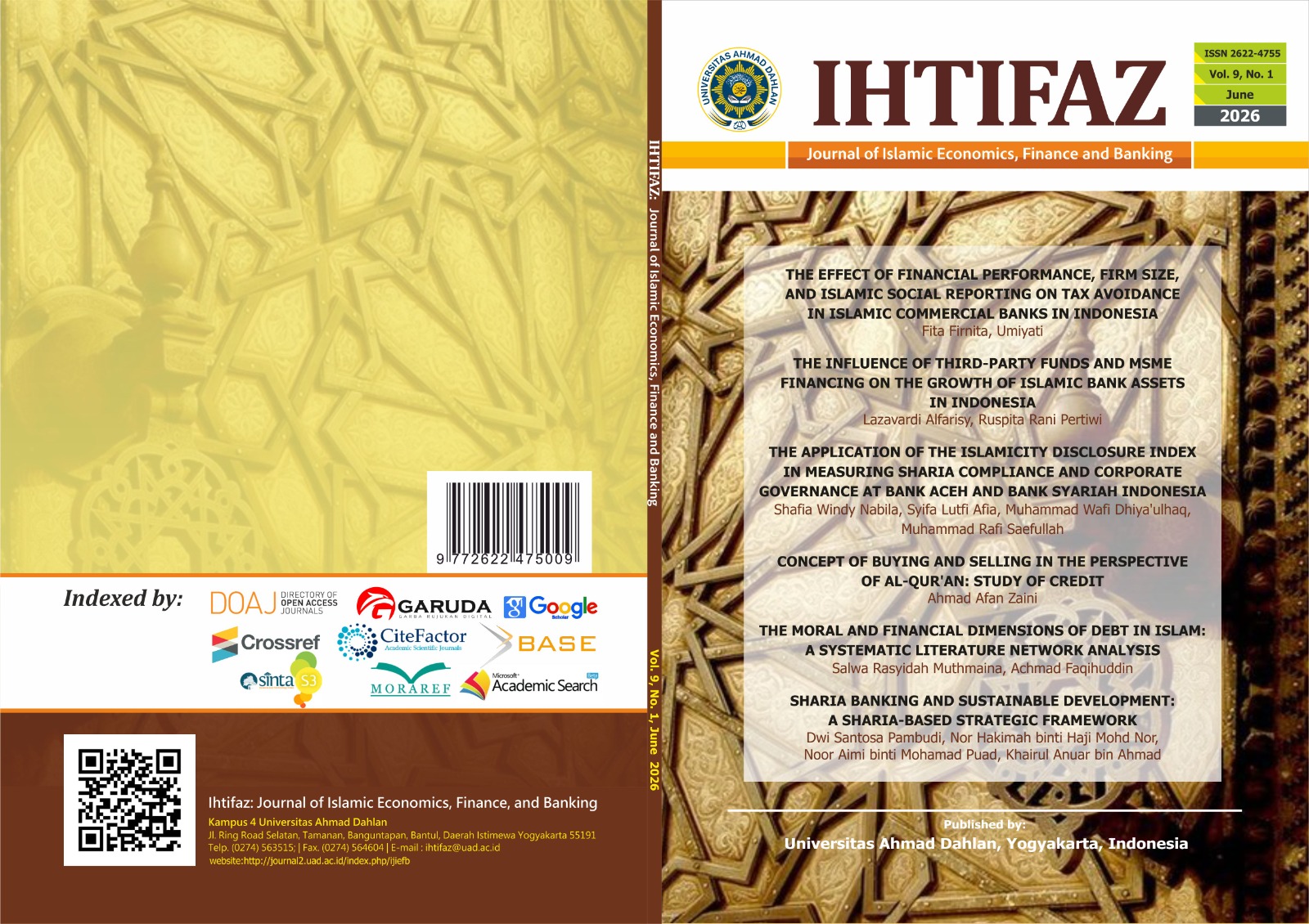
The Moral and Financial Dimensions of Debt in Islam: A Systematic Literature Network Analysis
DOI:
https://doi.org/10.12928/ijiefb.v9i1.16083Keywords:
Islamic debt, Islamic finance, Moral responsibility, Bibliometric analysis, SLNAAbstract
Introduction to The Problem: Debt in Islam is not only a financial instrument but also a moral responsibility that influences individual and social behavior.
Purpose/Objective Study: This study aims to map the development of academic research on debt in Islamic perspective and identify major research themes..
Design/Methodology/Approach: This research employs Systematic Literature Network Analysis (SLNA) combining systematic review and bibliometric network analysis using Scopus data (2015–2025), PRISMA procedure, and VOSviewer.
Findings: The results reveal four main research orientations: debt as financial necessity, moral responsibility, institutional Islamic finance practice, and Islamic social solidarity.
Paper Type: Research Article
Keywords: Islamic debt; Islamic finance; moral responsibility; bibliometric analysis; SLNA
References
Almaskati, N. (2022). Sukuk versus bonds: New evidence from the primary market. Borsa Istanbul Review, 22(5), 1033–1038. https://doi.org/10.1016/j.bir.2022.06.005
Alqahtani, F., & Mayes, D. G. (2017). The global financial crisis and Islamic banking: The direct exposure to the crisis. Banks and Bank Systems, 12(3), 100–112. https://doi.org/10.21511/bbs.12(3).2017.08
Belal, A. R., Abdelsalam, O., & Nizamee, S. S. (2015). Ethical Reporting in Islami Bank Bangladesh Limited (1983–2010). Journal of Business Ethics, 129(4), 769–784. https://doi.org/10.1007/s10551-014-2133-8
Bogatzki, T., Stadelmann, D., & Torgler, B. (2025). Guiltily indebted? How a word is linked to individual borrowing. Applied Economics Letters, 32(9), 1269–1272. https://doi.org/10.1080/13504851.2024.2302891
Chen, F., Yu, D., & Sun, Z. (2023). Investigating the associations of consumer financial knowledge and financial behaviors of credit card use. Heliyon, 9(1). https://doi.org/10.1016/j.heliyon.2022.e12713
Gulzar, R., Ibrahim, M. H., & Ariff, M. (2020). ARE ISLAMIC BANKS SUFFERING FROM A MODEL MISFIT? A COMPARISON WITH COOPERATIVE BANKS. Journal of Islamic Monetary Economics and Finance, 6(2), 325–352. https://doi.org/10.21098/jimf.v6i2.1086
Hassan, M. K., & Kayed, R. N. (2009). THE GLOBAL FINANCIAL CRISIS, RISK MANAGEMENT AND SOCIAL JUSTICE IN ISLAMIC FINANCE. ISRA International Journal of Islamic Finance, 1(1), 33–58. https://doi.org/10.55188/ijif.v1i1.63
Jusoh, M., & Khalid, N. (2013). A model of demand for Islamic banks’ debt-based financing instruments. Jurnal Pengurusan, 39, 31–36. https://doi.org/10.17576/pengurusan-2013-39-03
Khalfi, M., & Saâdaoui, F. (2023). Banking efficiency: Basic concepts, forms, and specificities of Islamic finance. In Islamic Accounting And Finance: A Handbook (pp. 431–460). World Scientific Publishing Co. https://doi.org/10.1142/9781800612426_0015
Mirakhor, A., Krichene, N., & Shaukat, M. (2012). UNSUSTAINABILITY OF THE REGIME OF INTEREST-BASED DEBT FINANCING. ISRA International Journal of Islamic Finance, 4(2), 25–52. https://doi.org/10.55188/ijif.v4i2.145
Mukhibad, H., & Setiawan, D. (2023). INVESTIGATING EQUITY-BASED FINANCING AND DEBT-BASED FINANCING IN ISLAMIC BANKS IN INDONESIA. ISRA International Journal of Islamic Finance, 15(4), 87–103. https://doi.org/10.55188/ijif.v15i4.689
Nayak, B. S. (2024). Eurocentric Fables of International Debt and China. China Report, 60(2), 212–217. https://doi.org/10.1177/00094455241287930
Sadr, S. K. (2014). QARḌ ḤASAN FINANCING IN ISLAMIC BANKS. ISRA International Journal of Islamic Finance, 6(2), 7–20. https://doi.org/10.12816/0019261
Wahyudi, H., Lestari, W. R., Said, U. B., Leny, S. M., & Awaluddin, I. (2025). Dynamics of Growth and Stability in the Islamic Financial Services Industry on ECA, GCC, MENA, SSA, and EAP. International Journal of Economics and Financial Issues , 15(3), 448–456. https://doi.org/10.32479/ijefi.19200
Widarjono, A., Alam, M. M., Rafik, A., Azra, K., & Mardhiyah, Z. (2025). Non-Risk-Sharing Financing in Indonesian Islamic Banks: The Role of Market Power. Management and Accounting Review, 24(2), 47–74. https://doi.org/10.24191/MAR.V24i02-03
Downloads
Published
Issue
Section
License
Copyright (c) 2026 Universitas Ahmad Dahlan

This work is licensed under a Creative Commons Attribution-NonCommercial-ShareAlike 4.0 International License.
License and Copyright Agreement
In submitting the manuscript to the journal, the authors certify that:
- They are authorized by their co-authors to enter into these arrangements.
- The work described has not been formally published before, except in the form of an abstract or as part of a published lecture, review, thesis, or overlay journal. Please also carefully read Ihtifaz, Journal of Islamic Economics, Finance, and Banking Posting Your Article Policy at http://journal2.uad.ac.id/index.php/ijiefb/about/submissions#onlineSubmissions
- That it is not under consideration for publication elsewhere,
- That its publication has been approved by all the author(s) and by the responsible authorities “tacitly or explicitly“ of the institutes where the work has been carried out.
- They secure the right to reproduce any material that has already been published or copyrighted elsewhere.
- They agree to the following license and copyright agreement.
Copyright
Authors who publish with Ihtifaz, Journal of Islamic Economics, Finance, and Banking agree to the following terms:
- Authors retain copyright and grant the journal right of first publication with the work simultaneously licensed under a Creative Commons Attribution License (CC BY-SA 4.0) that allows others to share the work with an acknowledgment of the work's authorship and initial publication in this journal.
- Authors are able to enter into separate, additional contractual arrangements for the non-exclusive distribution of the journal's published version of the work (e.g., post it to an institutional repository or publish it in a book), with an acknowledgment of its initial publication in this journal.
- Authors are permitted and encouraged to post their work online (e.g., in institutional repositories or on their website) prior to and during the submission process, as it can lead to productive exchanges, as well as earlier and greater citation of published work.
_1.png)