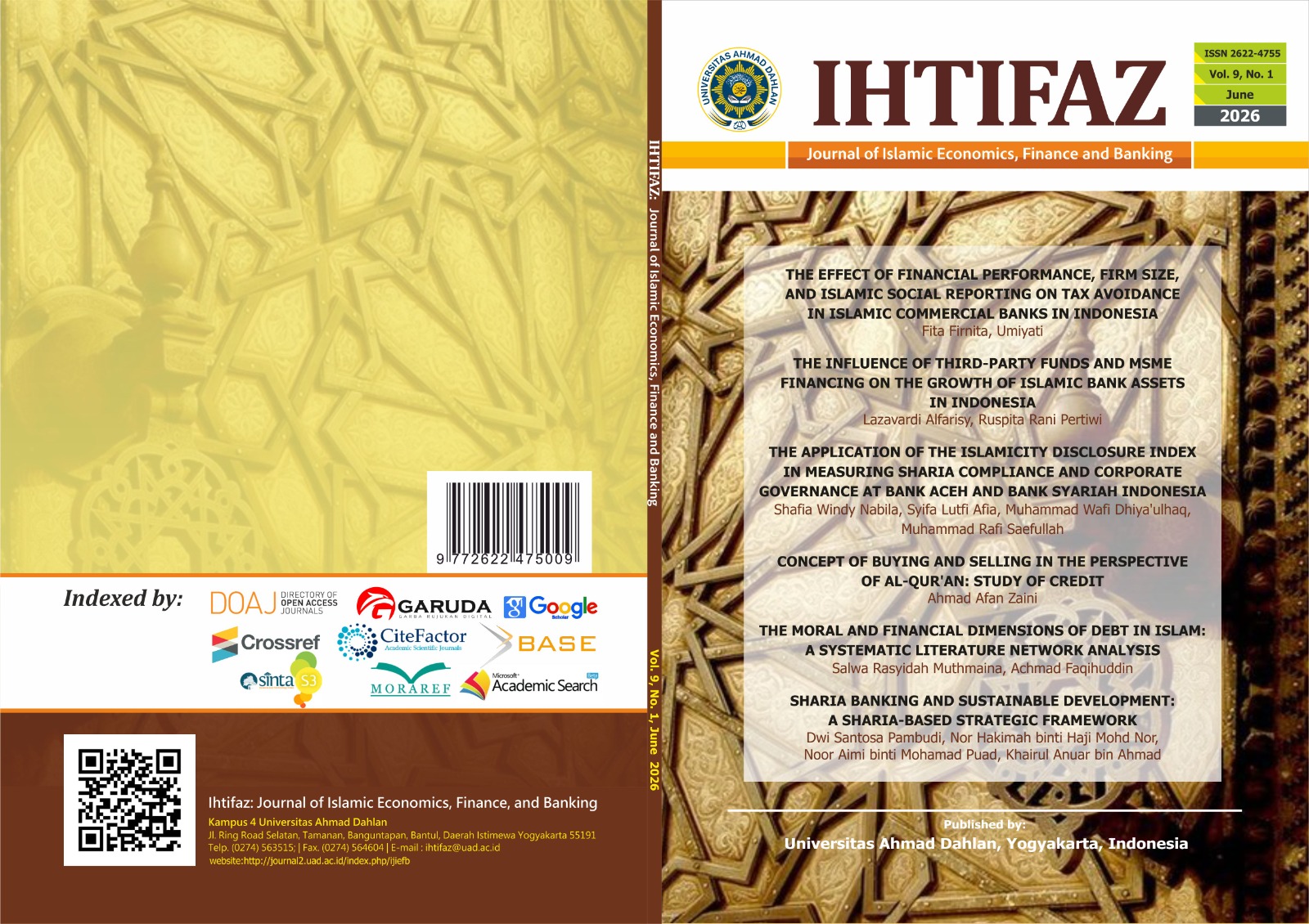
Concept of Buying and Selling In The Perspective of Al-Qur'an: Study Of Credit
DOI:
https://doi.org/10.12928/ijiefb.v9i1.15553Keywords:
Buying and Selling, Credit, Riba, Al-Quran, Islamic EconomicsAbstract
Introduction: Buying and selling is an economic activity that is clearly regulated in the Al-Qur'an as part of the Islamic muamalah. Along with the development of the modern economy, the practice of buying and selling credit is increasingly being used, but it has given rise to debate regarding its suitability with sharia principles, especially in terms of usury and transaction fairness. Therefore, this article examines the concept of buying and selling from the perspective of the Koran with a focus on the practice of buying and selling credit.
Purpose: The purpose of this article is to examine and analyze the concept of buying and selling from the perspective of the Qur'an, especially in relation to the practice of credit transactions, by examining the normative foundations, principles of justice, the prohibition of usury, and muamalah ethics which form the basis for the validity and application of credit buying and selling in the Islamic economic system.
Methodology: This research uses a qualitative approach with library research methods. Data was obtained from the Al-Qur'an, tafsir books, as well as Islamic economic literature that is relevant to the concept of buying and selling and credit. Data analysis was carried out descriptively-analytically with a thematic interpretation approach, namely examining verses from the Al-Qur'an related to buying and selling and credit transactions to understand the principles and provisions of sharia in the practice of buying and selling credit.
Findings: This research found that the Qur'an allows the practice of buying and selling on credit (bai' bi at-taqsith) as part of a valid muamalah, as long as it meets the principles of justice, clarity of the contract and the willingness of the parties. The Koran, especially in QS. Al-Baqarah verses 275 and 282, emphasize the fundamental difference between buying and selling and usury, as well as providing legitimacy to non-cash transactions provided that there is clear recording and a price agreement at the beginning of the contract. This research also found that adding prices in credit buying and selling is not automatically classified as usury, as long as it is not exploitative, does not contain elements of gharar, and does not occur unilaterally after the contract has been agreed. Thus, the concept of buying and selling credit from the perspective of the Qur'an emphasizes aspects of ethics, transparency and protection for both parties, so that it can become a normative basis for contemporary sharia financing practices.
References
al-Aṣfahānī, Al-Rāghib. (2009). Al-Mufradāt fī Gharīb al-Qur’ān (Damaskus: Dār al-Qalam), 356–357.
al-Farmāwī, ‘Abd al-Ḥayy. (1977). Al-Bidāyah fī al-Tafsīr al-Maudhū‘ī (Kairo: Dār al-Manār), 45–47.
al-Ghazālī, Abū Ḥāmid. (1993). Al-Mustaṣfā min ‘Ilm al-Uṣūl (Beirut: Dār al-Kutub al-‘Ilmiyyah), Juz I, 286–287; Abū Isḥāq al-Syāṭibī, Al-Muwāfaqāt (Beirut: Dār al-Ma‘rifah, t.t.), Juz II, 8–10.
al-Nabhānī, Taqī al-Dīn. (2004). Al-Niẓām al-Iqtiṣādī fī al-Islām (Beirut: Dār al-Ummah), 143–146.
al-Rāzī, Fakhr al-Dīn. (1999). Mafātīḥ al-Ghayb (Beirut: Dār Iḥyā’ al-Turāth al-‘Arabī), Juz X, 91–93.
al-Ṣadr, Muhammad Baqir. (1987). Iqtisādunā (Beirut: Dār al-Ta‘āruf), 293–295.
_____________________. (1987). Iqtisādunā (Beirut: Dār al-Ta‘āruf), 301–305.
Al-Suyūṭī. (1998). Al-Ashbāh wa al-Naẓā’ir (Beirut: Dār al-Kutub al-‘Ilmiyyah), 121.
al-Zuḥaylī, Wahbah. (1985). Al-Fiqh al-Islāmī wa Adillatuhu (Damaskus: Dār al-Fikr), Juz IV, 3–5.
________________ (1985). Al-Fiqh al-Islāmī wa Adillatuhu (Damaskus: Dār al-Fikr), Juz IV, 7–12.
________________ (1985). Al-Fiqh al-Islāmī wa Adillatuhu (Damaskus: Dār al-Fikr), Juz IV, 8–10.
________________ (1985). Al-Fiqh al-Islāmī wa Adillatuhu (Damaskus: Dār al-Fikr), Juz V, 349–352.
________________ (1985). Al-Fiqh al-Islāmī wa Adillatuhu (Damaskus: Dār al-Fikr), Juz V, 371–373.
________________ (1986). Uṣūl al-Fiqh al-Islāmī (Damaskus: Dār al-Fikr), 451–453.
Auda, Jasser. (2008). Maqāṣid al-Sharī‘ah as Philosophy of Islamic Law (London: IIIT), 3–7.
___________ (2008). Maqāṣid al-Sharī‘ah as Philosophy of Islamic Law (London: IIIT), 65–68.
___________ (2008). Maqāṣid al-Sharī‘ah as Philosophy of Islamic Law (London: IIIT), 75–78.
___________ (2008). Maqāṣid al-Sharī‘ah as Philosophy of Islamic Law (London: IIIT), 101–104.
___________ (2008). Maqāṣid al-Sharī‘ah as Philosophy of Islamic Law (London: IIIT), 111–114.
___________ (2008). Maqāṣid al-Sharī‘ah as Philosophy of Islamic Law (London: IIIT), 117–120.
___________ (2008). Maqāṣid al-Sharī‘ah as Philosophy of Islamic Law (London: IIIT), 121–124.
___________ (2008). Maqāṣid al-Sharī‘ah as Philosophy of Islamic Law (London: IIIT), 132–135.
Chapra, Muhammad Umer. (2000). The Future of Economics: An Islamic Perspective (Leicester: The Islamic Foundation), 265–268.
El-Gamal, Mahmoud A. (2006). Islamic Finance: Law, Economics, and Practice (Cambridge: Cambridge University Press), 116–119.
Harvey, David. (2005). A Brief History of Neoliberalism (Oxford: Oxford University Press), 74–76.
Kamali, Muhammad Hashim. (2000). Islamic Commercial Law (Cambridge: Islamic Texts Society), 89–92.
Kathīr, Ibn. (1964). Tafsīr al-Qur’ān al-‘Aẓīm (Beirut: Dār al-Fikr, t.t.), Juz I, 326; al-Qurṭubī, Al-Jāmi‘ li Aḥkām al-Qur’ān (Kairo: Dār al-Kutub al-Miṣriyyah), Juz III, 241.
_________ (1964). Tafsīr al-Qur’ān al-‘Aẓīm (Beirut: Dār al-Fikr, t.t.), Juz I, 326.
_________ (1964). Tafsīr al-Qur’ān al-‘Aẓīm (Beirut: Dār al-Fikr, t.t.), Juz I, 343–345.
Khan, Muhammad Akram. (1994). An Introduction to Islamic Economics (Islamabad: IIIT), 52–55.
Mehmet, Asutay. (2011). “Conceptualising and Locating the Social Failure of Islamic Finance,” Journal of Islamic Economics, Banking and Finance 7, no. 3 (2011): 1–14.
Piketty, Thomas. (2014). Capital in the Twenty-First Century (Cambridge: Harvard University Press), 571–573.
Rahman, Fazlur. (1982). Islam and Modernity (Chicago: University of Chicago Press), 35–38.
Saeed, Abdullah. (1996). Islamic Banking and Interest (Leiden: Brill), 9–12.
_____________ (1996). Islamic Banking and Interest (Leiden: Brill), 37–40.
Samuelson, Paul A. dan William D. Nordhaus. (2010). Economics (New York: McGraw-Hill), 610–612.
Siddiqi, Muhammad Nejatullah. (2004). Riba, Bank Interest and the Rationale of Its Prohibition (Jeddah: IRTI), 21–24
Soekanto, Soerjono dan Sri Mamudji. (2006). Penelitian Hukum Normatif (Jakarta: Rajawali Pers), 13–15.
Stiglitz, Joseph E. (2002). Globalization and Its Discontents (New York: W.W. Norton), 89–91.
________________ (2010). Freefall: America, Free Markets, and the Sinking of the World Economy (New York: W.W. Norton), 93–96.
Qudāmah, Ibn. (1997). Al-Mughnī (Riyadh: Dār ‘Ālam al-Kutub), Juz IV, 176–178.
Zed, Mestika. (2008). Metode Penelitian Kepustakaan (Jakarta: Yayasan Obor Indonesia), 3–5.
Downloads
Published
Issue
Section
License
Copyright (c) 2026 Universitas Ahmad Dahlan

This work is licensed under a Creative Commons Attribution-NonCommercial-ShareAlike 4.0 International License.
License and Copyright Agreement
In submitting the manuscript to the journal, the authors certify that:
- They are authorized by their co-authors to enter into these arrangements.
- The work described has not been formally published before, except in the form of an abstract or as part of a published lecture, review, thesis, or overlay journal. Please also carefully read Ihtifaz, Journal of Islamic Economics, Finance, and Banking Posting Your Article Policy at http://journal2.uad.ac.id/index.php/ijiefb/about/submissions#onlineSubmissions
- That it is not under consideration for publication elsewhere,
- That its publication has been approved by all the author(s) and by the responsible authorities “tacitly or explicitly“ of the institutes where the work has been carried out.
- They secure the right to reproduce any material that has already been published or copyrighted elsewhere.
- They agree to the following license and copyright agreement.
Copyright
Authors who publish with Ihtifaz, Journal of Islamic Economics, Finance, and Banking agree to the following terms:
- Authors retain copyright and grant the journal right of first publication with the work simultaneously licensed under a Creative Commons Attribution License (CC BY-SA 4.0) that allows others to share the work with an acknowledgment of the work's authorship and initial publication in this journal.
- Authors are able to enter into separate, additional contractual arrangements for the non-exclusive distribution of the journal's published version of the work (e.g., post it to an institutional repository or publish it in a book), with an acknowledgment of its initial publication in this journal.
- Authors are permitted and encouraged to post their work online (e.g., in institutional repositories or on their website) prior to and during the submission process, as it can lead to productive exchanges, as well as earlier and greater citation of published work.
_1.png)