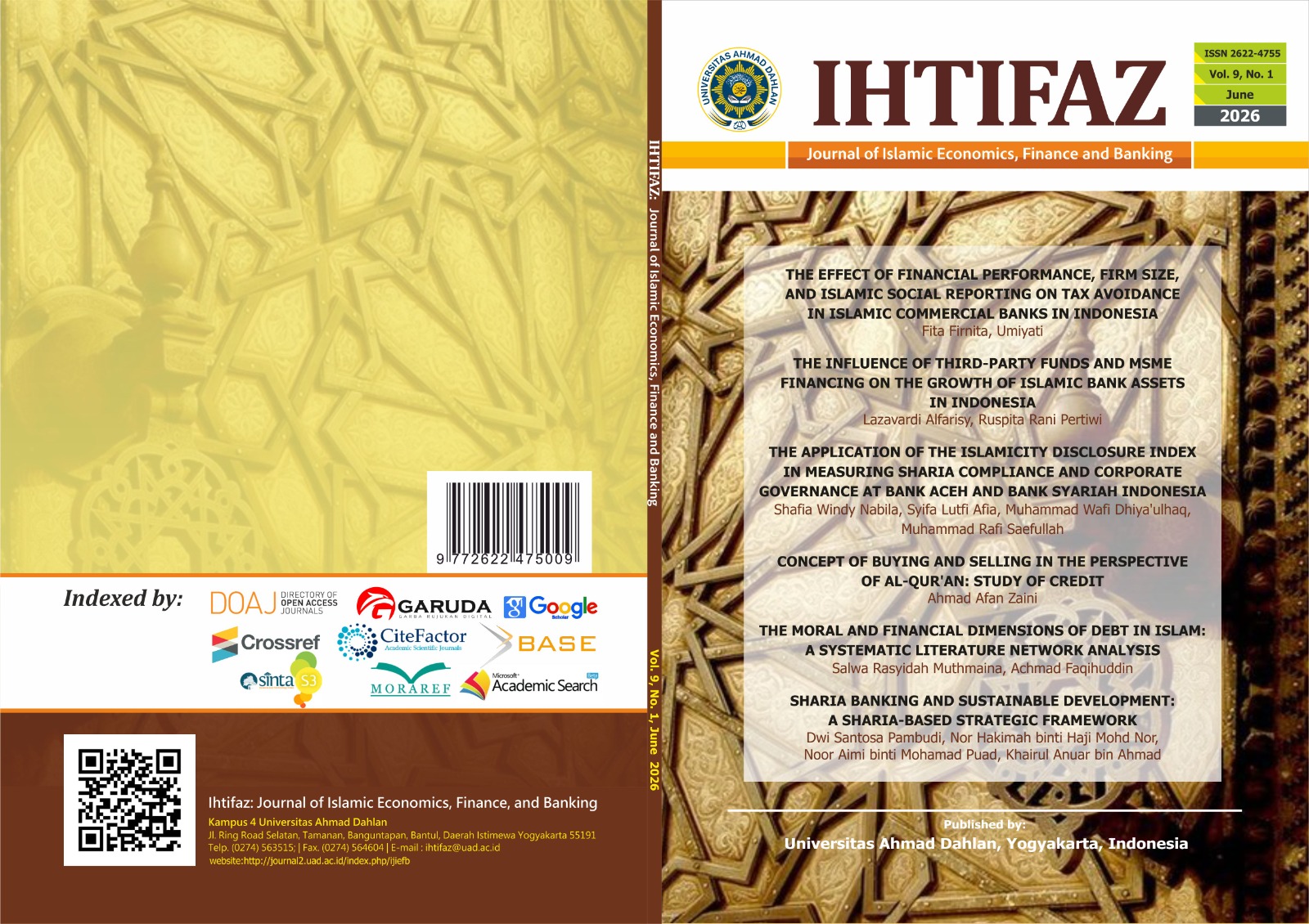
The Application of the Islamicity Disclosure Index in Measuring Sharia Compliance and Corporate Governance at Bank Aceh and Bank Syariah Indonesia
DOI:
https://doi.org/10.12928/ijiefb.v9i1.15516Keywords:
Islamicity Disclosure Index, Shariah Compliance, Corporate Governance, Social and Environmental Disclosure, Bank Syariah Indonesia, Bank Aceh SyariahAbstract
Introduction to The Problem: Transparency and accountability are fundamental principles in Islamic banking, ensuring compliance with Sharia principles and good corporate governance. The Islamicity Disclosure Index (IDI) has been widely recognized as a comprehensive framework for evaluating the extent of Sharia-related disclosures in Islamic financial institutions. However, empirical comparisons of IDI implementation among Islamic banks in Indonesia remain limited, particularly between national and regional Islamic banks.
Purpose/Objective Study: This study aims to analyze and compare the level of Islamicity Disclosure Index (IDI) disclosure between Bank Syariah Indonesia (BSI) and Bank Aceh Syariah during the 2023–2024 period as an indicator of Sharia compliance and corporate governance quality.
Design/Methodology/Approach: This study employed a quantitative descriptive approach using content analysis of the annual reports of Bank Syariah Indonesia and Bank Aceh Syariah for the 2023–2024 period. The assessment was based on three main dimensions of the Islamicity Disclosure Index, namely Shariah Compliance, Corporate Governance, and Social/Environmental Disclosure, with respective weights of 50%, 30%, and 20%. The disclosure scores were calculated and compared to evaluate each bank's level of compliance and transparency.
Findings: Both banks achieved a very high level of Islamicity disclosure. Bank Aceh Syariah recorded an IDI score of 87.30% in both 2023 and 2024, while Bank Syariah Indonesia achieved higher scores of 96.67% in 2023 and 96.88% in 2024. Bank Syariah Indonesia demonstrated superior performance, particularly in the Shariah Compliance dimension. In contrast, Bank Aceh Syariah exhibited relatively lower disclosure regarding non-halal income, non-halal investments, and several aspects of corporate governance structure. Nevertheless, both banks performed consistently well in the Social/Environmental Disclosure dimension. These findings indicate that although both institutions have maintained a high level of Sharia disclosure, Bank Syariah Indonesia demonstrates greater consistency and comprehensiveness in its implementation of the Islamicity Disclosure Index
References
Abdallah, M. Ben, & Bahloul, S. (2021). Disclosure, Shariah Governance and Financial Performance in Islamic Banks. Asian Journal of Economics and Banking Emerald Publishing Limited, 2615–9821. https://doi.org/10.1108/AJEB-03-2021-0038
Afridawati. (2015). Stratifikasi Al-Maqashid Al-Khamsah (Agama, Jiwa, Akal, Keturunan dan Harta) dan Penerapannya dalam Maslahah. Al-Qisthu: Jurnal Kajian Ilmu-Ilmu Hukum, 13(1), 15–30. https://doi.org/10.32694/qst.v13i1.1211
Anshori, M., & Tachiyat. (2025). Analysis of the Performance of Islamic Commercial Banks in Indonesia in 2021-2023 ( Maqashid Sharia Index and Islamicity Performance Index Approach ). International Journal of Islamic Finance, 03(01), 16–41. https://doi.org/10.14421/ijif.v3i1.2320
Arianugrahini, I., & Firmansyah, E. A. (2020). Determinan Pengungkapan Islamic Social Reporting (ISR) pada Bank Umum Syariah (BUS) di Indonesia. Islamic Banking and Finance Journal, 4(2), 88–101. https://doi.org/10.21070/perisai.v4i2.841
Baltzer, B., & Ulrich, P. (2025). Integrating Value-Added Statements In Corporate Governance : Theory And Empirical Findings From Germany. Corporate Governance and Sustainability Review, 9(3), 105–115. https://doi.org/10.22495/cgsrv9i3p8
Baydoun, N., & Willett, R. (2002). Islamic Corporate Reports. Abacus : A Journal of Accounting, Finance and Business Studies, 36(1), 71–90. https://doi.org/10.1111/1467-6281.00054
Botosan, C. A. (1997). Disclosure Level and The Cost of Equity Capital. The Accounting Review, 72(3), 323–349. https://doi.org/10.2308/accr.1997.72.3.323
Farook, S. Z., Lanis, R., & Hassan, M. K. (2011). Determinants of Corporate Social Responsibility Disclosure: The Case of Islamic Banks. Journal of Islamic Accounting and Business Research, 2(2), 114–141. https://doi.org/10.1108/17590811111170539
Fatmawati, D., Ariffin, N. M., Abidin, N. H. Z., & Osman, A. Z. (2022). Shariah Governance In Islamic Banks: Practices, Practitioners And Praxis. Global Finance Journal, 51. https://doi.org/10.1016/j.gfj.2020.100555
Griffin, J. J., & Mahon, J. F. (1997). The Corporate Social Performance and Corporate Financial Performance Debate: Twenty-Five Years of Incomparable Research. Business & Society, 36(1), 5–31. https://doi.org/10.1177/000765039703600102
Hameed, S., Wirman, A., Alrazi, B., Nor, M. N. bin M., & Pramon, S. (2004). Alternative Disclosure and Performance Measures for Islamic Banks. In Proceedings of the Second Conference on Administrative Sciences: Meeting the Challenges of the Globalization Age.
Haniffa, R., & Hudaib, M. (2007). Exploring the Ethical Identity of Islamic Banks via Communication in Annual Reports. Journal of Business Ethics, 76(1), 97–116. https://doi.org/10.1007/s10551-006-9272-5
Haniffa, R. M., & Cooke, T. E. (2005). The Impact of Culture and Governance on Corporate Social Reporting. Journal of Accounting and Public Policy, 24(5), 391–430. https://doi.org/10.1016/j.jaccpubpol.2005.06.001
Hansen, E. G. (2010). Stakeholder Governance : An Analysis of BITC Corporate Responsibility Index Data on Stakeholder Engagement and Governance. Doughty Centre for Corporate Responsibility Occasional Paper, 1–36. https://ssrn.com/abstract=1690600
Hasan, Z., Abduh, M., & Rosman, R. (2025). Transparency , Accountability , and Customer Trust in Islamic Banking : A Panel Data Analysis from Selected OIC Countries. Jurnal Magister Ekonomi Syariah, 4(2), 915–935. https://doi.org/10.14421/jmes.2025.042-04
Klapper, L. F., & Love, I. (2002). Corporate Governance, Investor Protection, and Performance in Emerging Markets. World Bank Policy Research Working Paper, 2818. https://doi.org/10.1596/1813-9450-2818
Muda, A. A. K. (2003). Kamus Lengkap Ekonomi. Gitamedia Press.
Mukhibad, H., Jayanto, P. Y., Suryarini, T., & Bagas, B. (2022). Corporate Governance and Islamic Bank Accountability Based On Disclosure — A Study On Islamic Banks In Indonesia. Cogent Business & Management, 9(1), 1–19. https://doi.org/10.1080/23311975.2022.2080151
Nugraheni, P., & Anuar, H. A. (2014). Implications of Shariah on The Voluntary Disclosure of Indonesian Listed Companies. Journal of Financial Reporting and Accounting, 12(1), 76–98. https://doi.org/10.1108/JFRA-11-2011-0018
Nurfalah, I., & Rofi’atu, L. (2023). Islamicity Disclosure Index for Shariah Banking : A Case. Maqasid Al-Shariah Review, 2(1). https://doi.org/doi.org/10.58968/msr.v2i1.310
OJK. (2024). Laporan Perkembangan Keuangan Syariah Indonesia 2024. Ojk.Go.Id. https://www.ojk.go.id/id/kanal/syariah/data-dan-statistik/laporan-perkembangan-keuangan-syariah-indonesia/default.aspx
Platonova, E., Asutay, M., Dixon, R., & Mohammad, S. (2018). The Impact of Corporate Social Responsibility Disclosure on Financial Performance : Evidence from the GCC Islamic Banking Sector. Journal of Business Ethics, 151(2), 451–471. https://doi.org/10.1007/s10551-016-3229-0
Putra, I. M. D., & Yaqin, A. A. (2023). Konsep Ushul–Furu’ dalam Tafsir Nusantara: Interpretasi QS. Al-Anfal [8]:65 Perspektif Tafsir Maqasidi. Al-Bayan: Jurnal Ilmu Al-Qur’an Dan Hadist, 6(2), 226–242. https://doi.org/10.35132/albayan.v6i2.351
Stanwick, P. A., & Stanwick, S. D. (1998). The Relationship Between Corporate Social Performance, and Organizational Size, Financial Performance, and Environmental Performance: An Empirical Examination. Journal of Business Ethics, 17(2), 195–204. https://doi.org/10.1023/A:1005784421547
Thomson, L. M. (2009). Corporate Governance: A Practical Guide For Accountants. CIMA Publishing.
Ziyad, M., Sukarno, H., & Paramu, H. (2026). Islamic Sustainable Banking as a Mediating Mechanism Between Financing Structures and Bank Performance : Evidence from Indonesia and Malaysia. Journal of Risk and Financial Management, 19(6), 416. https://doi.org/10.3390/jrfm19060416
Downloads
Published
Issue
Section
License
Copyright (c) 2026 Universitas Ahmad Dahlan

This work is licensed under a Creative Commons Attribution-NonCommercial-ShareAlike 4.0 International License.
License and Copyright Agreement
In submitting the manuscript to the journal, the authors certify that:
- They are authorized by their co-authors to enter into these arrangements.
- The work described has not been formally published before, except in the form of an abstract or as part of a published lecture, review, thesis, or overlay journal. Please also carefully read Ihtifaz, Journal of Islamic Economics, Finance, and Banking Posting Your Article Policy at http://journal2.uad.ac.id/index.php/ijiefb/about/submissions#onlineSubmissions
- That it is not under consideration for publication elsewhere,
- That its publication has been approved by all the author(s) and by the responsible authorities “tacitly or explicitly“ of the institutes where the work has been carried out.
- They secure the right to reproduce any material that has already been published or copyrighted elsewhere.
- They agree to the following license and copyright agreement.
Copyright
Authors who publish with Ihtifaz, Journal of Islamic Economics, Finance, and Banking agree to the following terms:
- Authors retain copyright and grant the journal right of first publication with the work simultaneously licensed under a Creative Commons Attribution License (CC BY-SA 4.0) that allows others to share the work with an acknowledgment of the work's authorship and initial publication in this journal.
- Authors are able to enter into separate, additional contractual arrangements for the non-exclusive distribution of the journal's published version of the work (e.g., post it to an institutional repository or publish it in a book), with an acknowledgment of its initial publication in this journal.
- Authors are permitted and encouraged to post their work online (e.g., in institutional repositories or on their website) prior to and during the submission process, as it can lead to productive exchanges, as well as earlier and greater citation of published work.
_1.png)