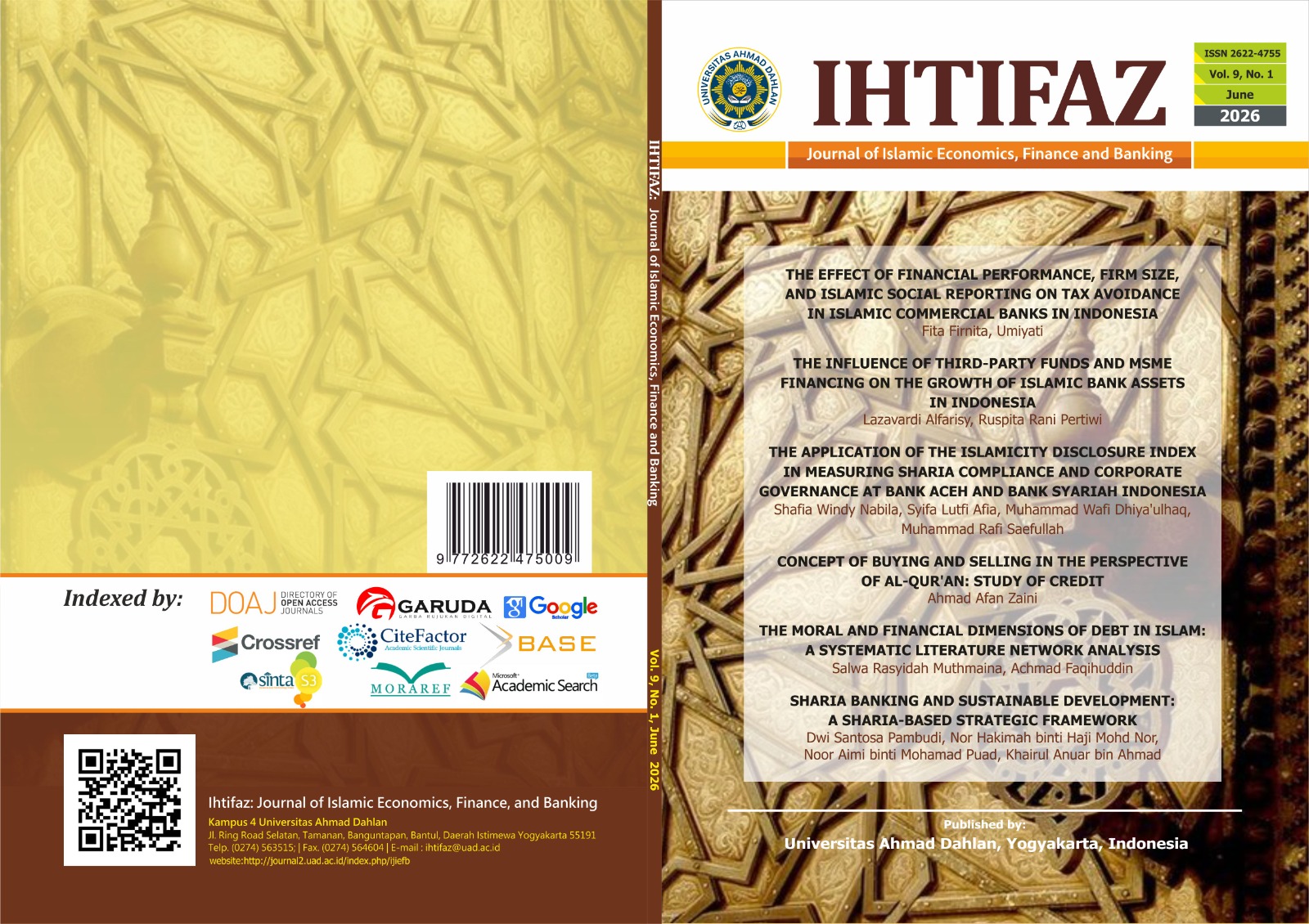
The Influence of Third-Party Funds and MSME Financing on the Growth of Islamic Bank Assets in Indonesia
DOI:
https://doi.org/10.12928/ijiefb.v9i1.15427Keywords:
Islamic banking asset growth, Third-Party Funds, MSME financing, Profit-Sharing Ratio, Panel dataAbstract
Problem Introduction: The growth of Islamic banking assets in Indonesia has shown a positive trend over the last five years; however, its market share remains relatively low compared to conventional banking. This condition raises questions regarding the effectiveness of internal banking factors in driving asset growth. Previous studies mainly focus on profitability and financial stability, while empirical evidence explaining Islamic bank asset growth using comprehensive internal variables remains limited.
Study Objectives/Goals: This study aims to analyze the influence of Third-Party Funds (DPK), MSME Financing, Non-Performing Financing (NPF), Capital Adequacy Ratio (CAR), and Profit Sharing Ratio (PSR) on the growth of Islamic commercial bank assets in Indonesia, with the Financing to Deposit Ratio (FDR) as a control variable.
Design/Methodology/Approach: This research employs a quantitative explanatory approach using panel data regression. The data consist of secondary data from Islamic Commercial Banks in Indonesia for the period 2020–2024, obtained from Islamic Banking Statistics published by the Financial Services Authority (OJK) and banks’ annual reports. Model selection was conducted through Chow and Hausman tests, resulting in the Fixed Effect Model as the most appropriate estimation method.
Findings: The results indicate that Third-Party Funds (DPK) and Profit Sharing Ratio (PSR) have a positive and significant effect on Islamic bank asset growth. In contrast, MSME financing has a negative and significant effect, suggesting that financing risk and efficiency challenges may suppress asset expansion. Meanwhile, NPF and CAR do not show a significant influence on asset growth. The Financing to Deposit Ratio (FDR) as a control variable negatively and significantly affects asset growth, indicating potential liquidity pressure due to excessive intermediation.
References
Adinda, V. (2023). Pengaruh Sertifikat Bank Indonesia Syariah Dan Dana Ketiga Terhadap Pembiayaan Perbankan Syariah Di Indonesia. 8(2).
Allen, F., & Santomero, A. M. (n.d.). The theory of Ænancial intermediation.
Amri, A. D. (n.d.). Analisis Pembiayaan Bank Syariah Terhadap UMKM dan Pertumbuhan di Indonesia Rentang Waktu 10 Tahun Terakhir.
Beck, T., Demirgüç-Kunt, A., & Merrouche, O. (2013). Islamic vs. conventional banking: model, efficiency and stability. Journal of Banking & Finance, 37(2), 433–447. https://doi.org/10.1016/j.jbankfin.2012.09.016
Berly, B., Mahi, B. R., & Mardanugraha, E. (2022). Peran Intermediasi Bank Pembangunan Daerah (BPD) Terhadap Pertumbuhan Ekonomi Daerah. Jurnal Akuntansi dan Bisnis, 22(2). https://doi.org/10.20961/jab.v22i2.830
Fakhrunnas, F., & Anto, M. B. H. (2024). Investigating the Determinants of Islamic Banks’ Financing Quality: A Regional Approach. International Journal of Islamic Economics and Finance (IJIEF), 7(1), 130–142. https://doi.org/10.18196/ijief.v7i1.18532
Grant, R. M. (2021). Contemporary Strategy Analysis. John Wiley & Sons.
Huwaida, N., Ufairoh, U., & Wahyudi, R. (2023). Pengaruh Pengeluaran Pemerintah dan Pembiayaan Bank Syariah terhadap Tingkat Pertumbuhan Ekonomi Indonesia Pada Tahun 2016–2020. AKSES: Jurnal Ekonomi Dan Bisnis, 18(1). https://doi.org/10.31942/akses.v18i1.8591
Ibnu Fadhilah, M., Rini, & Fitriya. (2025). Non Performing Finance,Dana Pihak Ketiga, dan Capital Adequacy Ratio sebagai Penyaluran Pembiayaan Bank Umum Syariah di Indonesia. Jurnal Ilmu Manajemen Retail Universitas Muhammadiyah Sukabumi, 6(3), 530–545. https://doi.org/10.37150/jimat.v6i3.3981
Jeslin, W. O., Mungkur, A. R., Afrina, M., & Harahap, M. I. (2025). Efektivitas Manajemen Pembiayaan Syariah Dalam Mengembangkan Sektor Riil Internasional, Journal of Sharia Business Management, 4(4), 34–51.
Khairunnisa, D. A., & Nofrianto, N. (2023). Pembiayaan Dan Keuangan Syariah: Menopang UMKM Dalam Fase Pemulihan Perekonomian (Economic Recovery) Indonesia. Jurnal Ilmiah Ekonomi Islam, 9(3), 3985–3992. https://doi.org/10.29040/jiei.v9i3.9878
Kornitasari, Y., Safitri, I. W., Wanakusuma, I., & Safitri, D. I. (2022). Peramalan Pertumbuhan Bank Syariah Indonesia Pasca Kebijakan Merger. Jurnal Ilmiah Ekonomi Islam, 8(2), 1470–1478. https://doi.org/10.29040/jiei.v8i2.5321
Koyyimah, A. K., Tanjung, H., & Ayuniyyah, Q. (2023). Pengaruh Likuiditas,Ukuran Perusahaan, Dan Risiko Pembiayaan Terhadap Kinerja Keuangan Bank Umum Syariah Tahun 2018-2022. Jurnal Syarikah : Jurnal Ekonomi Islam, 9(1), 47–60. https://doi.org/10.30997/jsei.v9i1.8742
Kuswahariani, W., Siregar, H., & Syarifuddin, F. (2020). Analisis Non Performing Financing (NPF) Secara Umum Dan Segmen Mikro Pada Tiga Bank Syariah Nasional Di Indonesia: Non Performing Financing Analysis With Regard To A General And Micro Segment On Three National Sharia Banks in Indonesia. Jurnal Aplikasi Bisnis Dan Manajemen, 6(1), 26–26. https://doi.org/10.17358/jabm.6.1.26
Levine, R. (n.d.). Finance, Growth And Economic Prosperity.
Mishkin, F. S. (2019). The economics of money, banking, and financial markets (Twelfth Edition). Pearson.
Mulyana, I., & Rahmat. (2025). Inovasi Skema Musyarakah Mutanaqisah Untuk Pembiayaan Aset Produktif Umkm Di Sektor Kreatif. Integrative Perspectives of Social and Science Journal, 2(03 Juni), 3139–3149.
Pengaruh Return On Assets Dan BOPO Terhadap Market Share Pada Bank Syariah | Jurnal Ilmiah Manajemen Kesatuan. (2021). https://jurnal.ibik.ac.id/index.php/jimkes/article/view/504
Pertiwi, N. J., Fasa, M. I., & Susanto, I. (2024). ANALISIS STRATEGI BANK SYARIAH DALAM MENINGKATKAN PEMBIAYAAN BAGI PELAKU USAHA KECIL MENENGAH (UKM). 5.
Purnomo, H. (2024). Manajemen Stratejik Bank: Strategi Bisnis Bank Syariah Pasca Spin-Off dan Konversi.
Ramadhani, N. H. N., & Purwanto, A. (n.d.). Analisis Tingkat Kesehatan Bank Syariah Dengan Metode RGEC Dan Financial Distress.
Setiawan, I. (2021). Pembiayaan UMKM, Kinerja Bank Syariah Dan Pertumbuhan Ekonomi Di Indonesia. Islamic Banking : Jurnal Pemikiran Dan Pengembangan Perbankan Syariah, 6(2), 263–278. https://doi.org/10.36908/isbank.v6i2.165
Shabiha, E. D., Tursinah, M., & Sari, S. N. (2025). Pengaruh Total Aset, Dana Pihak Ketiga, dan Financing to Deposit Ratio Terhadap Profitabilitas Pada Bank Umum Syariah. RIGGS: Journal of Artificial Intelligence and Digital Business, 4(2), 696–704. https://doi.org/10.31004/riggs.v4i2.556
Suharnanto, P. D. M., & Nusantara, A. (2024). The Analysis of The Impact of Financing, Third-Party Funds, and Non-Performing Financing on The Profitability of Bank Syariah Indonesia.
Syamsulbahri, D. (2018). UMKM Dalam Perspektif Pembiayaan Inklusif Di Indonesia. Jurnal Ekonomi Dan Pembangunan, 26(1), 59–76. https://doi.org/10.14203/JEP.26.1.2018.59-76
Zaini, F., Vitaloka, D. D., & Bin Shuib, M. S. (2023). The Influence of Third-Party Funds and Other Operating Income on Profits of Islamic banking: Financing as an Intervening Variable. IKONOMIKA, 8(1), 13. https://doi.org/10.24042/febi.v8i1.15428
Downloads
Published
Issue
Section
License
Copyright (c) 2026 Universitas Ahmad Dahlan

This work is licensed under a Creative Commons Attribution-NonCommercial-ShareAlike 4.0 International License.
License and Copyright Agreement
In submitting the manuscript to the journal, the authors certify that:
- They are authorized by their co-authors to enter into these arrangements.
- The work described has not been formally published before, except in the form of an abstract or as part of a published lecture, review, thesis, or overlay journal. Please also carefully read Ihtifaz, Journal of Islamic Economics, Finance, and Banking Posting Your Article Policy at http://journal2.uad.ac.id/index.php/ijiefb/about/submissions#onlineSubmissions
- That it is not under consideration for publication elsewhere,
- That its publication has been approved by all the author(s) and by the responsible authorities “tacitly or explicitly“ of the institutes where the work has been carried out.
- They secure the right to reproduce any material that has already been published or copyrighted elsewhere.
- They agree to the following license and copyright agreement.
Copyright
Authors who publish with Ihtifaz, Journal of Islamic Economics, Finance, and Banking agree to the following terms:
- Authors retain copyright and grant the journal right of first publication with the work simultaneously licensed under a Creative Commons Attribution License (CC BY-SA 4.0) that allows others to share the work with an acknowledgment of the work's authorship and initial publication in this journal.
- Authors are able to enter into separate, additional contractual arrangements for the non-exclusive distribution of the journal's published version of the work (e.g., post it to an institutional repository or publish it in a book), with an acknowledgment of its initial publication in this journal.
- Authors are permitted and encouraged to post their work online (e.g., in institutional repositories or on their website) prior to and during the submission process, as it can lead to productive exchanges, as well as earlier and greater citation of published work.
_1.png)