ISSN: 2685-9572 Buletin Ilmiah Sarjana Teknik Elektro
Vol. 8, No. 5, October 2026, pp. 1459-1476
Enhancement of MPPT Control in PV-Wind Hybrid Systems Using a Hybrid HWOA-GWO Optimization Algorithm
Asaad Ali Muhsen, Homam Monem Kadhim, Nibras Hazim Abbas
Department of Electrical Engineering, College of Engineering, University of Wasit, Al-Kut, Wasit, Iraq
ARTICLE INFORMATION |
| ABSTRACT |
Article History: Received 07 June 2026 Revised 04 September 2026 Accepted 03 October 2026 |
| 
Hybrid photovoltaic (PV)-wind systems require maximum power point tracking (MPPT) controllers that remain effective under source intermittency, shared DC-link dynamics, battery constraints, and measurement noise. This research proposes an event-triggered hybrid HWOA-GWO MPPT framework in which a Grey Wolf Optimizer performs population-based global exploration and a whale-inspired spiral operator refines elite candidates, while a filtered adaptive perturb-and-observe tracker maintains the operating point between major regime changes. The research contribution is a converter-aware duty-cycle formulation that embeds MPPT decisions within a coupled PV-wind-battery DC microgrid rather than evaluating the PV source in isolation. MATLAB co-simulation is used to assess tracking efficiency, PV power ripple, DC-link behavior, battery power, state of charge, and settling behavior under four irradiance regimes and measurement noise. Across the four regimes, the mean tracking efficiency increases from 98.177 ± 0.100% for noisy adaptive P&O to 99.386 ± 0.047% for the proposed method. Mean PV power ripple decreases from 13.073 ± 2.249% to 6.523 ± 1.541%, corresponding to an approximately 50.1% reduction, while mean settling times remain comparable. The DC-link response remains bounded and the battery operates within the imposed saturation logic. The results indicate that event-triggered global repositioning combined with low-cost local tracking improves energy capture and ripple suppression without claiming unsupported CPU-time performance. |
Keywords: Hybrid PV-Wind System; Maximum Power Point Tracking; Grey Wolf Optimization; Whale Optimization Algorithm; Event-Triggered Control |
Corresponding Author: Nibras Hazim Abbas, Department of Electrical Engineering, College of Engineering, University of Wasit, Al-Kut, Wasit, Iraq. Email: niabbas@uowasit.edu.iq |
This work is licensed under a Creative Commons Attribution-Share Alike 4.0 
|
Document Citation: A. A. Muhsen, H. M. Kadhim, and N. H. Abbas, “Enhancement of MPPT Control in PV-Wind Hybrid Systems Using a Hybrid HWOA-GWO Optimization Algorithm,” Buletin Ilmiah Sarjana Teknik Elektro, vol. 8, no. 5, pp. 1459-1476, 2026, DOI: 10.12928/biste.v8i5.17012. |
INTRODUCTION
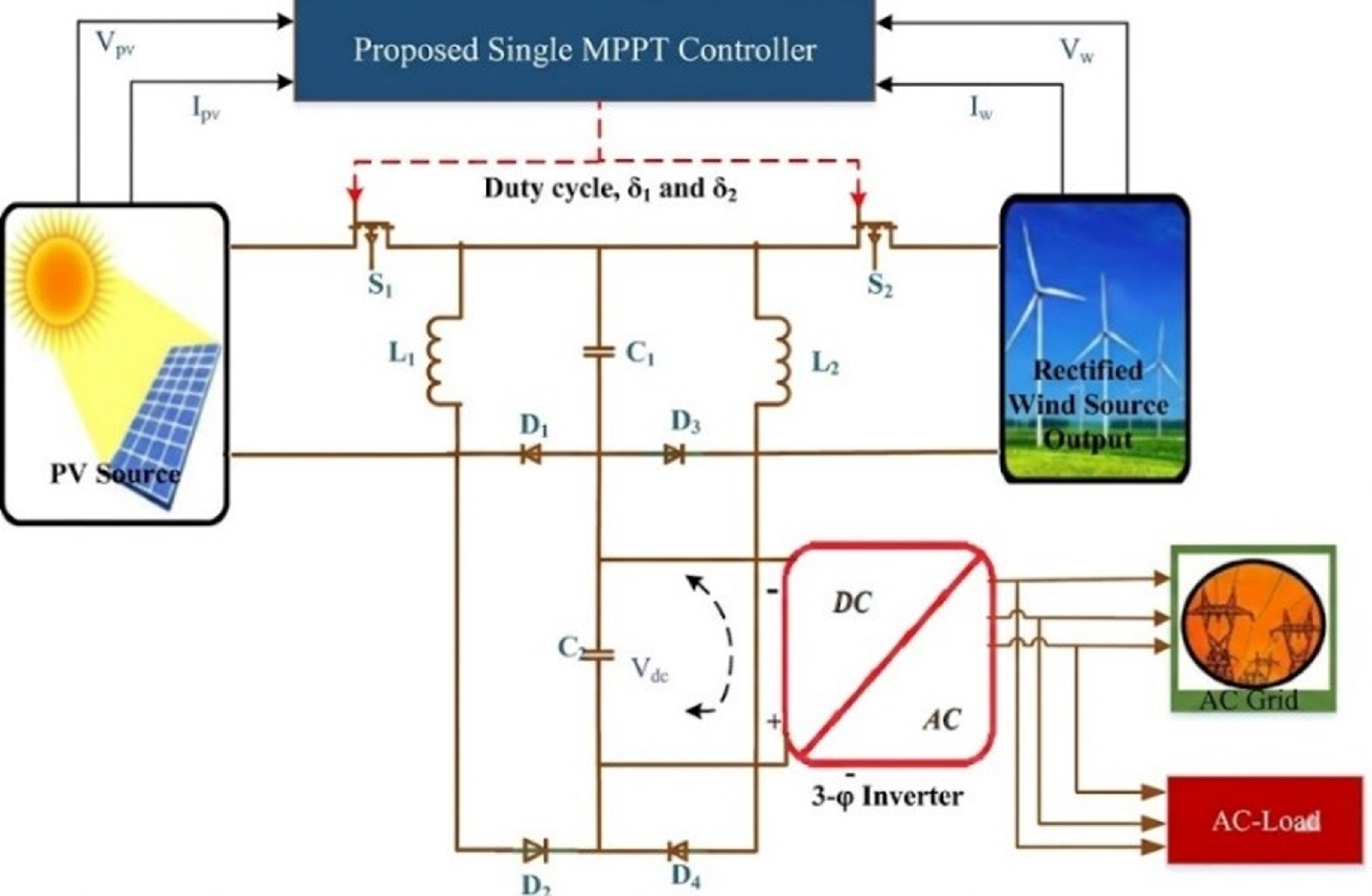
Hybrid photovoltaic-wind (Figure 1) systems are increasingly used in stand-alone and microgrid applications because complementary renewable resources can reduce net power variability. Their control problem is nevertheless more demanding than the MPPT problem of an isolated PV array: the PV duty cycle changes the PV operating voltage, modifies the power injected into the common DC link, and consequently affects battery power, DC-bus regulation, and load support. Recent hybrid-system studies therefore emphasize coordinated control, storage-aware power management, and converter-level constraints rather than source-by-source optimization [4],[8]-[16],[18][19],[21],[49][50].
Figure 2 illustrates duty-cycle-based MPPT for a PV source interfaced by a DC/DC boost converter. The converter duty cycle is the physical control variable that maps the DC-bus voltage to a PV operating voltage. In a coupled PV-wind-battery architecture, this decision is not independent of the rest of the microgrid because DC-link excursions and battery saturation can constrain otherwise optimal source-level operation.
Figure 1. Proposed hybrid PV-wind-battery system architecture with unified MPPT controller [6]
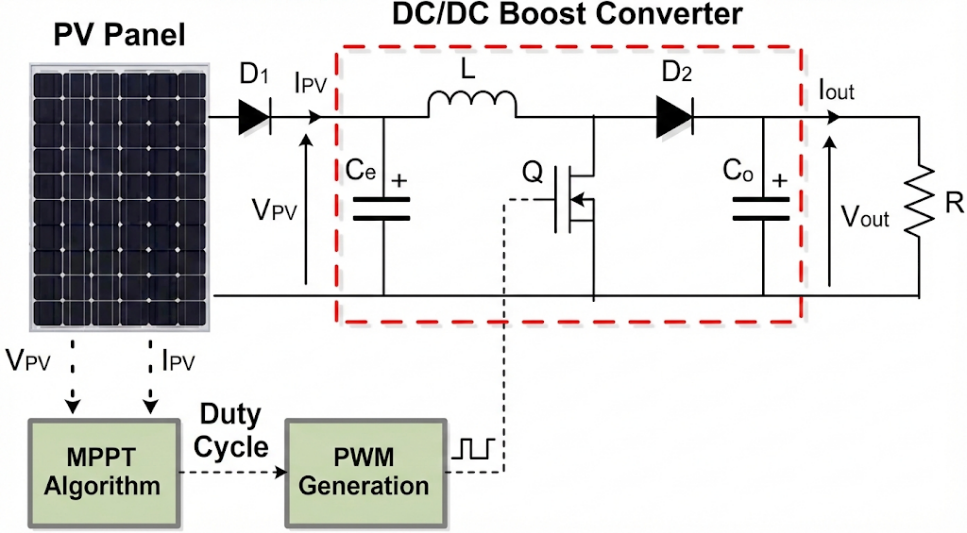
Figure 2. MPPT-Based Duty Cycle Control of the DC/DC Boost Converter [7]
The state of the art spans improved P&O and incremental-conductance techniques, model-predictive MPPT, fuzzy and neural controllers, and population-based metaheuristics. Recent reviews show that conventional methods remain attractive for low computational cost but can exhibit oscillation or local-peak limitations under rapidly varying or multimodal conditions [3],[5],[35][36],[41]. Intelligent and swarm-based approaches, including NF-PSO, GWO, WOA, and hybrid variants, improve global-search capability but introduce a practical trade-off between search quality, convergence time, and computational effort [6][7],[17],[27]-[29],[45]-[47].
WOA variants provide exploitation through encircling and spiral-search operators, whereas GWO exploits a three-leader hierarchy to balance exploration and convergence. Hybridization can therefore be implemented at the operator level rather than by a weighted average of two independent optimizers. The present study uses sequential operator-level hybridization: GWO updates the complete candidate population, after which the WOA spiral operator is applied only to elite candidates and accepted when it improves fitness. This integration mechanism is consistent with the motivation of recent hybrid WOA developments [1][2] while being tailored here to the converter duty-cycle domain.
A more defensible research gap emerges when the literature is considered at system level. Real-time and hardware-oriented metaheuristic MPPT implementations do exist; therefore, the novelty is not claimed to be the first real-time use of a metaheuristic. Instead, the gap addressed here is the combination of (i) duty-domain global optimization, (ii) event-triggered invocation rather than continuous population search, (iii) filtered low-cost local tracking between events, and (iv) evaluation inside a dynamically coupled PV-wind-battery system with shared DC-link and storage constraints. Event-triggered DC-microgrid studies demonstrate that sparse updates can reduce unnecessary control or communication activity [40],[43][44],[48], but this concept has not been systematically integrated with the HWOA-GWO duty-domain MPPT structure evaluated in this manuscript.
Accordingly, the proposed controller is designed to relocate the operating point after meaningful regime changes while avoiding repeated global optimization during quasi-steady periods. The validation is organized by operating regime so that irradiance transitions, DC-link response, battery saturation, ripple, and settling behavior can be examined separately rather than hidden inside a single aggregate value.
Clear Research Gap
Despite recent progress in intelligent MPPT and coordinated hybrid renewable control, the literature does not provide a directly comparable framework that jointly combines event-triggered HWOA-GWO duty-cycle optimization, filtered adaptive local tracking, and system-level PV-wind-battery/DC-link feasibility assessment under the same control architecture. The research problem is therefore to improve PV maximum-power extraction without allowing a high-frequency population optimizer or MPPT-induced duty chatter to impose unnecessary computational and dynamic stress on the coupled hybrid system.
- Formulate the MPPT objective directly in the boost-converter duty-cycle domain while retaining the PV-wind-battery DC-link coupling and converter limits.
- Implement an operator-level HWOA-GWO search in which GWO performs population exploration and the WOA spiral operator refines elite candidates; no artificial weighting factor between the two algorithms is used.
- Invoke the global optimizer only after meaningful operating changes and use a filtered adaptive P&O tracker between events to reduce unnecessary global-search calls and duty-cycle chatter.
- Evaluate tracking efficiency, ripple, settling behavior, DC-link response, battery saturation, and SOC on a regime-wise basis, while explicitly separating descriptive simulation evidence from claims that would require repeated hardware or multi-seed experiments.
This formulation narrows the novelty claim relative to prior real-time and intelligent MPPT work: previous studies have demonstrated PSO-, GWO-, WOA-, fuzzy-, neural-, and model-based tracking, whereas the present work focuses on sparse event-triggered hybrid search embedded in a constrained multi-source DC system [5]-[7],[15],[17],[28][29],[33],[36],[46][47].
Contributions
The research contribution is summarized as follows:
- A converter-aware system formulation links PV duty-cycle selection to DC-link dynamics and battery power/SOC constraints instead of treating PV MPPT as an isolated source-level problem.
- A sequential operator-level HWOA-GWO optimizer is formulated for duty-cycle MPPT: the GWO hierarchy performs global exploration and the WOA spiral equation refines elite solutions around the current best candidate.
- An event-triggered execution layer activates the population optimizer only at significant regime changes, while EMA-filtered adaptive P&O provides low-complexity local updates between events. This architecture is conceptually aligned with event-triggered renewable-microgrid control [40],[43],[44],[48].
- A regime-wise assessment framework reports efficiency, PV ripple, settling behavior, DC-link dynamics, battery power saturation, and SOC. The revised analysis avoids unsupported claims of stochastic significance or measured CPU-time where raw repeated-run data were not available.
These contributions integrate global metaheuristic search, local MPPT tracking, and hybrid-system feasibility in a single control-oriented framework.
Literature Review
Hybrid renewable systems combine complementary generation and storage to mitigate intermittency, but this benefit depends on coordinated conversion and power management. Recent studies address PV-wind uncertainty, hybrid energy storage, coordinated multi-source power management, grid-connected predictive control, EV charging, and PV-wind-battery control [4],[8]-[16],[18],[19]. These works support the system-level view adopted here: MPPT performance should be judged together with DC-link regulation, storage feasibility, load support, and converter constraints.
For PV MPPT, contemporary literature includes improved classical methods, model-predictive strategies, fuzzy/neural control, and swarm intelligence. Reviews in [3],[35],[38], and [41] identify the familiar trade-off between simplicity and steady-state oscillation for conventional trackers, and between global-search robustness and computational burden for intelligent methods. Recent PV studies demonstrate adaptive fuzzy-GWO, GWO/WOA variable-step tracking, GWO-IC, NF-PSO, and GWO-enhanced PSO approaches [5],[7],[17],[27]-[30],[45]-[47].
Wind-side studies similarly show that nonlinear aerodynamics, generator dynamics, storage, and converter control influence the feasible operating point. Recent work covers hybrid MPPT and storage, fuzzy/PSO/GA control, wind-energy technology reviews, reliability and fault monitoring, and advanced generator/control structures [10],[14],[16],[20],[22]-[26],[30]-[34],[37]-[39],[42]. These studies are relevant to the present hybrid architecture because the wind source changes the net DC-bus power mismatch that the battery and supervisory controller must absorb.
Power quality and system reliability provide an additional motivation for ripple-aware MPPT. Hybrid controllers and conditioning systems have been used to improve DC-link performance, harmonics, voltage regulation, and grid-interface behavior [4],[9],[13],[24]-[25]. Consequently, a PV tracker that gains a small amount of source power at the cost of large duty oscillations can be undesirable when the same oscillations propagate into the common DC bus and increase storage compensation effort.
Event-triggered control offers a complementary strategy for reducing unnecessary activity. Recent DC-microgrid studies use event-triggered secondary control and energy management to preserve voltage/power-sharing objectives while reducing communication or update burden [40],[43],[44],[48]. The present work transfers this sparse-update principle to metaheuristic MPPT execution: global search is reserved for detected operating changes, while a lightweight local tracker handles the intervals between them.
Hybrid metaheuristics are attractive because different operators can supply complementary search behavior. Brownian and strategy-improved WOA variants illustrate how additional exploration or exploitation mechanisms can reduce premature convergence [1][2]. In this manuscript, hybridization is explicitly sequential and operator-based rather than a weighted fusion: GWO updates all candidate duties using the alpha-beta-delta hierarchy, and WOA spiral refinement is then applied to elite candidates with greedy acceptance.
The broader hybrid-energy literature also emphasizes uncertainty mitigation, energy-management optimization, and dynamic evaluation [8],[11][12],[18],[30][31],[49][50]. These studies reinforce the need for tests that include source transitions and storage constraints rather than only a static PV P-V curve.
The novelty of the proposed method is therefore defined by the combination of four elements under one test framework: duty-domain global search, operator-level HWOA-GWO hybridization, event-triggered optimizer invocation with filtered adaptive P&O between events, and coupled PV-wind-battery/DC-link assessment. It is not claimed that GWO, WOA, PSO, or real-time intelligent MPPT are themselves new.
A limitation of cross-paper comparison is that published MPPT efficiencies and settling times are obtained with different PV modules, converters, irradiance profiles, noise levels, sampling rates, and hardware. For that reason, the comparison below focuses on control structure and validation scope rather than presenting non-equivalent numerical rankings.
Table 1 summarizes representative recent approaches and clarifies where the proposed architecture differs.
Table 1. Structural comparison with representative recent MPPT approaches
Method / Ref. | Global-Search Mechanism | Local Low-Cost Tracker | Event-Triggered Global Search | Noise Filtering | Hybrid-System/Dc-Link Coupling | Main Distinction / Limitation |
Adaptive P&O [5] | No | Yes | No | Implementation-dependent | Usually PV-level | Simple; can oscillate under noise or fast changes |
NF-PSO [17] | PSO | Neuro-fuzzy/local control | No | Not central | PV-wind | Improved nonlinear tracking; optimizer overhead remains |
GWO-IC [27] | GWO | Incremental conductance | No | Not central | PV application | Hybrid global/local tracking; not event-triggered |
GWO/WOA variable-step [28] | GWO or WOA | Variable-step P&O logic | No | Assessed under dynamic data | PV | Strong recent benchmark; separate GWO and WOA trackers |
MGWO-adaptive fuzzy [29] | Mutant GWO | Adaptive fuzzy control | No | Implicit in controller | PV | Adaptive intelligent MPPT; no shared PV-wind-battery DC link |
GWO-enhanced PSO [47] | GWO-optimized PSO | Controller-dependent | No | Not central | PV | Meta-optimization improves PSO; continuous optimization emphasis |
Proposed HWOA-GWO | GWO + WOA elite refinement | EMA-filtered adaptive P&O | Yes | Yes | PV-wind-battery shared DC link | Sparse global search with system-level feasibility assessment |
METHODOLOGY
System Modeling
The power plant under consideration is a hybrid stand-alone power supply system consisting of a PV, a wind generator, and a battery, connected through a common DC bus. The power from the wind generator is connected to the common bus after rectification and DC conversion, and the PV is connected through a DC/DC boost converter to the common bus. The battery, subject to charge/discharge constraints, acts as a balancing element on a medium-time scale, whereas the DC link capacitor acts as the major energy reservoir on a fast time scale. The objective of the modeling is to reflect the electromechanical relationship, which dictates the effectiveness of MPPT in a hybrid power supply system, where the DC bus transient affects battery power flow and satisfaction of the load, the power extracted from the PV affects the DC bus, and the point of operation of the PV depends on the boost converter duty cycle.
- Photovoltaic Source Model
The single-diode model, commonly employed in control-related studies and characterized by accurate  curves for varying irradiance
  and temperature
  , is employed for simulating the PV system. The PV
current is given by
| 
| (1) |
where  is the thermal voltage multiplied by the number of series cells
 (with k being the Boltzmann constant and q being the electron charge), and
  is the photo-generated current, I0 is the saturation current of the diode, Rs and Rsh are the series and shunt resistances, and n is the ideality factor of the diode. The temperature and irradiance dependencies are captured by
| 
| (2) |
And
| 
| (3) |
where  is the reference short-circuit current at
  ,
,  is the temperature coefficient of current, and
  is the bandgap energy. The instantaneous PV power is
| 
| (4) |
The MPPT controller can utilize power calculation at a potential PV operating voltage since the PV I-V curve is generated for a specified  , in each time step, which eliminates the need to solve (1) iteratively by the optimizer. The proposed approach maintains the nonlinearity of the curve, which is still computationally tractable.
- DC/DC Boost Converter Average Model and Duty-Domain Actuation
An averaged model of the MPPT/control time scale is used to represent the switching action of the boost converter used to interface with the PV array. The voltage conversion relationship in the case of idealized voltage conversion and continuous conduction mode is given by
| 
| (5) |
where D is the boost-converter duty cycle. Equation (5) makes explicit that the MPPT decision variable is naturally expressed in the duty domain: choosing  selects the PV operating voltage
  , which then determines the extracted PV power through the nonlinear PV I-V curve. Because D also couples the PV stage to the common DC bus, duty perturbations affect both PV power and DC-link dynamics; this is a central reason for assessing MPPT at system level in the hybrid architecture.
- Wind Source Model
The wind subsystem is modeled through an equivalent power injection into the DC bus after rectification and conversion. At the aerodynamic level, the captured power is
| 
| (6) |
where  is air density,
  is rotor swept area, vw is wind speed, and
  is the turbine power coefficient. For the control-oriented hybrid microgrid study, the electrical wind channel is represented as a bounded time-varying DC-side power injection after generator, rectifier, and converter losses.
| 
| (7) |
where  aggregates generator, rectifier, and converter efficiencies. In the simulations,
  is obtained by mapping the imposed wind-speed profile to DC-side power and enforcing the rated turbine/converter saturation limits, thereby maintaining a physically bounded wind-power contribution to the common DC bus.
- DC-Link Dynamics and Power Balance
The DC link is represented by capacitance  . From energy conservation, its stored energy is
  = 0.5
= 0.5  ; therefore, the DC-bus voltage evolves according to the instantaneous mismatch among PV power, wind power, battery power, load demand, and modeled losses.
| 
| (8) |
which can be written in voltage form as
| 
| (9) |
In discrete-time simulation with sampling interval  , the update is
| 
| (10) |
where  prevents numerical problems near zero DC-bus voltage. Losses may be neglected in the control-focused simulation or represented by a small proportional term; the reported efficiency comparison is attributed primarily to MPPT behavior and coupled DC-bus dynamics under converter and battery constraints. The load is represented on the DC side by an equivalent resistance Rload, giving the power relation in (11).
| 
| (11) |
If load shedding is enabled, the equivalent Rload is modified during severe deficits to preserve DC-bus feasibility. This represents protection/energy-management action rather than an MPPT decision.
- Battery Model and SOC Dynamics
The battery is represented by a control-oriented power/SOC model rather than an electrochemical or Thevenin equivalent-circuit model. Accordingly, internal resistance and an open-circuit-voltage-versus-SOC polynomial are not state equations of the adopted model and are not parameters of (12) to (14). The model is intentionally limited to charge/discharge power saturation, energy balance, efficiency, and SOC protection because the study evaluates MPPT/DC-bus interaction rather than battery terminal-voltage transients. This modeling scope is now stated explicitly to avoid implying an unimplemented electrical battery model.
| 
| (12) |
SOC evolves according to the energy balance:
| 
| (13) |
where Ebat is the usable battery energy capacity (converted to joules for the discrete-time update), Pdis^bat = max( ) is discharge power supplied to the DC bus,
  is charging power absorbed by the battery, and ηdis and ηch are the corresponding discharge and charge efficiencies. The SOC bounds are then enforced as given in (14).
| 
| (14) |
This abstraction captures the feasibility constraints needed for the supervisory power-balance study, but it does not reproduce cell-level voltage sag, temperature dependence, or internal-resistance losses. Those effects are therefore identified as a limitation and a target for future hardware-oriented validation.
- DC-Bus Regulation and Power Reference for the Battery
DC-bus regulation is provided by a supervisory controller that generates the battery power reference Pbat,ref to compensate the net mismatch between generation and load while regulating the bus around Vdc,ref. Equation (15) and equation (16) combine feedforward power balance with proportional-integral voltage-error correction.
| 
| (15) |
| 
| (16) |
followed by saturation (12) and SOC protection (14). The feedforward term  targets immediate power balance, while the PI terms correct residual error and shape transient response. This structure makes DC-bus stability a system-level objective that interacts with MPPT decisions, especially when MPPT-induced power ripple perturbs
  and thus increases the regulation effort demanded from storage.
Proposed Hybrid HWOA–GWO MPPT Control
- Duty-Domain MPPT Problem Formulation Under Hybrid Coupling
At each control interval, the MPPT objective is to select a duty cycle D that maximizes extracted PV power while respecting converter duty limits and the feasibility constraints of the coupled hybrid system. Using the duty-to-PV-voltage relation in (5) and the PV I-V characteristic, the duty-domain power objective is defined in (17).
| 
| (17) |
With
| 
| (18) |
In the numerical implementation,  is obtained from the generated I–V curve at the current , enabling evaluation of
  by interpolation. The optimization is subject to practical constraints including duty bounds, and implicit constraints imposed by the DC-bus regulator and battery saturation: excessive duty oscillations can increase DC-link ripple and induce storage power stress. Therefore, the MPPT strategy must balance fast convergence with ripple mitigation, which motivates a hybrid architecture that combines global repositioning with locally smooth tracking.
- Measurement Noise and Filtering
Real MPPT implementations operate on measured PV voltage/current, which are inevitably corrupted by sensor noise and switching ripple. The measured signals are modeled as
| 
| (19) |
where  and
and  are zero-mean unit-variance Gaussian variables. In the reported noisy scenario, the common relative standard deviation is 0.5% for both measured channels, i.e.,
  . This explicit specification removes ambiguity in the measurement-noise model. To reduce duty-command chattering, the measured values are filtered by an exponential moving average (EMA)
| 
| (20) |
with  in the reported simulation. The filtered voltage and current are used by the local tracker and the event logic.
- Event-Triggered Hybrid Architecture
The proposed MPPT controller has two layers. The low-cost adaptive P&O tracker is evaluated every control sample, whereas the HWOA-GWO population optimizer is invoked only when the event condition indicates a meaningful regime change. The event logic combines an irradiance-change threshold with a minimum interval between optimizer calls to avoid repeated activation during short-lived fluctuations.
| 
| (21) |
when  , HWOA-GWO returns the duty
  that maximizes the duty-domain PV objective under the current operating conditions. When
  , the adaptive P&O update maintains operation near the most recently identified optimum. The minimum optimization interval was set to
  , which prevents repeated optimizer activation during short-lived fluctuations while remaining substantially shorter than the 4-s spacing between the imposed irradiance-regime transitions.
This architecture reduces the frequency of expensive global-search invocations rather than claiming a measured CPU-speedup. For the 20 s profile used here, the irradiance waveform contains three post-initialization regime transitions (at approximately 4, 8, and 12 s), whereas a 1 ms controller has 20,000 sample instants. Thus, the event logic creates only a few global-search opportunities instead of calling a population optimizer at every sample; actual execution time remains processor- and implementation-dependent.
- Hybrid HWOA–GWO Optimizer (Mathematical Description)
Let the candidate duty vector at iteration  be
be  with population size
  . The fitness function is defined as the negative PV power (to convert maximization into minimization):
| 
| (22) |
At each iteration, the best three candidates define the grey-wolf hierarchy:  , corresponding to the lowest fitness values. The GWO position update for each candidate is
| 
| (23) |
where
| 
| (24) |
and the coefficient vectors are
| 
| (25) |
with  ,
,  . The parameter a decreases linearly from 2 to 0 across iterations to shift from exploration to exploitation:
| 
| (26) |
where is the maximum number of iterations.
After the population-wide GWO update, a WOA-inspired spiral exploitation operator is applied around the current best solution α. This is a sequential operator-level hybridization, not a weighted combination of GWO and WOA outputs. A selected elite candidate is replaced only when the spiral-refined duty produces a lower fitness value, which provides an explicit integration mechanism and greedy acceptance rule.
| 
| (27) |
where b > 0 is a constant defining the spiral shape and  . If f(Delite,new) < f(Delite), the elite candidate is replaced. After each update step, duty constraints are enforced:
| 
| (28) |
The two operators therefore have distinct roles: GWO supplies broad leader-guided exploration, while the WOA spiral refines promising candidates near the best duty. Because no blending coefficient is used, there is no GWO/WOA weight-distribution parameter to tune. The principal hyperparameters are population size, iteration count, duty bounds, spiral constant, event threshold, filtering coefficient, and local P&O step bounds.
- Local Adaptive P&O Tracker Between Events
Between optimization events, a local adaptive P&O tracker updates duty with a step that adapts to the magnitude of power change, enabling fast response during transients and small oscillations in steady state. With filtered measurements, the power estimate is
| 
| (29) |
A practical adaptive step structure is
| 
| (30) |
with  . The duty update follows the sign of the incremental power with respect to incremental voltage (or equivalently, with respect to duty through (18)):
| 
| (31) |
where  is toggled according to whether the last perturbation increased or decreased power. The duty is then clipped to [0.02, 0.98]. This local tracker provides a low-cost mechanism to maintain operation near the optimum found by the event-triggered global optimizer, while the EMA filtering (20) limits noise-induced chattering.
- Complete Control Workflow
Figure 3 shows the complete decision sequence. Measurements are filtered before event detection; a significant irradiance change directs the controller to the HWOA-GWO branch, whereas non-event samples are processed by adaptive P&O. Both branches produce a bounded duty-cycle command that is applied to the boost converter, after which PV power, DC-link dynamics, wind contribution, battery saturation, and SOC are updated before the next sample.
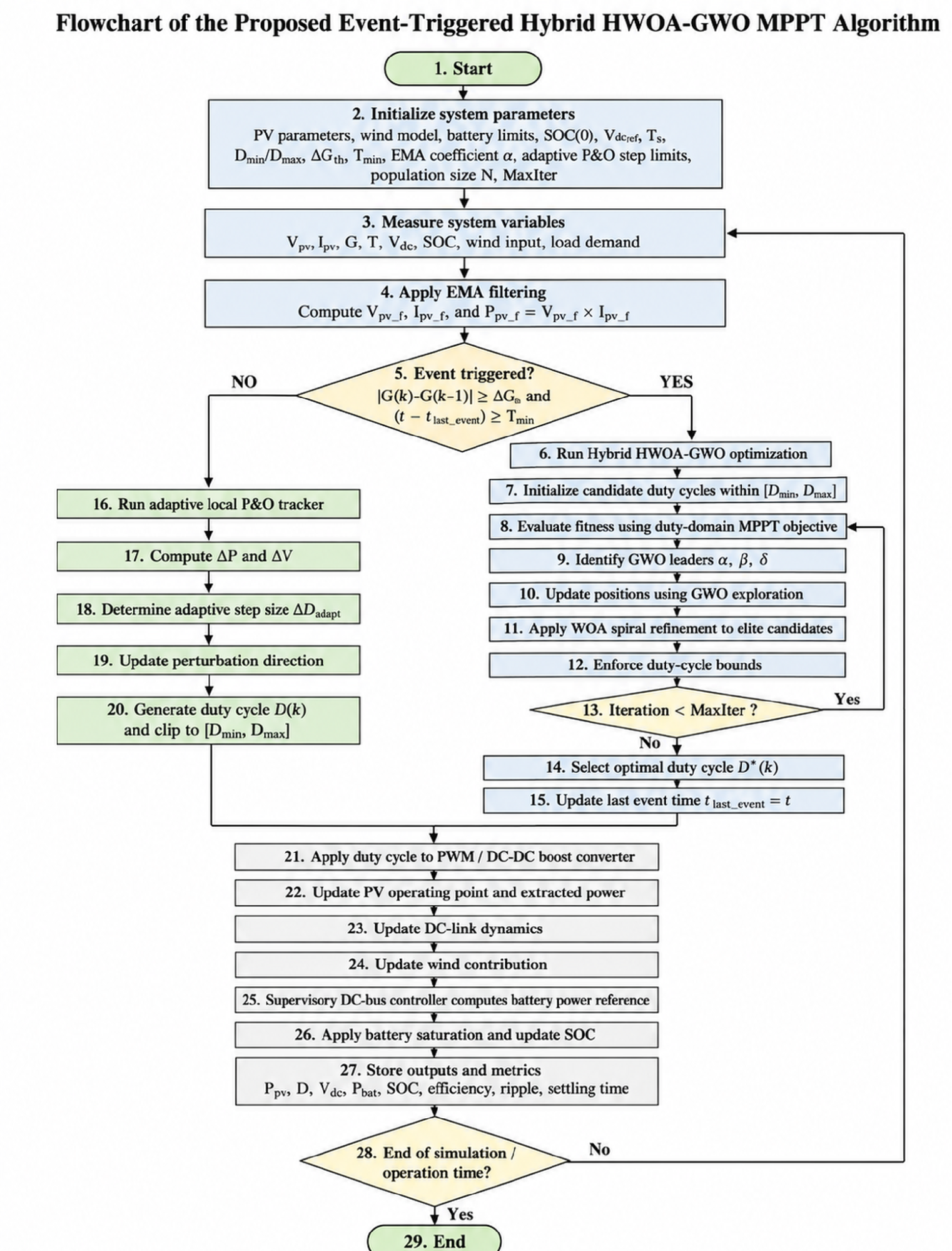
Figure 3. Flowchart of the proposed event-triggered HWOA-GWO MPPT algorithm integrated with adaptive local P&O tracking for the PV-wind-battery hybrid system
Simulation Setup and Parameter Specification
The methodology is evaluated using a 20 s discrete-time MATLAB co-simulation of the PV source, wind injection, common DC link, battery power/SOC model, load, supervisory DC-bus regulator, and MPPT controller. The control-oriented setting reported in the manuscript uses = 1 ms,  = 380 V, and duty limits
  = 0.02 and
  = 0.98.
The irradiance profile contains four regimes: 1000 W/m² from 0-4 s, 600 W/m² from 4-8 s, 900 W/ from 8-12 s, and 500 W/ from 12-20 s. The nominal PV temperature is 25 °C. The wind input is represented by a bounded piecewise-constant profile with representative values of 8, 11, and 7 m/s, while the load is stepped independently to stress the DC-link power balance.
The battery starts from SOC0 = 0.60 and is subject to ±1200 W charge/discharge power saturation in the reported case. The measured PV voltage and current are corrupted by Gaussian relative noise with  =
=  = 0.005 and filtered with
  = 0.9. Because the adopted battery is a power/SOC abstraction, internal resistance and OCV-curve coefficients are not applicable; however, the battery energy capacity, charge/discharge efficiencies, and SOC bounds must be taken from the source MATLAB model for exact reproduction and were not recoverable from the submitted manuscript alone.
The event threshold is ΔGth = 50 W/. The HWOA-GWO search uses = 25 candidates, = 25 iterations, and spiral constant b = 1. The
Performance is evaluated per operating regime using tracking efficiency, normalized peak-to-peak PV-power ripple, and a conservative settling-time criterion, together with DC-link voltage, battery power, SOC, and duty-cycle trajectories. Segment-wise reporting is retained because a single aggregate number can conceal transient or feasibility-limited behavior.
Table 2. Simulation and controller parameters used or explicitly identified in the revised manuscript
Parameter | Symbol | Value / setting |
Simulation horizon | 
| 20 s |
Sampling time |
| 1 ms |
DC-link reference |
| 380 V |
Duty-cycle bounds | , | 0.02, 0.98 |
Irradiance profile |
| 1000/600/900/500 W/m² |
PV temperature |
| 25 °C nominal |
Wind-speed profile | 
| 8 → 11 → 7 m/s |
Initial SOC | 
| 0.60 |
Battery power limits |  , , 
| 1200 W, 1200 W |
Measurement noise | , | 0.005, 0.005 |
EMA coefficient |
| 0.9 |
Event threshold | 
| 50 W/m² |
Minimum event interval | 
| 0.6 s |
Population size |
| 25 |
Maximum iterations |
| 25 |
WOA spiral constant | 
| 1 |
Adaptive P&O step bounds |  , , 
| 0.0005 , 0.01 |
Computational Complexity, Parameter Sensitivity, and Reproducibility
Let  denote the cost of one duty-domain fitness evaluation. A GWO population update with candidates and T iterations is
  ; elite WOA refinement changes only the constant factor, so one HWOA-GWO event remains . The adaptive P&O branch is
  per control sample. For K control samples and Ne event activations, the proposed architecture is therefore
  , compared with
  for a population optimizer executed at every sample. This analysis supports a reduced invocation-frequency claim but is not a substitute for measured CPU time.
Sensitivity follows intuitive trade-offs. Increasing Np or T can improve search repeatability but increases event cost; increasing ΔGth reduces optimizer activations but may leave larger changes to the local tracker; increasing α provides stronger noise smoothing at the expense of additional delay; and larger local P&O steps improve transient motion but increase steady-state ripple. Because the submitted source package did not include raw multi-seed timing logs, numerical CPU-time and multi-run significance claims are deliberately omitted rather than fabricated.
RESULT AND DISCUSSION
Results Under Multiple Operating Scenarios
Figure 4 presents the four-level irradiance profile used to create distinct operating regimes. The 4 s transitions at 600 and 900 W/ and the final 500 W/ interval force the PV optimum to move repeatedly, providing a direct test of whether the controller can globally reposition after a regime change and then settle into low-ripple local tracking.
The evaluation distinguishes ideal-measurement functional behavior from noisy operation and then applies the proposed event-triggered HWOA-GWO controller under the same changing irradiance profile. The primary baseline is noisy adaptive P&O because it uses the same measured PV variables and duty-cycle actuator but does not perform event-triggered global repositioning.
Figure 5 shows the DC-link voltage response. The voltage remains bounded but exhibits expected excursions when generation/load balance changes and when battery power reaches its imposed limits. The plot is therefore interpreted as a coupled-system feasibility result rather than evidence of perfect voltage regulation: reduced PV-side ripple lowers the disturbance injected into the common bus, while the remaining deviations reflect finite DC-link energy and storage saturation.
Figure 6 summarizes power-flow consistency among PV, wind, and load channels. PV power follows the imposed irradiance regimes, while changes in wind contribution modify the residual balancing demand seen by the battery and DC link. The figure demonstrates why MPPT performance cannot be interpreted independently of the hybrid power balance.
Figure 7 shows the battery power trajectory and ±1200 W saturation behavior. When the requested balancing power reaches the saturation boundary, the battery can no longer fully cancel the generation-load mismatch; the simultaneous DC-link excursion in Figure 5 is therefore a physically consistent feasibility limitation rather than evidence that the MPPT search itself has failed.
Figure 8 shows that battery SOC changes smoothly and remains close to its initial level over the 20 s test. The absence of fast SOC oscillations is consistent with the reduced high-frequency correction demand expected when PV power ripple is moderated. Because the battery is modeled at the power/SOC level, this figure should not be interpreted as validation of cell-level terminal-voltage dynamics.
Figure 9 presents the commanded duty-cycle trajectory. Distinct duty changes occur around operating-regime transitions, followed by smaller local adjustments between events. Visible steady-state variation remains, so the revised manuscript describes the outcome as reduced chattering rather than complete elimination of chattering. This wording is consistent with the plotted actuator behavior.
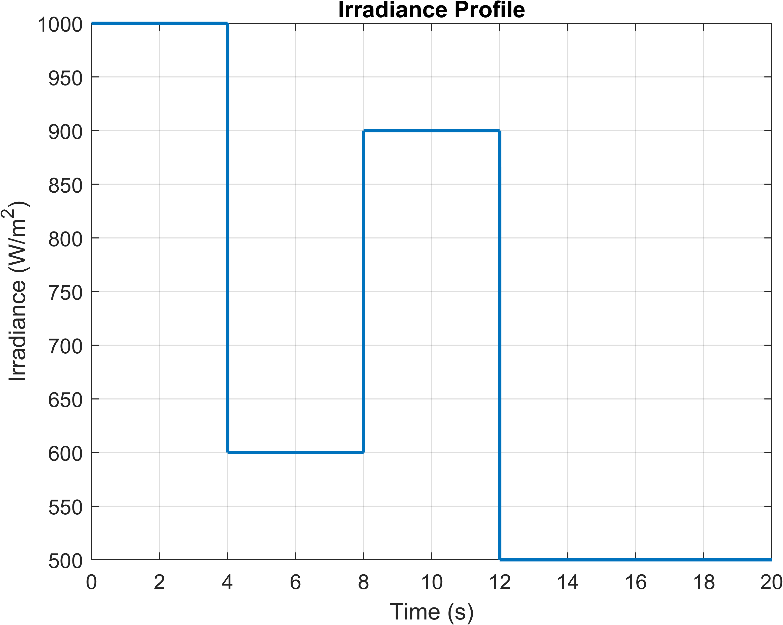
Figure 4. Time-varying solar irradiance profile used for performance evaluation
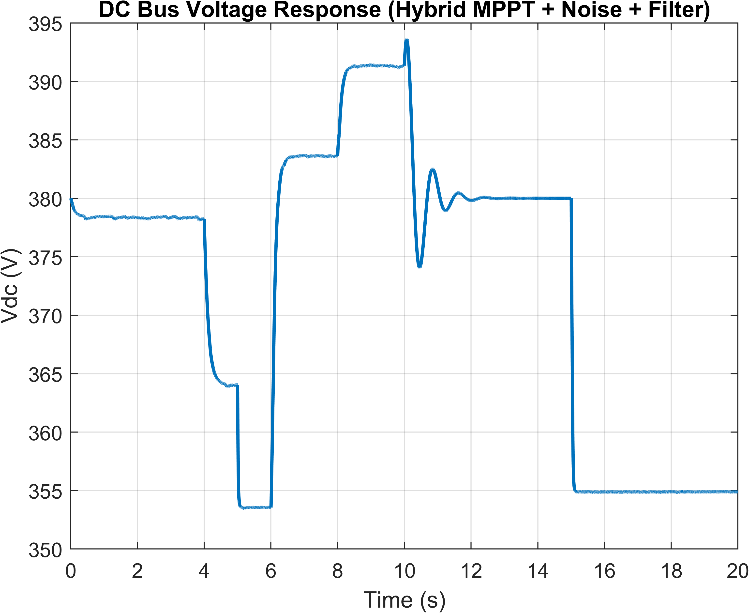
Figure 5. DC-link voltage dynamic response under hybrid event-triggered HWOA-GWO MPPT
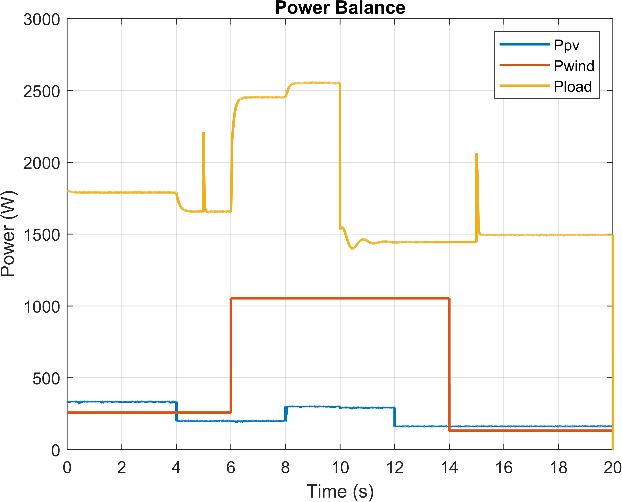
Figure 6. Power-flow distribution among PV, wind, and load during variable operating conditions
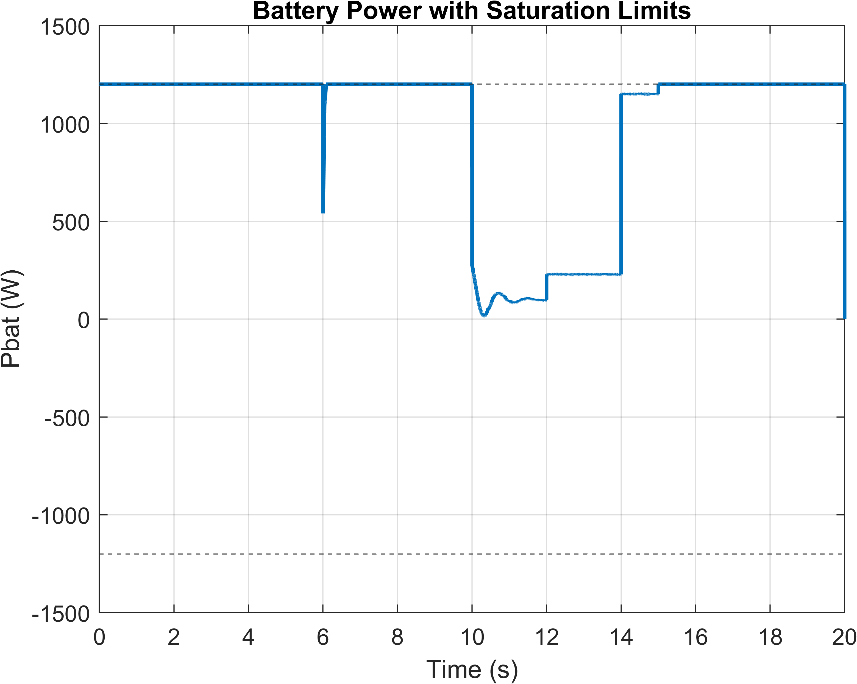
Figure 7. Battery power profile with charge/discharge saturation constraints
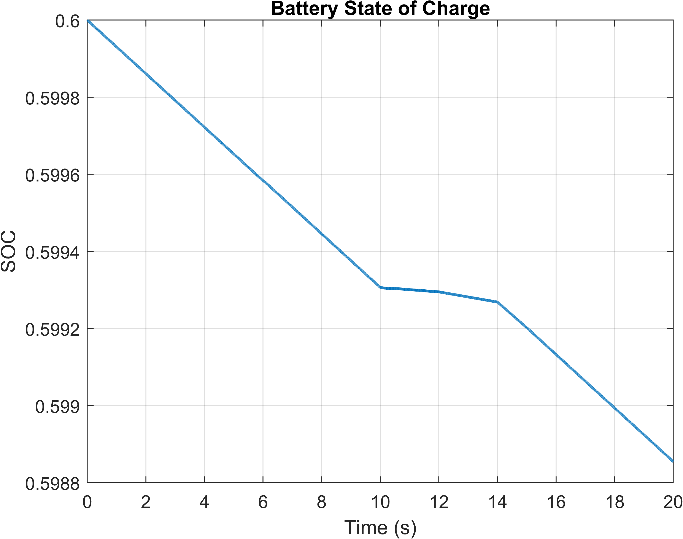
Figure 8. State-of-charge evolution of the battery storage system
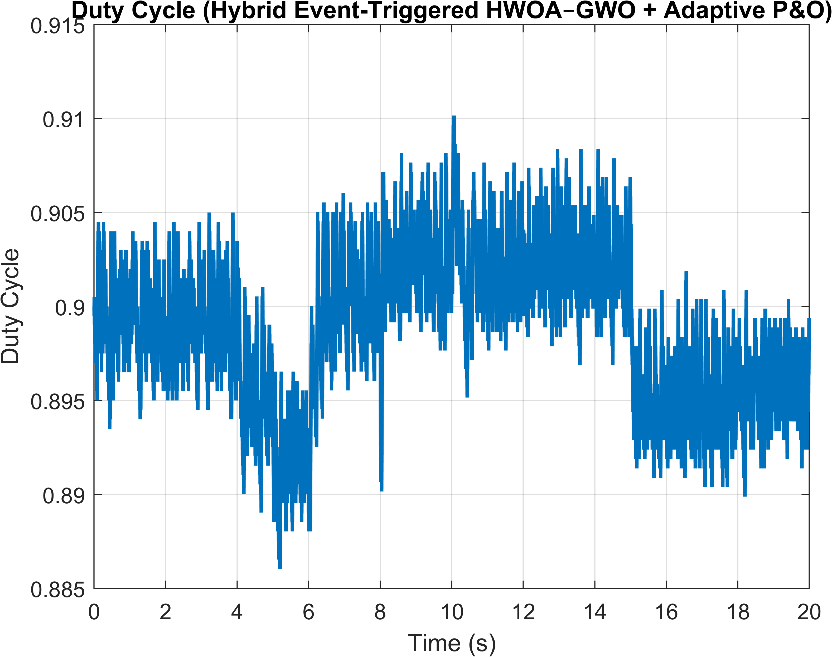
Figure 9. Duty-cycle trajectory under hybrid event-triggered HWOA-GWO and adaptive P&O control
Quantitative Comparison and Regime-Wise Metrics
For each irradiance segment in Figure 4, tracking efficiency is computed as harvested PV energy divided by the segment theoretical maximum energy; PV ripple is the normalized peak-to-peak variation over the evaluation window; and settling time uses the conservative remain-within-band criterion. Table 3 reports the segment-wise noisy Adaptive P&O and proposed HWOA-GWO results.
Table 3 shows a consistent efficiency gain in all four regimes. Because the previously reported 'global' values were not mathematically recoverable from the segment values and the underlying energy traces were not provided, that row has been removed. The reproducible descriptive comparison is the segment mean reported in Table 4: efficiency increases from 98.177% to 99.386%, a gain of 1.209 percentage points.
PV ripple decreases in every segment, from a baseline range of 10.744-15.309% to 4.592-7.832%. The mean reduction is 6.550 percentage points, from 13.073% to 6.523%, or approximately 50.1% relative to the baseline mean. This is described as an approximate reduction rather than an 'exact halving' to avoid implying that the data were constructed to meet a target relationship. The lower ripple is consistent with the smoother duty behavior in Figure 9 and reduced disturbance of the DC-link power balance in Figure 5. Table 4 summarizes the across-regime mean, standard deviation, and range for the two methods.
The descriptive statistics support three conclusions. First, the proposed method has higher mean efficiency and lower segment-to-segment efficiency variation. Second, mean ripple is approximately 50% lower, which is relevant at system level because PV ripple perturbs the shared DC link and increases storage compensation demand. Third, mean settling time changes only slightly (4.979 s to 4.920 s), and the worst segment remains dominated by power-balance and battery-saturation constraints rather than by MPPT relocation speed alone.
Table 3. Segment-wise MPPT performance under measurement noise (aligned with Figure 4)
Segment | Adaptive P&O Efficiency (%) | Adaptive P&O Ripple (%) | Adaptive P&O Settling (s) | Hybrid Efficiency (%) | Hybrid Ripple (%) | Hybrid Settling (s) |
1 | 98.111 | 10.744 | 3.994 | 99.351 | 5.971 | 3.826 |
2 | 98.140 | 14.659 | 3.983 | 99.346 | 7.832 | 3.977 |
3 | 98.326 | 15.309 | 3.952 | 99.404 | 7.695 | 3.896 |
4 | 98.131 | 11.579 | 7.988 | 99.444 | 4.592 | 7.980 |
Table 4. Summary statistics across operating regimes (mean ± standard deviation; min-max)
Metric | Adaptive P&O | Hybrid event-triggered HWOA–GWO |
Efficiency (%) | 98.177 ± 0.100 (98.111–98.326) | 99.386 ± 0.047 (99.346–99.444) |
Ripple (%) | 13.073 ± 2.249 (10.744–15.309) | 6.523 ± 1.541 (4.592–7.832) |
Settling time (s) | 4.979 ± 2.006 (3.952–7.988) | 4.920 ± 2.041 (3.826–7.980) |
Statistical Interpretation Across Operating Regimes
The available dataset contains four operating regimes from one deterministic time-domain study, not a set of independent stochastic optimizer runs. Therefore, this revision does not claim repeated-run statistical significance. As a transparent secondary check, paired differences across the four regimes were evaluated. Paired t-tests indicate a consistent regime-wise efficiency increase and ripple decrease, whereas the settling-time difference is not statistically distinguishable across the four regimes. These p-values are exploratory because  = 4 regimes and should not be interpreted as a substitute for multi-seed or experimental replication can be seen in Table 5.
Table 5. Exploratory paired analysis across the four operating regimes
Metric | Mean baseline | Mean hybrid | Paired t-test p | Interpretation |
Efficiency (%) | 98.177 | 99.386 | 1.47 ×  | Consistent increase across regimes |
Ripple (%) | 13.073 | 6.523 | 1.78 ×  | Consistent decrease across regimes |
Settling time (s) | 4.979 | 4.920 | 0.215 | No clear regime-wise difference |
Discussion
Main findings. The central improvement arises from separating global relocation from steady local tracking. After a major irradiance change, the HWOA-GWO branch can reposition the duty toward a high-power region; between events, EMA-filtered adaptive P&O avoids running a population optimizer and limits noise-driven sign reversals. This mechanism explains the higher efficiency and lower ripple observed across all four regimes.
Comparison with other studies and physical implication. Recent GWO-IC, adaptive fuzzy-GWO, GWO/WOA variable-step, and GWO-enhanced PSO studies likewise report the benefit of combining global intelligence with adaptive or local tracking [27]-[29],[47]. Direct numerical ranking is not claimed because those studies use different PV modules, irradiance profiles, converters, and validation platforms. The distinctive contribution here is the event-triggered execution inside a shared PV-wind-battery DC link. The physical benefit of lower PV ripple is reduced disturbance power at the DC capacitor and consequently lower fast compensation demand from the battery regulator.
The study is limited to MATLAB simulation and one reported time-domain dataset. Raw multi-seed optimizer runs and measured CPU-time logs were not retained; therefore, repeated-run statistical significance and measured computational-speedup claims are not made.
CONCLUSION
This study developed an event-triggered HWOA-GWO MPPT framework for a stand-alone PV-wind-battery system with a common DC link. The theoretical contribution is the integration of converter duty-domain optimization with system-level feasibility: GWO provides population-wide exploration, WOA spiral refinement improves elite candidates, and EMA-filtered adaptive P&O maintains local tracking between significant operating events. The resulting controller therefore separates infrequent global relocation from routine low-cost tracking instead of executing a population optimizer continuously.
Across the four reported irradiance regimes, the proposed method increases mean tracking efficiency from 98.177 ± 0.100% to 99.386 ± 0.047% and decreases mean PV power ripple from 13.073 ± 2.249% to 6.523 ± 1.541%, an approximately 50.1% mean-ripple reduction. Settling-time means remain comparable (4.979 s for Adaptive P&O and 4.920 s for the proposed method), indicating that the most constrained intervals are influenced strongly by generation-load imbalance and battery saturation. The DC-link response remains bounded, battery power respects the saturation logic, and SOC evolves smoothly. The duty trajectory shows reduced, not eliminated, steady-state chattering.
The principal limitations are simulation-only validation, the absence of raw repeated stochastic runs and processor timing logs in the submitted dataset, and the use of a control-oriented battery power/SOC model rather than an electrical equivalent-circuit model. Future work should implement the algorithm on DSP or FPGA hardware, perform hardware-in-the-loop and laboratory PV-wind testing under broader irradiance, temperature, wind, load, and noise conditions, report execution-time distributions and optimizer invocation counts, conduct multi-seed statistical significance and sensitivity studies, and include experimentally identified battery OCV/internal-resistance dynamics. These steps will establish the real-time and hardware robustness of the proposed framework beyond the current simulation evidence.
REFERENCES
- L. Zhang, X. Wang, T. Liu, Y. Zhang, and Y. Hu, "A novel Brownian motion-based hybrid whale optimization algorithm," Journal of Internet Technology, vol. 24, no. 3, pp. 795-808, 2023, https://doi.org/10.53106/160792642023052403022.
- C. Ju, H. Ding, and B. Hu, "A hybrid strategy improved whale optimization algorithm for web service composition," The Computer Journal, vol. 66, no. 3, pp. 662-677, 2023, https://doi.org/10.1093/comjnl/bxab187.
- C. Zeng, B. Yang, P. Cao, Q. Li, J. Deng, and S. Tian, "Current status, challenges, and trends of maximum power point tracking for PV systems," Frontiers in Energy Research, vol. 10, p. 901035, 2022, https://doi.org/10.3389/fenrg.2022.901035.
- R. K. Naidu, M. Palavalasa, and S. Chatterjee, "Integration of hybrid controller for power quality improvement in photo-voltaic/wind/battery sources," Journal of Cleaner Production, vol. 330, p. 129914, 2022, https://doi.org/10.1016/j.jclepro.2021.129914.
- Z. Alaas, Z. M. S. Elbarbary, A. Rezvani, and B. N. Le, "Analysis and enhancement of MPPT technique to increase accuracy and speed in photovoltaic systems under different conditions," Optik, vol. 289, p. 171208, 2023, https://doi.org/10.1016/j.ijleo.2023.171208.
- K. Kumar, V. Lakshmi Devi, C. Dhanamjayulu, H. Kotb, and A. ELrashidi, "Evaluation and deployment of a unified MPPT controller for hybrid Luo converter in combined PV and wind energy systems," Scientific Reports, vol. 14, no. 1, p. 3248, 2024, https://doi.org/10.1038/s41598-024-53605-z.
- M. Melhaoui et al., "Hybrid fuzzy logic approach for enhanced MPPT control in PV systems," Scientific Reports, vol. 15, no. 1, p. 19235, 2025, https://doi.org/10.1038/s41598-025-03154-w.
- M. M. R. Ahmed et al., "Mitigating uncertainty problems of renewable energy resources through efficient integration of hybrid solar PV/wind systems into power networks," IEEE Access, vol. 12, pp. 30311-30328, 2024, https://doi.org/10.1109/ACCESS.2024.3370163.
- Z. Reguieg, F. Mehedi, I. Bouyakoub, W. M. Kacemi, F. Saidi, and S. Mekhilef, "ANN-based PV-integrated power conditioning system for MPPT optimization and power quality enhancement in hybrid microgrids," Energy Reports, vol. 15, p. 109129, 2026, https://doi.org/10.1016/j.egyr.2026.109129.
- D. Rekioua et al., "Effective optimal control of a wind turbine system with hybrid energy storage and hybrid MPPT approach," Scientific Reports, vol. 14, no. 1, p. 30013, 2024, https://doi.org/10.1038/s41598-024-78847-9.
- D. Rekioua et al., "Coordinated power management strategy for reliable hybridization of multi-source systems using hybrid MPPT algorithms," Scientific Reports, vol. 14, no. 1, p. 10267, 2024, https://doi.org/10.1038/s41598-024-60116-4.
- A. A. Gharahbagh, V. Hajihashemi, N. Salehi, M. Moradi, J. J. Machado, and J. M. R. Tavares, "Enhancing efficiency in hybrid solar–wind–battery systems using an adaptive MPPT controller based on shadow motion prediction," Applied Sciences, vol. 14, no. 24, p. 11710, 2024, https://doi.org/10.3390/app142411710.
- M. Mohamed, Z. M. Alaas, B. Al Faiya, H. Y. Hegazy, W. I. Mohamed, and S. A. M. Abdelwahab, "Performance improvement of grid-connected PV-wind hybrid systems using adaptive neuro-fuzzy inference system and fuzzy FOPID advanced control with OPAL-RT," IEEE Access, vol. 13, pp. 55996-56020, 2025, https://doi.org/10.1109/ACCESS.2025.3548926.
- M. Salman, S. A. R. Kashif, M. S. Fakhar, A. Rasool, and A. S. Hussen, "Optimizing power generation in a hybrid solar wind energy system using a DFIG-based control approach," Scientific Reports, vol. 15, no. 1, p. 10550, 2025, https://doi.org/10.1038/s41598-025-95248-8.
- M. F. Elmorshedy, H. U. R. Habib, M. M. Ali, M. J. Sathik, and D. J. Almakhles, "Improved performance of hybrid pv and wind generating system connected to the grid using finite-set model predictive control," IEEE Access, vol. 10, pp. 110344-110361, 2022, https://doi.org/10.1109/ACCESS.2022.3214996.
- A. Selvaraj and G. Mayilsamy, "Optimized energy management system for wind lens-enhanced PMSG utilizing zeta converter and advanced MPPT control strategies," Wind, vol. 4, no. 4, pp. 275-287, 2024, https://doi.org/10.3390/wind4040014.
- P. A. Malobé, P. Djondiné, P. N. Eloundou, and H. A. Ndongo, "Improvement of the energy production of a photovoltaic-wind hybrid system using NF-PSO MPPT," Journal of Renewable Energies, vol. 25, no. 1, pp. 5-25, 2022, https://doi.org/10.54966/jreen.v25i1.1068.
- R. T. Kumar and C. C. A. Rajan, "Integration of hybrid PV-wind system for electric vehicle charging: Towards a sustainable future," E-Prime - Advances in Electrical Engineering, Electronics and Energy, vol. 6, p. 100347, 2023, https://doi.org/10.1016/j.prime.2023.100347.
- F. Menzri, T. Boutabba, I. Benlaloui, H. Bawayan, M. I. Mosaad, and M. M. Mahmoud, "Applications of hybrid SMC and FLC for augmentation of MPPT method in a wind-PV-battery configuration," Wind Engineering, vol. 48, no. 6, pp. 1186-1202, 2024, https://doi.org/10.1177/0309524X241254364.
- A. Borni et al., "Enhancing grid connected wind energy conversion systems through fuzzy logic control optimization with PSO and GA techniques," Scientific Reports, vol. 15, no. 1, p. 27678, 2025, https://doi.org/10.1038/s41598-025-12593-4.
- L. Ashok Kumar and V. Indragandhi, “Power quality improvement of grid-connected wind energy system using facts devices,” International Journal of Ambient Energy, vol. 41, no. 6, pp. 631-640, 2020, https://doi.org/10.1080/01430750.2018.1484801.
- C. Ai et al., "A review of energy storage technologies in hydraulic wind turbines," Energy Conversion and Management, vol. 264, p. 115584, 2022, https://doi.org/10.1016/j.enconman.2022.115584.
- R. J. Barthelmie and S. C. Pryor, "Climate change mitigation potential of wind energy," Climate, vol. 9, no. 9, p. 136, 2021, https://doi.org/10.3390/cli9090136.
- S. Roga, S. Bardhan, Y. Kumar, and S. K. Dubey, "Recent technology and challenges of wind energy generation: A review," Sustainable Energy Technologies and Assessments, vol. 52, p. 102239, 2022, https://doi.org/10.1016/j.seta.2022.102239.
- O. Attallah, R. A. Ibrahim, and N. E. Zakzouk, "Fault diagnosis for induction generator-based wind turbine using ensemble deep learning techniques," Energy Reports, vol. 8, pp. 12787-12798, 2022, https://doi.org/10.1016/j.egyr.2022.09.139.
- A. D. Bebars, A. A. Eladl, G. M. Abdulsalam, and E. A. Badran, "Internal electrical fault detection techniques in DFIG-based wind turbines: A review," Protection and Control of Modern Power Systems, vol. 7, no. 2, pp. 1-22, 2022, https://doi.org/10.1186/s41601-022-00236-z.
- D. Shetty and J. N. Sabhahit, "Grey wolf optimization and incremental conductance based hybrid MPPT technique for solar powered induction motor driven water pump," International Journal of Renewable Energy Development, vol. 13, no. 1, pp. 52-61, 2024, https://doi.org/10.14710/ijred.2024.57096.
- A. Zemmit, A. Loukriz, K. Belhouchet, Y. Z. Alharthi, M. Alshareef, P. Paramasivam, and S. S. Ghoneim, "GWO and WOA variable step MPPT algorithms-based PV system output power optimization," Scientific Reports, vol. 15, no. 1, p. 7810, 2025, https://doi.org/10.1038/s41598-025-89898-x.
- Y. G. Omali, H. Shokouhandeh, M. A. Kamarposhti, M. Sedighi, and J. Y. Hwang, "An adaptive fuzzy maximum power point tracking for PV systems by a mutant gray wolf optimization algorithm," International Journal of Low-Carbon Technologies, vol. 19, pp. 1841-1849, 2024, https://doi.org/10.1093/ijlct/ctae109.
- B. Wang, X. Yu, J. Chang, R. Huang, Z. Li, and H. Wang, "Techno-economic analysis and optimization of a novel hybrid solar-wind-bioethanol hydrogen production system via membrane reactor," Energy Conversion and Management, vol. 252, p. 115088, 2022, https://doi.org/10.1016/j.enconman.2021.115088.
- A. Rahman, O. Farrok, and M. M. Haque, "Environmental impact of renewable energy source based electrical power plants: Solar, wind, hydroelectric, biomass, geothermal, tidal, ocean, and osmotic," Renewable and Sustainable Energy Reviews, vol. 161, p. 112279, 2022, https://doi.org/10.1016/j.rser.2022.112279,
- J. Zhang, J. Lu, J. Pan, Y. Tan, X. Cheng, and Y. Li, "Implications of the development and evolution of global wind power industry for China—An empirical analysis is based on public policy," Energy Reports, vol. 8, pp. 205-219, 2022, https://doi.org/10.1016/j.egyr.2022.01.115.
- O. I. Owolabi, N. Madushele, P. A. Adedeji, and O. O. Olatunji, "FEM and ANN approaches to wind turbine gearbox monitoring and diagnosis: a mini review," Journal of Reliable Intelligent Environments, vol. 9, no. 4, pp. 399-419, 2023, https://doi.org/10.1007/s40860-022-00183-4.
- O. Goman, A. Dreus, A. Rozhkevych, K. Heti, and V. Karplyuk, "Improving the efficiency of Darier rotor by controlling the aerodynamic design of blades," Energy Reports, vol. 8, pp. 788-794, 2022, https://doi.org/10.1016/j.egyr.2022.10.162.
- M. Ahmed, I. Harbi, R. Kennel, J. Rodríguez, and M. Abdelrahem, "Maximum power point tracking-based model predictive control for photovoltaic systems: Investigation and new perspective," Sensors, vol. 22, no. 8, p. 3069, 2022, https://doi.org/10.3390/s22083069.
- J. Li, Y. Wu, S. Ma, M. Chen, B. Zhang, and B. Jiang, "Analysis of photovoltaic array maximum power point tracking under uniform environment and partial shading condition: A review," Energy Reports, vol. 8, pp. 13235-13252, 2022, https://doi.org/10.1016/j.egyr.2022.09.192.
- B. Babaghorbani, M. T. Beheshti, and H. A. Talebi, "A Lyapunov-based model predictive control strategy in a permanent magnet synchronous generator wind turbine," International Journal of Electrical Power & Energy Systems, vol. 130, p. 106972, 2021, https://doi.org/10.1016/j.ijepes.2021.106972.
- K. Benamara, H. Amimeur, Y. Hamoudi, M. G. Abdolrasol, U. Cali, and T. S. Ustun, "Grey wolf optimization for enhanced performance in wind power system with dual-star induction generators," Frontiers in Energy Research, vol. 12, p. 1421336, 2024, https://doi.org/10.3389/fenrg.2024.1421336.
- J. L. Rodríguez-Amenedo, S. A. Gómez, J. C. Martínez, and J. Alonso-Martinez, "Black-start capability of DFIG wind turbines through a grid-forming control based on the rotor flux orientation," IEEE Access, vol. 9, pp. 142910-142924, 2021, https://doi.org/10.1109/ACCESS.2021.3120478.
- Z. Wu, S. Geng, and Z. Xie, "Event triggering fixed time secondary control of DC microgrid considering FDI attacks," International Journal of Adaptive Control and Signal Processing, vol. 38, no. 10, pp. 3311-3328, 2024, https://doi.org/10.1002/acs.3875.
- L. Bhukya, N. R. Kedika, and S. R. Salkuti, "Enhanced maximum power point techniques for solar photovoltaic system under uniform insolation and partial shading conditions: a review," Algorithms, vol. 15, no. 10, p. 365, 2022, https://doi.org/10.3390/a15100365.
- S. Ouhssain et al., "Performance optimization of a DFIG-based variable speed wind turbines by IVC-ANFIS controller," Journal of Robotics and Control (JRC), vol. 5, no. 5, pp. 1492-1501, 2024, https://doi.org/10.18196/jrc.v5i5.22118.
- A. Calpbinici, E. Irmak, and E. Kabalcı, "Design and implementation of an energy management system with event-triggered distributed secondary control in DC microgrids," Energies, vol. 17, no. 3, p. 662, 2024, https://doi.org/10.3390/en17030662.
- E. Irmak, E. Kabalcı, and A. Calpbinici, "Event‐triggered distributed secondary control for enhancing efficiency, reliability and communication in island mode DC microgrids," IET Renewable Power Generation, vol. 18, no. 1, pp. 78-94, 2024, https://doi.org/10.1049/rpg2.12897.
- M. J. Alshareef, "An innovative maximum power point tracking for photovoltaic systems operating under partially shaded conditions using Grey Wolf Optimization algorithm," Automatika, vol. 65, no. 4, pp. 1487-1505, 2024, https://doi.org/10.1080/00051144.2024.2388445.
- S. Chtita et al., "A novel hybrid GWO–PSO-based maximum power point tracking for photovoltaic systems operating under partial shading conditions," Scientific Reports, vol. 12, no. 1, p. 10637, 2022, https://doi.org/10.1038/s41598-022-14733-6.
- J. Águila-León, C. Vargas-Salgado, D. Díaz-Bello, and C. Montagud-Montalvá, "Optimizing photovoltaic systems: A meta-optimization approach with GWO-Enhanced PSO algorithm for improving MPPT controllers," Renewable Energy, vol. 230, p. 120892, 2024, https://doi.org/10.1016/j.renene.2024.120892.
- H. Negahdar, A. Karimi, Y. Khayat, and S. Golestan, "Reinforcement learning-based event-triggered secondary control of DC microgrids," Energy Reports, vol. 11, pp. 2818-2831, 2024, https://doi.org/10.1016/j.egyr.2024.02.033.
- A. Halmous, Y. Oubbati, M. Lahdeb, P. K. Balachandran, and S. Kannan, "Optimizing control and management of hybrid power system, consisting PV-wind and battery-super capacitor, using COOT algorithm," Scientific Reports, vol. 15, no. 1, p. 33342, 2025, https://doi.org/10.1038/s41598-025-12585-4.
- E. Jacob and H. Farzaneh, "Modeling and performance evaluation of hybrid photovoltaic thermal, wind, and battery microgrids using optimization and dynamic simulation," Scientific Reports, vol. 15, no. 1, p. 11528, 2025, https://doi.org/10.1038/s41598-025-95149-w.
AUTHOR BIOGRAPHY

| Asaad Ali Muhsen was born in 1986 in Iraq. He is currently serving as an assistant lecturer in the Electrical Engineering Department, College of Engineering, Wasit University, Wasit, Iraq. His main research interests are power quality, FACTS, power electronics, power system operation and control, and application of intelligent control techniques. He can be contacted at email: asaad@uowasit.edu.iq. https://orcid.org/0009-0003-1164-5883 |
|
|

| Homam Monem Kadhim was born in 1990, Iraq. He has secured Masters in Electrical Engineering from College of Engineering ،Wasit university. He is currently serving as Assistant Lecturer in Electrical Engineering Department, College of Engineering, University of Wasit, Iraq. His main interests are renewable energy , power systems protection and PLC. He can be contacted at email hokadhim@uowasit.edu.iq https://orcid.org/0009-0007-9726-0026
|
|
|

| Nibras Hazim Abbas was born in Iraq in 1991. He received the M.Sc. degree in Electrical Engineering from Altinbas University, Istanbul, Türkiye, in 2021. He is currently an Assistant Lecturer in the Department of Electrical Engineering, College of Engineering, University of Wasit, Iraq. His research interests include solar energy, power electronics, power systems, and communication systems. He can be contacted at niabbas@uowasit.edu.iq. ORCID: https://orcid.org/0009-0004-6156-3066. |
Asaad Ali Muhsen (Enhancement of MPPT Control in PV-Wind Hybrid Systems Using a Hybrid HWOA-GWO Optimization Algorithm)