ISSN: 2685-9572 Buletin Ilmiah Sarjana Teknik Elektro
Vol. 8, No. 4, August 2026, pp. 1034-1056
Big Data Acquisition in Wireless Sensor Networks Using an AI-Based Interval Type-2 Fuzzy Unequal Clustering and Selective Multi-Hop Routing Framework
Ammar Dawood Jasim 1, Tareq Abed Mohammed 2, Mas Al-Qutbi 3
1 Department of Computer Networks Engineering, College of Information Engineering, Al-Nahrain University, Jadriya, Baghdad, Iraq
2 College of Veterinary Medicine, University of Kirkuk, Kirkuk, Iraq
3 Department of Medical Physics, University of Kut, College of Science, Wasit, Iraq
ARTICLE INFORMATION |
| ABSTRACT |
Article History: Received 01 June 2026 Revised 22 July 2026 Accepted 31 July 2026 |
| 
Wireless Sensor Networks (WSNs) constitute a critical data-acquisition layer for large-scale sensing and big-data analytics; however, limited battery capacity, uneven energy dissipation, hotspot formation, and excessive clustering overhead can interrupt continuous data collection and reduce network lifetime. This paper proposes an Interval Type-2 Fuzzy Unequal Clustering with Selective Multi-Hop and Adaptive Re-clustering protocol (IT2F-UC-SMH-AR) for reliable and energy-efficient WSN data acquisition. The framework combines interval Type-2 fuzzy-based cluster-head selection, unequal cluster formation, load-aware node association, selective relay-based forwarding, and energy-dependent re-clustering. By preserving sensing-node availability, balancing forwarding loads, and sustaining data delivery to the base station, the proposed protocol strengthens the upstream data pipeline required for subsequent storage, processing, and big-data analytics. Its performance is evaluated through MATLAB simulations under three deployment scenarios and compared with Low-Energy Adaptive Clustering Hierarchy (LEACH), Cluster Head Election using Fuzzy logic (CHEF), and Gupta fuzzy logic-based scheme (Gupta-FL). The results demonstrate that IT2F-UC-SMH-AR delays early node failure, improves cluster-head stability and energy balance, and maintains competitive packet delivery under different network sizes and communication distances. Its advantages become particularly evident in scenarios with increased routing complexity, where unequal clustering and selective multi-hop transmission reduce long-range communication costs. Although LEACH achieves higher throughput in some compact or dense deployments, the proposed protocol provides a more favorable trade-off between network stability, energy preservation, and reliable data acquisition. These findings establish IT2F-UC-SMH-AR as a promising framework for energy-constrained WSN applications supporting continuous, large-scale data collection. |
Keywords: Wireless Sensor Networks; Interval Type-2 Fuzzy Logic; Unequal Clustering; Selective Multi-Hop Routing; Big Data |
Corresponding Author: Mas Al-Qutbi, Department of Medical Physics, University of Kut, College of Science, Wasit, Iraq Email: mass.khudhair@alkutcollege.edu.iq |
This work is open access under a Creative Commons Attribution-Share Alike 4.0 
|
Document Citation: A. D. Jasim, T. A. Mohammed, and M. Al-Qutbi, “Big Data Acquisition in Wireless Sensor Networks Using an AI-Based Interval Type-2 Fuzzy Unequal Clustering and Selective Multi-Hop Routing Framework,” Buletin Ilmiah Sarjana Teknik Elektro, vol. 8, no. 4, pp. 1034-1056, 2026, DOI: 10.12928/biste.v8i4.16952. |
INTRODUCTION
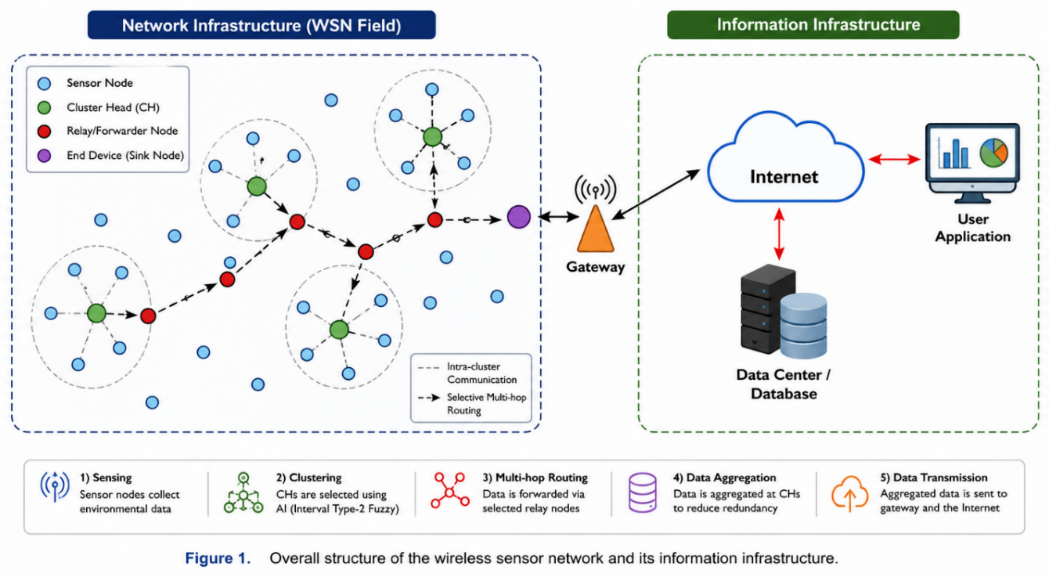
Wireless Sensor Networks (WSN) form one of the important categories of distributed communication systems that consist of many low power sensor nodes spread throughout the physical environment for data sensing, collection, processing, and transmission. The application of such networks can be found in environmental monitoring, industrial automation, smart agriculture, health care systems, military surveillance, disaster management, and smart infrastructure [1][2]. Generally, in a WSN, each sensor node has a sensing unit, a processing unit, a radio transceiver, and limited battery energy source. Consequently, the performance of WSNs is highly dependent on energy consumption, communication range, packet routing, node density, and network topology. Usually, due to deployment of sensor nodes in remote or inaccessible areas, battery replacement or recharge is very difficult. This is the reason why energy consumption and network life time are very important design issues of WSNs. Generally, the architecture of a WSN network is made up of the following components: sensing nodes, Cluster Head (CH), relay or forwarding nodes, Base Station (BS), gateway and the information infrastructure which includes the Internet, data center, database and application layer. From the illustration in Figure 1, the sensor nodes detect the environment and send the collected data to some selected CHs. The CHs aggregate the data to minimize redundancy and then send the collected information to the BS or gateway, either directly or through the selection of multi-hop routing scheme [2][3]. The gateway acts as a connection between the WSN network and the information infrastructure where data can be stored, analyzed and accessed by the end-users. This architecture depicts that WSN networks not only act as communication networks but also as data acquisition systems [1]-[4].
Figure 1. General architecture of a wireless sensor network
Low-Energy Adaptive Clustering Hierarchy (LEACH) is one of the first and most popular clustering protocols used in WSNs. The primary concept of LEACH is that it makes clusters in the network and rotates the role of the CH among the sensor nodes so that energy consumption could be distributed [5]. In every round, certain sensor nodes become CH randomly and the other nodes form clusters with these CHs and transmit sensed data to them. Afterward, the CH transmits collected data to the BS. Although LEACH is efficient and relatively simple as compared to direct transmission protocol, it is also characterized by certain deficiencies, such as randomness in CH selection, imbalanced energy consumption, repetitive re-clustering operations, and inefficient data transmission over long distance [6][7].
A lot of work has been done on introducing Fuzzy Logic (FL) in WSNs due to inherent deficiencies of classical clustering algorithms based on random decision making. In contrast to threshold-based and probability-based methods, FL allows multiple uncertain and nonlinear parameters such as residual energy, distance between nodes, node centrality, node density, communication cost, and node load to be considered during clustering. Thus, it is much more appropriate to use fuzzy-based clustering in dynamic WSNs, since energy level and communication properties of nodes vary dynamically in time. It should be noted that Type-2 and Interval Type-2 fuzzy systems have better ability to handle uncertainty in comparison with Type-1 fuzzy systems [8][9].
Increasingly, the application of AI is contributing to the improvement of the intelligence, adaptability, and autonomy of WSNs. The Artificial Intelligence (AI) techniques will assist the network to achieve more efficient decision-making regarding the present conditions at the node and at the communication channel level. Some of the applications that can employ AI in WSN include CH selection, routing, data aggregation, anomaly detection, energy prediction, fault diagnosis, and adaptive resource management. The intelligent techniques like FL, ML, RL, NNs, and metaheuristics optimization can be useful in helping the network to learn or predict the optimal communication behavior in light of the changes. However, recent research into forecasting techniques has also revealed that the models employing machine learning, deep learning, and meta-heuristic assistance can predict temporal load with competitive accuracy and computational efficiency. These prediction abilities might facilitate proactive energy allocation, traffic management, and resource scheduling in intelligent WSNs [10].
Data analysis using big data technology is also gaining popularity in WSN-enabled applications owing to the fact that today’s sensing environments are capable of producing large amounts of heterogeneous and continuous data. The large-scale WSNs can collect their data from hundreds or thousands of nodes; hence, continuous streams of data will be obtained on parameters such as temperature, humidity, pressure, vibration, motion, healthcare information, industrial information, or any environmental events. Data analysis using big data technology can then be applied after data collection for purposes such as extracting useful patterns, detecting abnormal events, prediction, and effective decision-making. However, successful implementation of big data analysis requires high-quality data acquisition and transfer within the WSN. This means that energy-efficient clustering, data aggregation, and routing become critical because these processes minimize unnecessary data transmissions, conserve energy at the nodes, and guarantee that valuable sensing data reaches the database or data centers for analysis. With respect to this discussion, AI-enabled routing together with big data enabled data collection forms a very promising research direction [11].
Taking this point further, the efficiency of big-data analytics through WSN-based applications hinges largely on the quality of the underlying data acquisition layer. Researchers have thus taken the next step from random cluster head rotation to energy-based clustering, where the algorithms take into account residual energy, node density, distance to communicate, centrality, quality of links, and traffic load [12]-[16]. There have also been a lot of research on the use of metaheuristic optimization to enhance the process of cluster heads selection, balancing energy consumption within and between clusters, cutting down communication overhead, and ensuring no premature node failures [17]-[22]. Similarly, there have been efforts aimed at designing optimized, fuzzy, neural, and hybrid routing approaches to tackle the issue of handling uncertainty, path selection, reduction of redundant transmissions, and packet delivery in dynamic network environment. While most of the current approaches optimize either clustering, routing, or data aggregation separately, this approach leaves much to be desired in terms of taking care of hotspots, imbalance, repeated control actions, and long-distance communications [23]-[26].
In this regard, the design of energy-efficient WSN protocols calls for a holistic approach involving the integration of intelligent cluster head selection, balanced cluster creation, efficient data aggregation, data forwarding, and minimizing the amount of communication overhead. As shown in Figure 2, clustering of WSN is typically done through two phases, which include: the setup phase, where the cluster heads are selected and clusters created, and the steady phase where data aggregation and communication take place. Whereas classical clustering methods serve as the basis for organizing sensor nodes, current WSN applications call for more flexible approaches, which are capable of handling energy changes, traffic load, node distribution, and communication uncertainties. This has motivated researchers to adopt not only probabilistic protocols, but also fuzzy-based, artificial intelligence (AI)-assisted, and data-driven clustering and routing approaches. Hence, the following papers are discussed to bring out the major achievements in energy-efficient clustering of WSNs, fuzzy decision-making, unequal clustering, and multi-hop routing [27].
The main contributions of this study are centered on energy-efficient clustering and routing in WSNs, validated through MATLAB-based simulation under multiple network scenarios. The key contributions and novelty of this research are as follows:
- This paper proposes a hybrid protocol called Interval Type-2 Fuzzy Unequal Clustering with Selective Multi-Hop and Adaptive Re-clustering (IT2F-UC-SMH-AR) to improve cluster-head selection and communication efficiency in Wireless Sensor Networks under dynamic and energy-constrained conditions.
- The proposed protocol integrates interval type-2 fuzzy logic, unequal clustering, selective multi-hop transmission, and adaptive re-clustering in a unified framework to achieve better energy utilization, improved cluster organization, and reduced control overhead.
- A load-aware member association and relay selection mechanism is introduced to improve packet forwarding behavior, reduce traffic imbalance among clusters, and enhance the stability of inter-cluster communication.
- The proposed method is compared with LEACH, CHEF, and Gupta-FL, and the simulation results demonstrate a more competitive overall performance, particularly in terms of energy preservation, early network stability, and clustering efficiency.
- The effectiveness of the proposed protocol is validated under three different Wireless Sensor Network scenarios, where major performance indicators such as alive nodes, dead nodes, average residual energy, total energy consumption, throughput, cluster-head stability, and lifetime milestones are analyzed comprehensively.
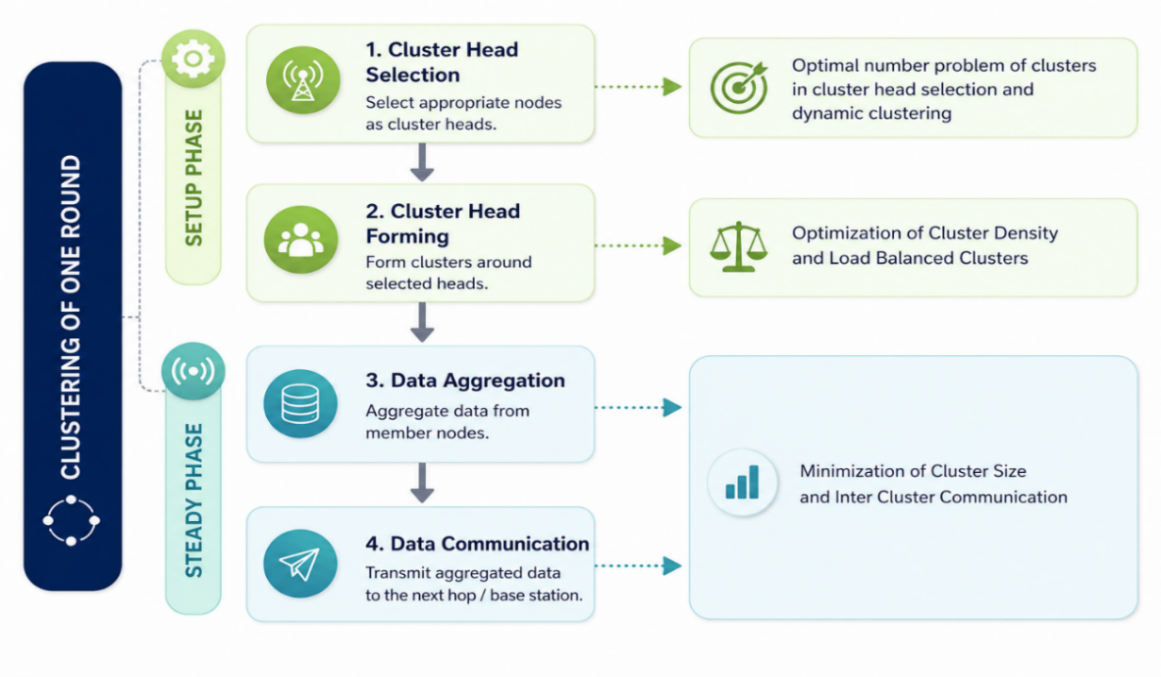
Figure 2. Clustering process in wireless sensor networks
LITERATURE SURVEY
Recent studies on the WSN have been concentrating on increasing energy efficiency, extending the life of the networks, providing reliability in data transfer, and enabling continuous acquisition of data in resource-limited environment. These issues have become vital especially due to the limited energy sources of the sensors, limited computational and transmission capacities, and deployment in large scale and dynamic environments. In such conditions, the use of traditional clustering and routing algorithms might result in uneven distribution of energy, early failure of overloaded sensors, instabilities in cluster formation, high control costs, and creation of hot spots near the base stations. In Big Data applications of WSNs, these issues will become much more serious since the hundreds or even thousands of sensors scattered across the environment will produce huge amount of high speed and heterogenous sensing data which should be gathered, aggregated, and transferred to gateways or data centers. Therefore, the efficiency of Big Data analysis is highly dependent on the quality and continuity of the data acquisition performed in WSN.
Therefore, in the past few years, there have been research works conducted on the intelligent and adaptive methods for the selection of cluster heads, the association of nodes, intra and intercluster communications, relay node selection, and connection of base stations. The methods that have received maximum consideration are improvements made to the LEACH protocol, Fuzzy Logic, Particle Swarm Optimization (PSO), Quantum Particle Swarm Optimization (QPSO), reinforcement learning, Deep Reinforcement Learning, and hybrid optimization. These techniques attempt to utilize residual energy, communication range, node density, centrality, link quality, traffic load, and energy imbalance in order to make decision regarding routing as opposed to making random or predetermined decisions. The classical shortest path algorithms too provide valuable theoretical guidance for the same. When the weights of links are non-negative, Dijkstra’s algorithm is used for efficient route calculation from one source, Bellman-Ford allows iterative path relaxation and deals with wider network scenarios, while Floyd-Warshall is used to compute paths between all pairs of nodes at higher computational costs [28]. However, shortest-path minimization by itself cannot cope with issues such as energy consumption, uncertainty, clustering instability, hotspot formation, and sustained large-scale data delivery needs in Big Data-powered sensor networks. Hence, modern research increasingly focuses on integrating energy-efficient clustering, uncertainty management using fuzzy logic, clustering reconfiguration, and multi-hop forwarding for optimal balance between reliability, complexity, energy conservation, network lifespan, and reliable data acquisition. The most relevant studies in this field are discussed below.
The authors Kiran et al. (2020) suggested the concept of fuzzy clustering and multidirectional routing for extending the lifetime of WSNs. It used FL to facilitate CH selection with respect to energy-based criteria and applied multidirectional routing for increasing data forwarding towards the BS. The main novelty of this research is in using fuzzy-based CH selection and routing flexibility as compared to direct communication. As a result, the increased network lifetime and energy efficiency have been achieved; however, the considered approach uses Type-1 fuzzy reasoning and does not consider the problem of uneven clusters and adaptive re-clustering [29].
Following that, the authors Phoemphon et al. (2021) suggested energy efficient fuzzy-based scheme for unequal multihop clustering in WSNs. The method simultaneously used FL for competition radius determination, CH selection, member joining, and relay selection. The main innovation of this paper is in considering clustering and routing as mutually related processes, wherein the process of unequal clustering reduces the hotspot effect close to the BS while multihop communication decreases the energy consumption for long range communications. Thus, the results of the research confirm that the combination of unequal clustering and relay-based communication increases energy efficiency and extends network lifetime; however, the method depends on fixed fuzzy rules [30].
The E-FUCA was developed by Mehra (2022), which is an advanced fuzzy unequal clustering and routing approach for achieving sustainable WSNs. This approach took into account some vital parameters in CH selection, and FL was also applied to assist non-CH nodes in selecting suitable CHs when forming clusters. Moreover, FL was also considered for next hop selection, thus increasing routing efficiency. The obtained results indicated higher lifetime, increased stability period, and better average residual energy in comparison with related protocols. The main significance of this paper lies in the fact that fuzzy decision-making becomes much more effective when considering CH selection, clustering and routing processes [31].
Distributed two-hop cluster routing protocol (D2CRP) for WSNs was proposed by Chen et al. (2022). It is noteworthy that their approach aimed at enhancing the data communication process in terms of clustering by arranging nodes using distributed two-hop routing. The contribution of this research was the possibility of reducing the communication load and scalable routing in sensor networks. The achieved results revealed higher energy efficiency and data delivery rate compared with traditional cluster routing approaches. It should be mentioned that the authors did not pay much attention to AI uncertainty management and fuzzy decision-making techniques [32].
Farooq et al. (2022) suggested the POWER protocol that is a probabilistic and weight-based clustering routing protocol that can be considered energy efficient for large scale WSNs. The authors utilized weighted probabilistic criteria to select CHs and solve the problem of unbalanced energy consumption in large scale WSNs. The contribution of the proposed model is that it uses several energy-aware parameters instead of random choice of CHs, making the clustering process more reliable than LEACH. The results obtained show improved network lifetime and scalability, but the probabilistic nature of the protocol limits its capacity for adaptive response to uncertainty, varying density, and traffic load [33].
Rawat et al. (2023) developed an FL- and PSO-based clustering protocol for WSNs. In this case, FL is applied to improve the process of decision-making in the CH selection process, whereas PSO is used for optimization of clustering behavior and improvement of energy distribution. The contribution of this protocol lies in the combination of fuzzy logic reasoning and swarm optimization to make clustering not random. The results are improved energy efficiency and increased network lifetime; however, optimization-based protocols could be characterized by higher computational complexity, especially in WSNs [34].
Moreover, Narayan et al. (2023) presented an E-FEERP method, which was an improved fuzzy-based energy-efficient routing protocol for WSNs. In this method, FL was employed to make routing decisions through certain criteria, including energy-related and communication-related parameters. The major contribution of this study was that this method allowed for making more accurate route selections through considering intelligent decision making instead of shortest-path or distance-based forwarding’s. According to the authors' reported results, the reliability and lifetime performance were increased. However, E-FEERP was still mostly dependent on fuzzy rules and had no adaptation through learning [35].
Additionally, Hu et al. (2024) developed QPSOFL, an energy-efficient clustering and routing protocol that utilized QPSO and FL techniques. In this protocol, the optimized QPSO was applied for selecting CH and FL for choosing the best relay CH with regard to residual energy, energy deviation, and relay distance. The major contribution of this work consisted in the integration of optimization and FL for achieving improved cluster formation and communication among clusters. The results showed that QPSOFL outperformed some other known methods in terms of lifetime, throughput, energy consumption, and scalability [36].
Moreover, Zaier et al. (2025) suggested IT2FUSS algorithm, which combined interval Type-2 fuzzy sets, dynamic unequal clustering, and sleep scheduling and addressed the problem of uncertainty and effective energy management in IoT-based WSNs. As a result, it was found out that using Type-2 fuzzy modeling, uncertainty in residual energy, node density, and relative distance to the BS could be managed better, thus leading to the improvement of energy distribution and extended network lifetime. Therefore, this paper is quite relevant since it clearly presents the benefit of using Type-2 fuzzy modeling in comparison with the traditional Type-1 fuzzy modeling in uncertain WSNs [37].
In turn, Wang and Duan (2025) suggested FQ-UCR protocol, which used FL and Q-learning. In particular, they designed FIS for calculating CH selection probability and competition radius as well as Q-learning technique for selecting the best forwarding CH for data forwarding toward the BS. The results indicated that the use of FQ-UCR protocol improves energy efficiency, network lifetime, and reduces the hotspot effect. This paper is significant since it combines fuzzy-based unequal clustering and reinforcement learning-based multi-hop routing [38].
Liu Guangjie (2026) introduced QPSODRL, a protocol that performs intelligent clustering and routing using QPSO and DRL. Entropy-aided QPSO was employed for the adaptation of CH election process while routing was optimized through the use of a modified version of Dueling Double Deep Q-Network (D3QN). Moreover, Enhanced Prioritized Experience Replay (E-PER) was employed to enhance the efficiency of learning process under energy constraint scenario. The resulting findings indicate that QPSODRL outperformed other recent protocols concerning network lifetime, load balancing, throughput, and energy consumption [39].
As summarized in Table 1, recent studies have adopted different intelligent clustering and routing strategies to improve energy efficiency in WSNs. These methods mainly rely on fuzzy logic, optimization algorithms, and learning-based techniques to enhance CH selection, reduce energy consumption, and extend network lifetime. However, most existing approaches still lack a unified design that jointly considers unequal clustering, selective multi-hop routing, adaptive re-clustering, and load-aware communication.
Table 1. Summary of recent related works on energy-efficient clustering and routing in WSNs.
Authors / Year | Utilized Method | Obtained Results |
Kiran et al. (2020) | FL-based clustering and routing | Improved energy use and network lifetime. |
Phoemphon et al. (2021) | FL-based unequal multi-hop clustering | Reduced hotspot effects and improved energy balance. |
Mehra (2022) | E-FUCA | Improved stability period, residual energy, and lifetime. |
Chen et al. (2022) | Distributed two-hop cluster routing | Enhanced scalable data forwarding and energy efficiency. |
Farooq et al. (2022) | Probabilistic energy-aware clustering | Improved CH selection and large-scale WSN lifetime. |
Rawat et al. (2023) | FL with PSO clustering | Improved clustering stability and energy distribution. |
Narayan et al. (2023) | Fuzzy energy-efficient routing | Improved route selection and network reliability. |
Hu et al. (2024) | QPSOFL | Improved lifetime, throughput, and energy consumption. |
Zaier et al. (2025) | IT2FUSS | Improved uncertainty handling and energy balance. |
Wang and Duan (2025) | FL with Q-learning routing | Improved CH selection, relay forwarding, and hotspot reduction. |
Liu Guangjie (2026) | QPSO with DRL | Improved lifetime, load balancing, throughput, and energy efficiency. |
NETWORK MODEL AND MATHEMATICAL FORMULATION
A clustered WSN is analyzed in this paper, in which Nsensor number of nodes are deployed randomly in a two dimensional sensing field of size  and all the sensed information is to be finally transferred to the BS. As the sensor nodes are power limited devices, the routing protocol should take care of the energy consumption while electing the CH, communicating within the cluster and exchanging messages between clusters. Just like several clustering based WSN protocols, the proposed scheme also follows the first order radio energy model, wherein the transmission energy is a function of both packet length and the distance of communication and the clustering process is affected by energy of the nodes, their location and neighboring density. The location of
  sensor node and the position of the base station can be expressed as [40]- [42]:
| 
| (1) |
| 
| (2) |
Accordingly, the Euclidean distance between node  and the BS, as well as the distance between node and node
  , can be expressed as follows [43]:
| 
| (3) |
| 
| (4) |
The radio energy dissipation model used in this work follows the common first-order formulation. The energy required to transmit an  -bit packet over distance
  is given by [44]:
| 
| (5) |
where  is the electronic energy per bit, the symbol
  and the
  denote the free-space and multipath amplifier parameters, respectively, and
  is the threshold distance defined by the following equation [44]:
| 
| (6) |
Besides the transmission energy, the radio model also includes the energy used in the process of receiving packets and aggregating the data at the CH. The amount of energy required to receive an L-bit packet is modeled by Equation (7), whereas the energy that is needed to aggregate the packets at the CH is provided in Equation (8). Thus, the total energy of communication consumed by a CH when it receives data from  member nodes, aggregates them, and transmits the aggregated packet to the BS is estimated using Equation (9), where
  denotes the distance for transmission between the CH and the BS. To enhance the CH election process, energy-based node descriptors are also utilized by the proposed protocol. Hence, the normalized residual energy of node is given in Equation (10), so nodes with more energy will have better suitability for the election of CHs [44][45]:
The normalized relative distance to BS can be applied for measuring proximity of sensors to the data gathering point. The use of this metric allows reducing the cost of long-range communication and choosing CH nodes more wisely [44][45]:
| 
| (11) |
To further improve the quality of CH election, the proposed model considers node centrality and local neighborhood density as additional descriptors. The centrality term in Equation (12) measures how close node i is to the geometric center of the sensing field, while the local density term in Equation (13) represents the relative number of neighboring nodes located within a predefined communication radius. These descriptors are then integrated with normalized residual energy, relative BS distance, and the uncertainty term to form the interval Type-2 fuzzy-inspired suitability score in Equation (14), where nodes with higher  values are more suitable for CH election. After CH selection, unequal clustering is applied using Equation (15), where CHs farther from the BS are assigned larger cluster radii, whereas CHs closer to the BS maintain smaller clusters to preserve energy for inter-cluster forwarding. For selective multi-hop routing, the relay score in Equation (16) evaluates each candidate relay according to energy, BS distance, hop quality, and relay load, and the candidate with the highest
  is selected as the forwarding relay. Finally, Equation (17) defines the adaptive re-clustering interval based on the average normalized energy of active CHs, which helps reduce unnecessary cluster reconstruction and control overhead [44][45]:
This process avoids unnecessary recomputation of the clusters when the network is in steady-state condition and activates re-clustering only if the mean residual energy of the remaining Cluster Heads (CHs) drops below a particular threshold value. Thus, the model presented herein incorporates an energy-efficient cluster head selection mechanism along with unequal clustering and adaptive re-clustering to optimize the performance of the WSN [44][45].
METHODOLOGY
The methodology adopted in this work is organized into three main phases. The first phase focuses on the construction of the WSN environment and the underlying energy-aware communication model, including node deployment, clustering structure, and radio energy dissipation formulation. The second phase is devoted to the development of the proposed Interval Type-2 Fuzzy Unequal Clustering with Selective Multi-Hop and Adaptive Re-clustering (IT2F-UC-SMH-AR) protocol, in which cluster-head election, cluster formation, member association, relay selection, and adaptive re-clustering are integrated into one hybrid framework. The third phase centers on the performance evaluation of the proposed method under multiple WSN scenarios, where its behavior is compared with LEACH, CHEF, and Gupta-FL using major network metrics such as alive nodes, dead nodes, residual energy, throughput, cluster-head stability, and lifetime milestones. Detailed explanations of each phase of the proposed WSN model and protocol implementation are presented in the following subsections.
Phase One: Wireless Sensor Network Model
The first phase consists of establishing the WSN simulation model used for protocol implementation and evaluation. In this study,  sensor nodes are randomly distributed over a two-dimensional sensing field, while a fixed base station is placed outside or above the monitored region depending on the selected scenario. Each node is initially assigned the same energy level, and the communication process is organized using a clustering structure in which ordinary sensor nodes transmit their data to elected cluster heads, and cluster heads forward the aggregated information toward the base station. Since the primary challenge in WSNs is energy limitation, the network model is constructed using the first-order radio energy model to represent transmission, reception, and data aggregation costs under realistic communication distances. The energy consumed to transmit an -bit packet over distance
  is expressed as:
|
| (18) |
where represents the electronic energy consumed per bit, while and  denote the free-space and multipath amplifier coefficients, respectively.
The threshold distance in Equation (19) identifies whether the free-space or multipath propagation model will be used in the process of packet transmission. For distances lower than the threshold value, the free-space amplifier coefficient is considered while distances higher than the threshold value need the use of multipath amplifier coefficient. Moreover, the radio model comprises the energy of reception in Equation (20) that is determined by the packet length and electronic energy consumption and energy for data aggregation in Equation (21) that is used to describe the energy consumed by CH to aggregate the received packets before sending them to BS. This type of energy cost calculation equations is widely used in clustering-based WSN routing models in order to calculate the communication cost and energy dissipation [44]-[47]. This formulation of radio-energy is used in recent WSN clustering and routing works, which given as follows:
Accordingly, the total communication burden of a cluster head depends on the number of associated member nodes, the reception of their packets, the aggregation of these packets, and the forwarding energy required to reach the base station or an intermediate relay node. The initial WSN simulation parameters used throughout this study are summarized in Table 2.
Table 2. Main WSN simulation parameters used for modeling and testing.
Parameter Name | Values |
Network field size |  , , 
|
Number of nodes | 100, 200 |
Initial node energy  | 0.5  |
Number of simulation rounds | 2000 |
Data packet length | 4000 bits |
Control packet length | 200 bits |
Desired CH probability  | 0.08 |
Electronics energy |  J/bit J/bit
|
Free-space coefficient | 
|
Multipath coefficient | 
|
Data aggregation energy  | 
|
Number of Monte Carlo runs | 25 |
Base station positions |  , , 
|
Network field size | , |
Parameter Name | Values |
Network field size | , |
Number of nodes | 100, 200 |
Initial node energy | 0.5 |
Number of simulation rounds | 2000 |
Data packet length | 4000 bits |
Control packet length | 200 bits |
Desired CH probability | 0.08 |
Electronics energy | J/bit |
Free-space coefficient |  J/bit/ J/bit/ 
|
Multipath coefficient |  J/bit/ J/bit/ 
|
Data aggregation energy |  J/bit J/bit
|
Number of Monte Carlo runs | 25 |
Base station positions | , |
Network field size | , |
Network Descriptors and Cluster-Head Selection Variables
To improve the quality of the CH election, each candidate node is evaluated using four main descriptors: residual energy, distance to the BS, centrality, and local density. The normalized residual energy in the Equation (22) gives priority to nodes with higher remaining energy, while the normalized distance-to-BS descriptor in Equation (23) helps reduce long-range communication cost. The centrality term in Equation (24) measures the relative position of the node with respect to the geometric center of the sensing field, which supports compact cluster formation. In addition, the local density term in Equation (25) reflects the number of neighboring nodes around each candidate node and helps identify nodes that can serve as effective CHs for nearby members. These descriptors are widely used in intelligent and fuzzy-based WSN clustering because they directly affect CH reliability, cluster compactness, forwarding cost, and energy balance [48][49], as follows:
where  is the number of neighboring nodes located within a predefined communication radius around node . These four descriptors are later used by the proposed interval Type-2 fuzzy-inspired scoring mechanism in order to determine the most appropriate nodes for CH election under uncertain and dynamic WSN conditions.
Phase Two: Proposed IT2F-UC-SMH-AR Protocol
The second phase consists of constructing the proposed hybrid protocol called IT2F-UC-SMH-AR, which combines interval Type-2 fuzzy-inspired cluster-head election, unequal clustering, selective multi-hop forwarding, adaptive re-clustering, and load-aware communication mechanisms. The objective of this phase is to improve network stability and energy efficiency while reducing the shortcomings of conventional clustering schemes, such as random CH election, repeated cluster reconstruction, hotspot formation near the base station, and inefficient inter-cluster transmission.
4.2.1. Interval Type-2 Fuzzy-Inspired Cluster-Head Suitability Scoring
The first parameter that is incorporated into the suggested protocol is the Interval Type-2 fuzzy-based numerical score for cluster-head selection. As compared to the random selection of cluster-heads in the LEACH protocol, the suggested method determines the score for each potential sensor node using four parameters based on energy and topology criteria. They include the normalized residual energy, normalized distance to the sink, centrality of the node, and local neighborhood density. This is done since these parameters influence the ability of the potential node to collect, process, and disseminate information.
The suggested mechanism is not a conventional rule-based Interval Type-2 Fuzzy Inference System, consisting of a set of linguistic IF-THEN rules, an inference engine, a type reduction process, and defuzzification step. Rather, it involves an uncertainty aware numerical aggregation system based on the principles of Interval Type-2 fuzzy logic. Each descriptor is first normalized to the interval [0, 1], where a higher value represents a more desirable condition for cluster-head selection. The nominal membership value of descriptor  for node is denoted by
  , where
  represents residual energy, BS proximity, centrality, and local density, respectively.
In order to model uncertainty in descriptor measurement values and network conditions, lower and upper membership bounds are created for each nominal membership value through the use of descriptor-specific uncertainty width  . The lower and upper membership bounds are computed as follows:
| 
| (26) |
| 
| (27) |
where  and denote the lower and upper membership values, respectively, and the
  determines the uncertainty width associated with the descriptor . The bounding operations ensure that all membership values remain within the normalized interval
  . The interval between the lower and upper membership values forms the footprint of uncertainty, representing possible variations caused by residual-energy fluctuations, communication-distance estimation, changes in node density, and local topology conditions.
Since the suggested approach does not employ a linguistic rule base and iteration-based type reduction, the midpoint value of each membership function is taken to be the crisp contribution of the respective descriptor. The midpoint membership function is defined as follows:
| 
| (28) |
The width of the membership interval corresponds to the degree of uncertainty in each description. The narrower the membership interval, the higher is the degree of confidence in its value, and vice versa. As such, the degree of uncertainty penalty imposed on node  is determined as follows:
| 
| (29) |
After incorporating the midpoints of all descriptors and considering the uncertainties involved in their membership intervals, the suitability measure for cluster heads in each node is formulated as below:
| 
| (30) |
where  ,
,  ,
,  , and
, and  are representing the midpoint membership contributions associated with normalized residual energy, normalized BS proximity, node centrality, and local density, respectively. The coefficients
  ,
,  ,
,  , and
, and  are nonnegative weighting factors satisfying the (
 ).
).
The value of the dimensionless uncertainty-penalty coefficient ( ) dictates how much weight will be given to the penalty term in the calculation of the final suitability scores in terms of reducing the suitability score for those nodes that have higher membership values and less accurate descriptors. Numerical values of all the weights along with their functions are given in Table 3.
Table 3. Weighting coefficients used in the proposed cluster-head suitability score.
Coefficient | Associated descriptor | Value | Selection rationale |
| Normalized residual energy | 0.40 | Gives priority to nodes with sufficient energy for data reception, aggregation, and forwarding |
| Normalized BS proximity | 0.24 | Reduces the energy cost associated with long-distance communication |
| Node centrality | 0.20 | Encourages compact cluster formation and shorter member-to-CH communication distances |
| Local node density | 0.16 | Favors nodes that can efficiently serve a sufficient number of neighbouring sensor nodes |
| Uncertainty penalty | 0.08 | Reduces the suitability of nodes associated with wide membership intervals and uncertain descriptor values |
The weights of the descriptors are determined based on the operational significance of the considered descriptors in clustered WSNs. Residual energy is given the highest weight since extra energy consumption by CHs occurs while receiving packets, aggregating them, and sending to other clusters. The distance to BS is used to decrease costly long distance communication, while centrality and density are required for small-sized clusters. An uncertainty coefficient is introduced in order to decrease the probability of selection of nodes with unstable or unreliable descriptor values. The same coefficients remain unchanged in all scenarios and during Monte Carlo simulations.
Those nodes having high residual energy level, better proximity with respect to BS, better centrality, better neighbor density, and small uncertainty intervals would get higher suitably values. On the other hand, those nodes which have more uncertainty with respect to the descriptors get penalized heavily and hence are not very much likely to be chosen. The candidate nodes are sorted according to their  values, and the nodes having the maximum values become cluster heads based on the required probability of cluster head and spatial separation. This way of uncertainty aware selection of cluster heads without linguistic rule evaluations is made possible through direct aggregation of the intervals.
Unequal Clustering
After the cluster heads are elected, the proposed protocol applies unequal clustering to mitigate the hotspot problem near the base station. In conventional equal clustering schemes, the CHs located close to the base station experience faster energy depletion because they not only serve their own cluster members but may also participate in forwarding traffic from distant clusters. To overcome this issue, the proposed method assigns smaller cluster radii to CHs near the base station and larger radii to the CHs farther away. The competition radius of the CH is defined by the following mathematical expression:
| 
| (31) |
where  is the basic cluster radius. This mechanism enables distant CHs to support more member nodes, while closer CHs preserve energy for inter-cluster forwarding.
Load-Aware Member Association
Once the cluster heads and their radii are determined, ordinary sensor nodes are associated with CHs according to a load-aware membership rule. Instead of joining only the nearest CH, each node selects the CH that minimizes a joint association cost considering communication distance, CH quality, current cluster load, and energy condition. The association cost for node with respect to cluster head is expressed as follows:
| 
| (32) |
where  is the normalized node-to-CH distance, is the quality of cluster head ,
  is the current load of cluster , and
  is an energy-related penalty term. This formulation improves cluster compactness and reduces excessive traffic concentration on weak CHs.
Selective Multi-Hop Forwarding
The proposed protocol further improves inter-cluster communication through selective multi-hop forwarding. In conventional LEACH, each CH transmits directly to the base station, which may cause large energy loss when the BS is located far from the sensing area. In the present work, a CH transmits directly to the BS only when direct communication is acceptable; otherwise, it forwards its aggregated packet through another CH selected as a relay. The relay selection score for candidate relay is given by the following mathematical expression:
| 
| (33) |
where  is referring to the normalized hop-quality term and
  is the normalized relay load. The CH with the highest relay score is selected for forwarding. This selective multi-hop strategy reduces expensive long-distance transmission and supports better packet delivery performance.
Adaptive Re-Clustering
Repeated re-clustering in every round introduces considerable control overhead and unnecessary energy consumption. Therefore, the proposed protocol adopts adaptive re-clustering, where the network decides whether to maintain the current clustering structure or rebuild it based on the average condition of the active CHs. The re-clustering interval is defined byn the following relationship:
| 
| (34) |
where  is the normalized average residual energy of the active cluster heads. This mechanism reduces clustering overhead when the current CH structure remains efficient and stable.
Phase Three: Performance Evaluation
The third phase focuses on evaluating the performance of the proposed IT2F-UC-SMH-AR protocol under different WSN deployment conditions. Three scenarios are considered in this work: a  field with 100 nodes, a field with 100 nodes, and a field with 200 nodes. For fairness, the same randomly generated topology is used for all compared protocols in each Monte Carlo run. The proposed method is compared with LEACH, CHEF, and Gupta-FL using the following metrics:
- Alive nodes
- Dead nodes
- Average residual energy
- Total energy consumed
- Packets delivered to the BS
- Cumulative throughput
- CH count stability
- Energy balance indicator
- Lifetime milestones: FND, HND, 70%ND, and LND
The following network lifetime milestones are adopted for assessing the lifetime of the WSN throughout the simulation process. The FND given in Equation (31) refers to the round when the energy of at least one sensor node is exhausted. On the other hand, the HND specified by Equation (32) is the round when half of the deployed nodes become dead. ND70 as presented in Equation (33) shows the network degradation phase. Finally, LND in Equation (34) is the round where all sensor nodes get drained. These parameters are normally adopted in energy-efficient WSN clustering and routing researches for assessing early stability, middle lifetime, late robustness, and overall network lifetime [50]-[52].
where  is the number of dead nodes at round
  , and is the total number of deployed nodes. The use of the above-mentioned extensive and multi-dimensional set of performance measures makes it possible to analyze the IT2F-UC-SMH-AR protocol not only from the communication but also from the point of view of energy management. These performance measures altogether demonstrate the efficiency of the protocol to conserve energy of nodes, to balance communication load distribution, control the process of cluster head selection, prevent unnecessary re-clustering processes, and guarantee efficient data delivery to the base station in case of changing network density and communication distance. In particular, FND, HND, 70% ND, and LND points describe all the stages of operation of the network. On the other hand, cumulative throughput and packets sent to the base station indicate the continuity and efficiency of the data collection process. At the same time, energy balance and cluster heads' number show how much workload fairness and cluster sustainability have been achieved using the suggested scheme. An analysis of these metrics will help identify the trade-off between aggressive packets delivery and sustainable energy saving. Therefore, the used method allows performing a fair comparison of IT2F-UC-SMH-AR with LEACH, CHEF, and Gupta-FL in various application environments. In order to make the process clearer and allow the reproduction of the algorithm independently, its full computation scheme is presented in Algorithm 1.
Algorithm 1. Proposed IT2F-UC-SMH-AR Protocol for Energy-Efficient Clustering and Routing in WSNs |
- Initialize node positions, initial energies, and BS location
|
- Compute node descriptors: distance to BS, centrality, and local density
|
- For each round r = 1 to Rmax do
|
- Update alive and dead nodes
|
- Compute residual energy and consumed energy
|
- If adaptive re-clustering is required then
|
- For each eligible alive node do
|
- Compute normalized energy, BS distance, centrality, and density
|
- Evaluate interval Type-2 fuzzy-inspired CH score
|
- End for
|
- Select highest-scored nodes as CHs
|
- Assign unequal clustering radius to each CH
|
- Set next re-clustering interval
|
- Else
|
- Reuse previous alive CHs
|
- End if
|
- For each non-CH alive node do
|
- Compute association cost to feasible CHs
|
- Join CH with minimum cost
|
- End for
|
- For each member node do
|
- Transmit data to its CH
|
- Update transmission, reception, and aggregation energies
|
- End for
|
- For each alive CH do
|
- If direct transmission to BS is efficient then
|
- Send aggregated packet directly to BS
|
- Else
|
- Select best relay CH using energy, hop distance, BS distance, and load
|
- Forward packet through relay
|
- End if
|
- Apply packet success condition
|
- Update throughput and residual energies
|
- End for
|
- Apply mild energy balancing if needed
|
- Update FND, HND, 70%ND, and LND
|
- End for
|
- Return alive nodes, dead nodes, residual energy, consumed energy,
|
- throughput, CH stability, and lifetime metrics
|
RESULTS AND DISCUSSION
In this section, the proposed IT2F-UC-SMH-AR protocol is analyzed in detail, and the results obtained from different WSN scenarios, comparative performance tables, and improvement figures are presented. The effectiveness of the proposed method in enhancing early network stability, improving energy-aware clustering behavior, and maintaining competitive overall performance is discussed in each subsection through comparison with LEACH, CHEF, and Gupta-FL.
Results of the Proposed IT2F-UC-SMH-AR Protocol Under Different WSN Scenarios
The performance analysis of the presented IT2F-UC-SMH-AR algorithm in the WSN is provided by considering three distinct WSN deployments, as shown in Figure 3 to Figure 5. These figures show a comparison of the presented algorithm versus LEACH, CHEF, and Gupta-FL algorithms concerning the number of alive nodes, the number of dead nodes, average residual energy, energy consumption, packets delivered to BS, total throughput, CH stability, energy balance, and lifetime. Figure 3 above, for Scenario #1 ( , 100 nodes), the presented algorithm shows better initial stability behavior and comparable residual energy conservation when compared to the benchmark algorithms. The presented algorithm is also showing less uncontrolled CH generation and energy fluctuation compared to conventional LEACH algorithm, which means that the incorporation of IT2FDM and clustering adaptation has helped provide better stability. The throughputs graphs above show that while the presented algorithm is still competitive, LEACH has better cumulative packet delivery performance in this small network.
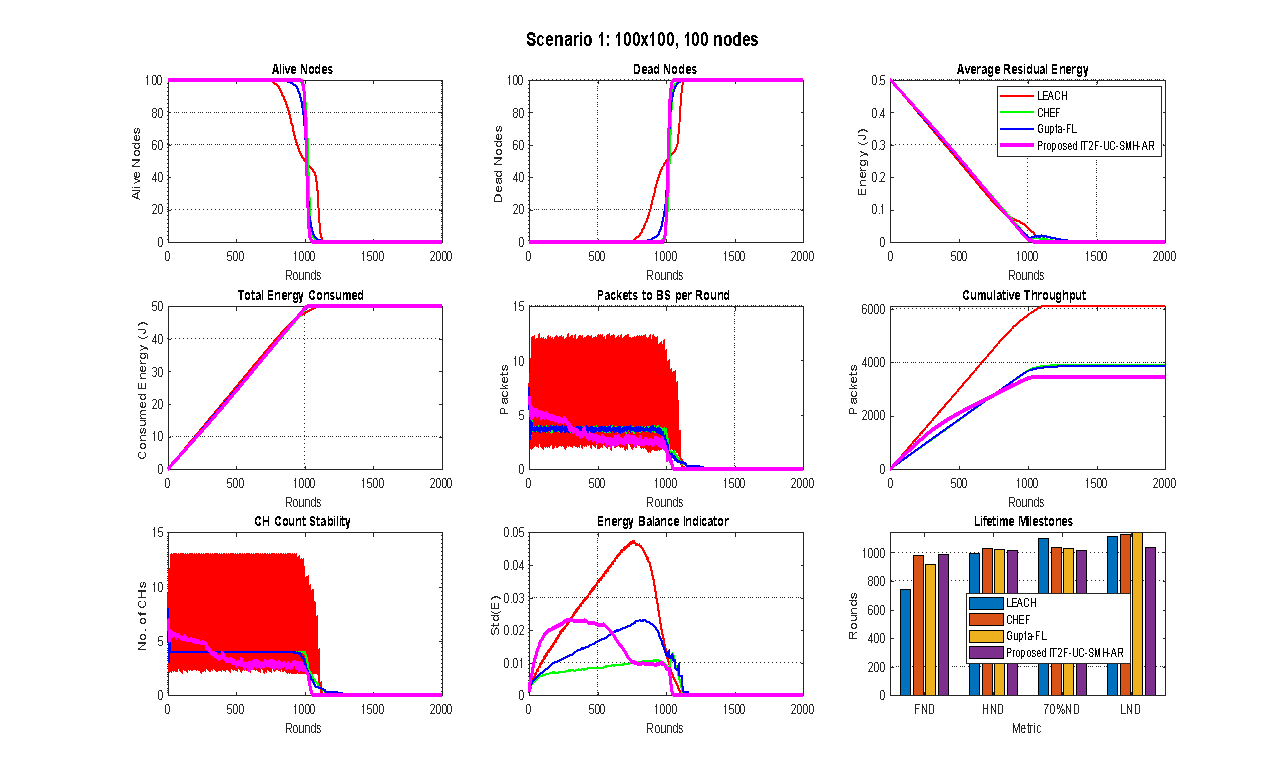
Figure 3. Comparative performance under Scenario 1: 100 × 100 m² with 100 nodes
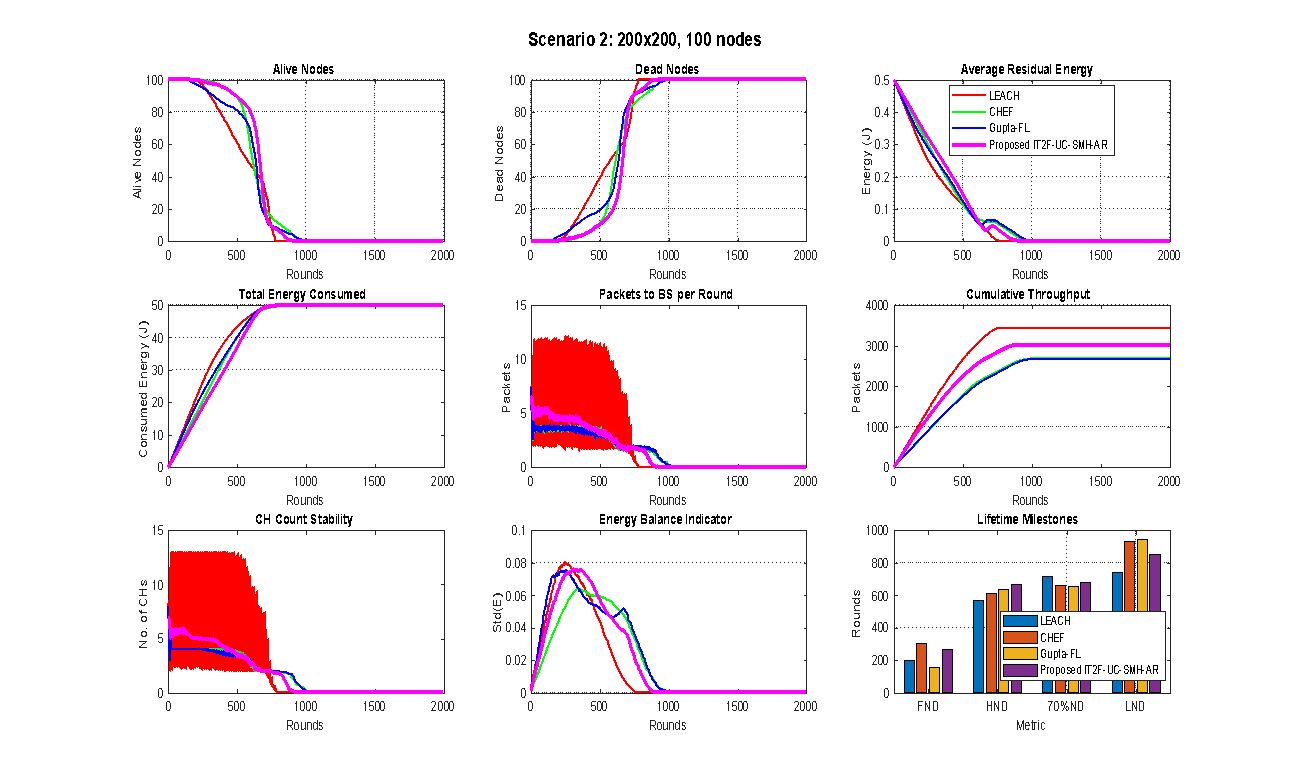
Figure 4. Comparative performance under Scenario 2: 200 × 200 m² with 100 nodes
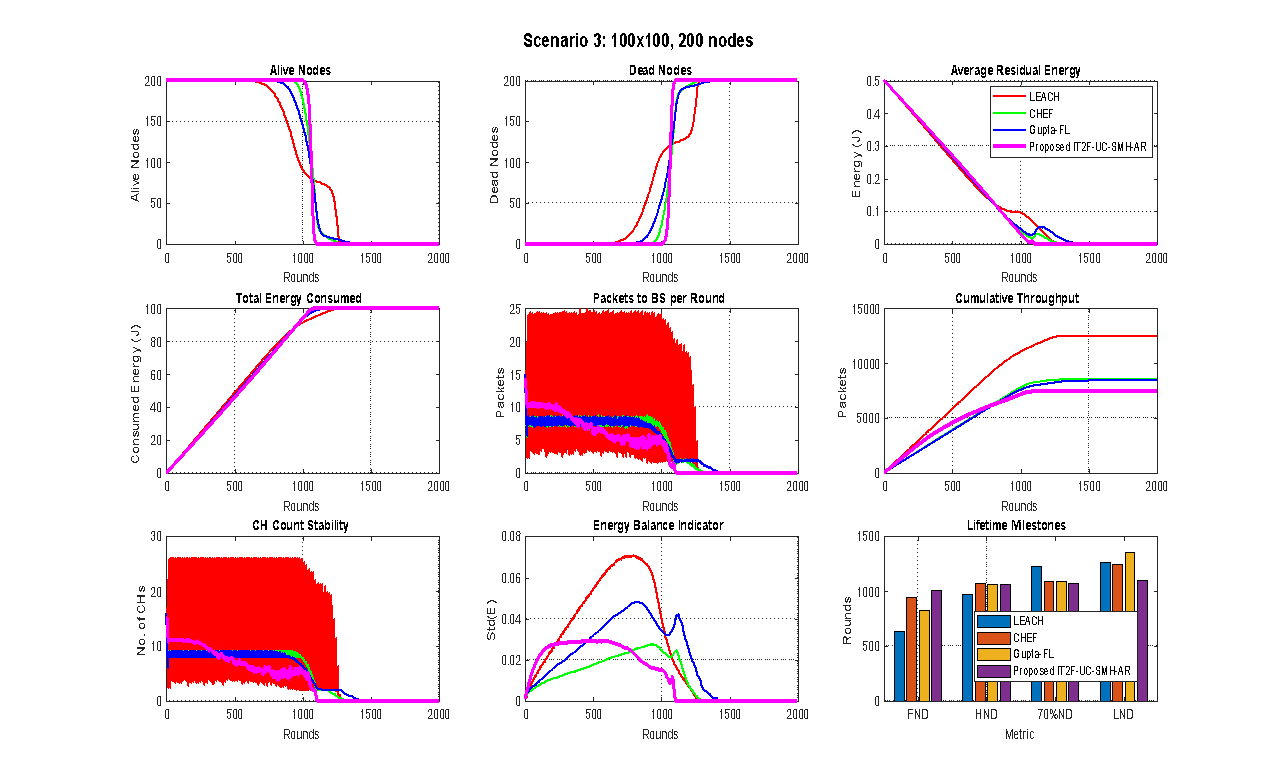
Figure 5. Comparative performance under Scenario 3: 100 × 100 m² with 200 nodes
In Figure 4, which represents Scenario #2 ( , 100 nodes), the performance of the proposed method becomes more balanced across the evaluated metrics. The larger network field increases the communication burden and makes direct transmission more costly, which highlights the importance of unequal clustering and selective multi-hop forwarding. Under this scenario, the proposed method achieves better behavior in terms of CH stability, residual energy trend, and several lifetime indicators, while maintaining competitive throughput relative to the compared methods. This result confirms that the proposed protocol becomes more effective when communication distance and routing complexity increase, since its hybrid structure is designed to better manage long-range transmission and traffic distribution.
In the following Figure 5, corresponding to Scenario #3 (, 200 nodes), the network becomes denser, and the influence of clustering efficiency becomes more pronounced. The proposed method shows strong performance in early stability and controlled energy dissipation, particularly during the initial and intermediate rounds of operation. The energy balance indicator also demonstrates that the proposed protocol can reduce excessive imbalance more effectively than LEACH, which suffers from larger fluctuations in CH behavior and energy consumption. Although LEACH achieves higher throughput in this dense deployment, the proposed protocol still preserves competitive communication performance while providing better clustering organization and more stable energy-aware operation.
Finally, the results mentioned indicate that the proposed IT2F-UC-SMH-AR protocol provides a more balanced and competitive overall performance than the classical clustering approaches. Its main strengths are reflected in improved early network stability, more efficient CH organization, and better energy-aware behavior under different deployment conditions. These findings confirm that combining interval Type-2 fuzzy-inspired CH election with unequal clustering, selective multi-hop routing, and adaptive re-clustering constitutes an effective strategy for enhancing the operation of energy-constrained WSNs.
The following Table 4 to Table 9 and Figure 5 to Figure 11 offer a thorough analysis of the performance of the suggested IT2F-UC-SMH-AR protocol in the context of the three scenarios analyzed for WSN deployment. Generally speaking, the obtained results prove that the suggested protocol has well-balanced performance with some scenario-specific advantages, which are mostly associated with early stability of the network, energy-aware clustering approach, and cluster formation control.
Specifically, in the case of Scenario #1, the suggested protocol provides the most significant improvement precisely during the stage of early stability based on the high FND value and its positive difference from all the protocols. Such a result proves the efficiency of the use of interval Type-2 fuzzy-based CH selection in providing the delay of node death and maintaining the network topology. Nevertheless, the suggested protocol demonstrates lower throughput and other lifetime-related values, indicating its preference for clustering stability over aggressive packet delivery.
With the Scenario #2, the performance of the suggested algorithm is now balanced since the expanded sensing area leads to increased distance and forwarding of data. In such a scenario, the algorithm of unequal clustering and selective multi-hop routing will be more advantageous and lead to better HND, ND70, and throughput than CHEF and Gupta-FL, while retaining high FND in comparison to LEACH and Gupta-FL. It is confirmed that the hybrid clustering and routing framework benefits from an increase in transmission distance and routing complexity.
In the case of Scenario #3, the tight deployment becomes another testament of the capability of the presented protocol to ensure network stability in its initial stages. Again, the protocol achieves the highest FND value and a competitive HND, together with the lowest average number of clusters created. This is an indication of greater control in creating clusters and less clustering overhead. However, the lifetime and throughput values are relatively lower compared to certain benchmark protocols such as LEACH.
In summary, these results indicate that the suggested IT2F-UC-SMH-AR mechanism is mostly efficient as a power-aware and stability-related approach. The significance of the approach is evidenced by the ability to postpone the node failure at an early stage, improve the clustering process, avoid the unnecessary formation of CHs, and maintain the network behavior. Nevertheless, further work on the approach is required to increase throughput and lifetime.
Table 4. Improvement of the proposed IT2F protocol in Scenario 1
Scenario | Compared with | Imp_FND (%) | Imp_HND (%) | Imp_ND70 (%) | Imp_LND (%) | Imp_Thr (%) | Imp_Balance (%) |
Scenario 1: , 100 nodes | LEACH | 32.54361 | 1.804662 | -7.51117 | -6.67315 | -43.5844 | 43.54745682 |
CHEF | 0.366958 | -1.50873 | -1.61197 | -7.82766 | -11.432 | -81.77223208 |
Gupta-FL | 7.460602 | -0.63162 | -1.19949 | -9.03382 | -10.7759 | -1.480989463 |
Table 5. Comparative performance metrics in Scenario #1
Scenario | Protocol | FND | HND | ND70 | LND | Throughput | Final energy | Consumed energy | CH count | Energy balance |
Scenario #1: , 100 nodes | LEACH | 742.88 | 995.20 | 1100.76 | 1111.32 | 6106.68 | 0 | 50 | 3.34516 | 0.01494777 |
CHEF | 981.04 | 1028.68 | 1034.76 | 1125.24 | 3889.80 | 0 | 50 | 2.13564 | 0.004642291 |
Gupta-FL | 916.28 | 1019.60 | 1030.44 | 1140.16 | 3861.20 | 0 | 50 | 2.11262 | 0.008315248 |
Proposed IT2F | 984.64 | 1013.16 | 1018.08 | 1037.16 | 3445.12 | 0 | 50 | 1.87012 | 0.008438396 |
Table 6. Percentage improvement in Scenario #2
Scenario | Compared with | Imp_FND (%) | Imp_HND (%) | Imp_ND70 (%) | Imp_LND (%) | Imp_Thr (%) | Imp_Balance (%) |
Scenario #2: , 100 nodes | LEACH | 33.12203 | 17.01725 | -4.89218 | 14.93149 | -12.08763 | -20.26524 |
CHEF | -11.63708 | 9.48632 | 3.36078 | -8.47152 | 12.40342 | -5.39656 |
Gupta-FL | 68.00000 | 4.33886 | 3.70618 | -9.59776 | 12.96957 | 8.37357 |
Table 7. Comparative performance metrics in Scenario #2
Scenario | Protocol | FND | HND | ND70 | LND | Throughput | Final energy | Consumed energy | CH count | Energy balance |
Scenario 2: , 100 nodes | LEACH | 201.92 | 570.48 | 717.88 | 741.52 | 3428.96 | 0 | 50 | 1.96238 | 0.016558082 |
CHEF | 304.20 | 609.72 | 660.56 | 931.12 | 2681.84 | 0 | 50 | 1.49856 | 0.018893991 |
Gupta-FL | 160.00 | 639.80 | 658.36 | 942.72 | 2668.40 | 0 | 50 | 1.48028 | 0.021733487 |
Proposed IT2F | 268.80 | 667.56 | 682.76 | 852.24 | 3014.48 | 0 | 50 | 1.65836 | 0.019913617 |
Table 8. Percentage improvement in Scenario #3.
Scenario | Compared with | Imp_FND (%) | Imp_HND (%) | Imp_ND70 (%) | Imp_LND (%) | Imp_Thr (%) | Imp_Balance (%) |
Scenario #3: , 200 nodes | LEACH | 60.12161 | 9.10994 | -12.74158 | -13.17356 | -40.24790 | 50.67387 |
CHEF | 6.71169 | -0.65787 | -2.24555 | -12.10218 | -12.67730 | -17.25177 |
Gupta-FL | 22.57564 | 0.16583 | -2.15251 | -18.90413 | -11.62940 | 34.42758 |
Table 9. Comparative performance metrics in Scenario #3
Scenario | Protocol | FND | HND | ND70 | LND | Throughput | Final energy | Consumed energy | CH count | Energy balance |
Scenario #3: , 200 nodes | LEACH | 631.52 | 974.32 | 1225.28 | 1263.44 | 12428.88 | 0 | 100 | 6.82012 | 0.025510572 |
CHEF | 947.60 | 1070.12 | 1093.72 | 1248.04 | 8504.68 | 0 | 100 | 4.66354 | 0.010731930 |
Gupta-FL | 824.96 | 1061.32 | 1092.68 | 1352.72 | 8403.84 | 0 | 100 | 4.58324 | 0.019190046 |
Proposed IT2F | 1011.20 | 1063.08 | 1069.16 | 1097.00 | 7426.52 | 0 | 100 | 4.01360 | 0.012583378 |
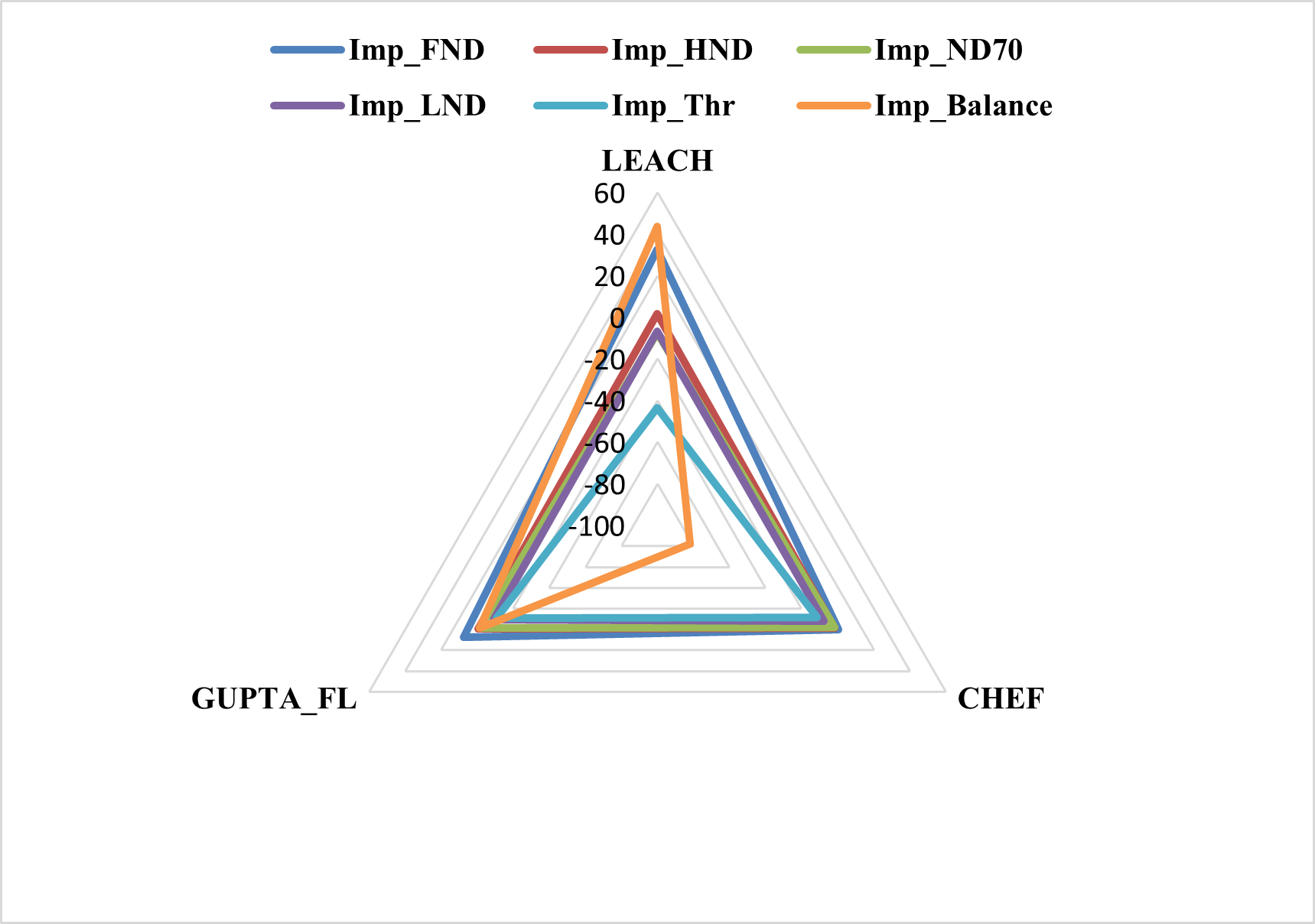
Figure 6. Percentage Improvement of the Proposed IT2F Protocol over LEACH, CHEF, and Gupta-FL in Scenario #1
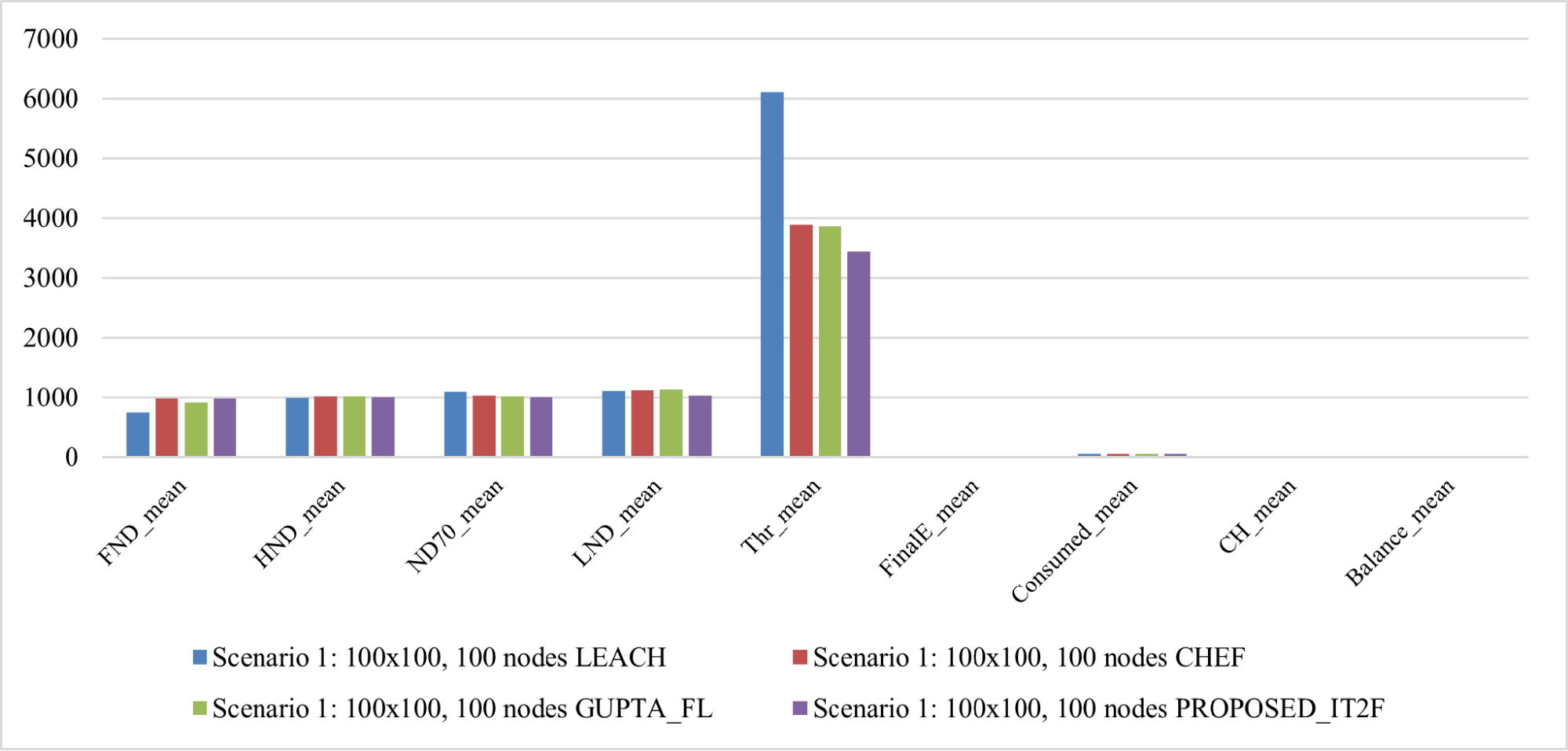
Figure 7. Comparative Performance Data Metrics of LEACH, CHEF, Gupta-FL, and the Proposed IT2F Protocol in Scenario #1
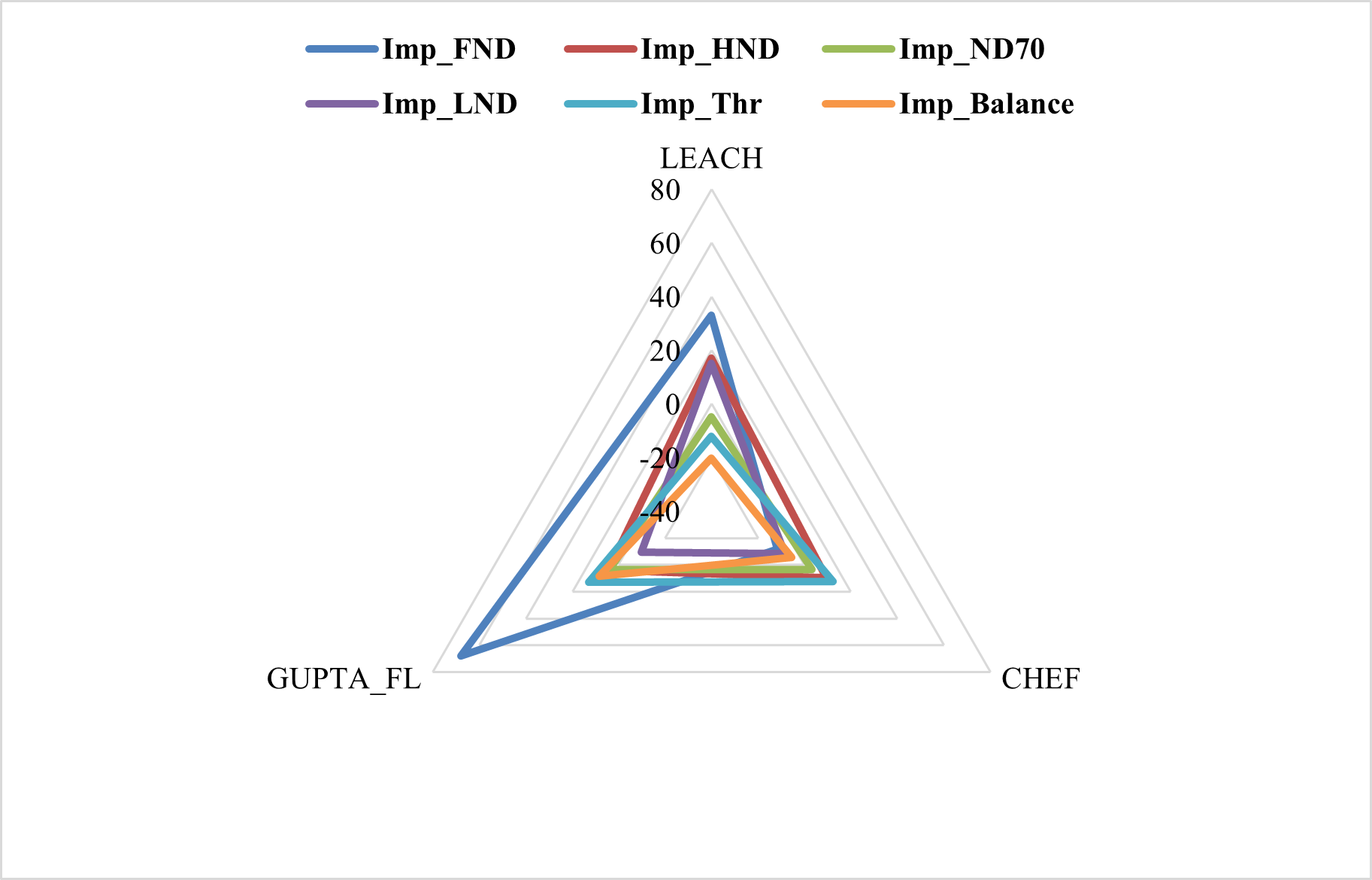
Figure 8. Percentage Improvement of the Proposed IT2F Protocol over LEACH, CHEF, and Gupta-FL in Scenario #2
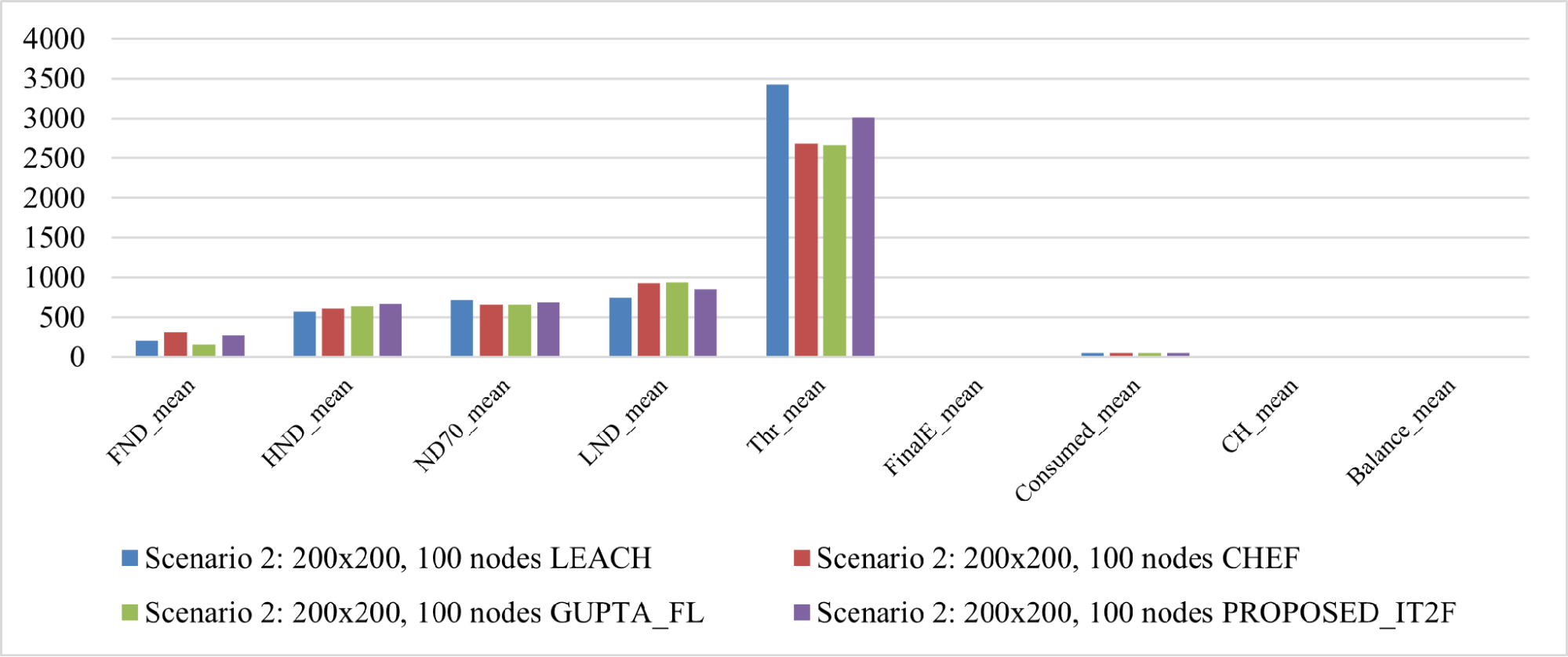
Figure 9. Comparative Performance Metrics of LEACH, CHEF, Gupta-FL, and the Proposed IT2F Protocol in Scenario#2
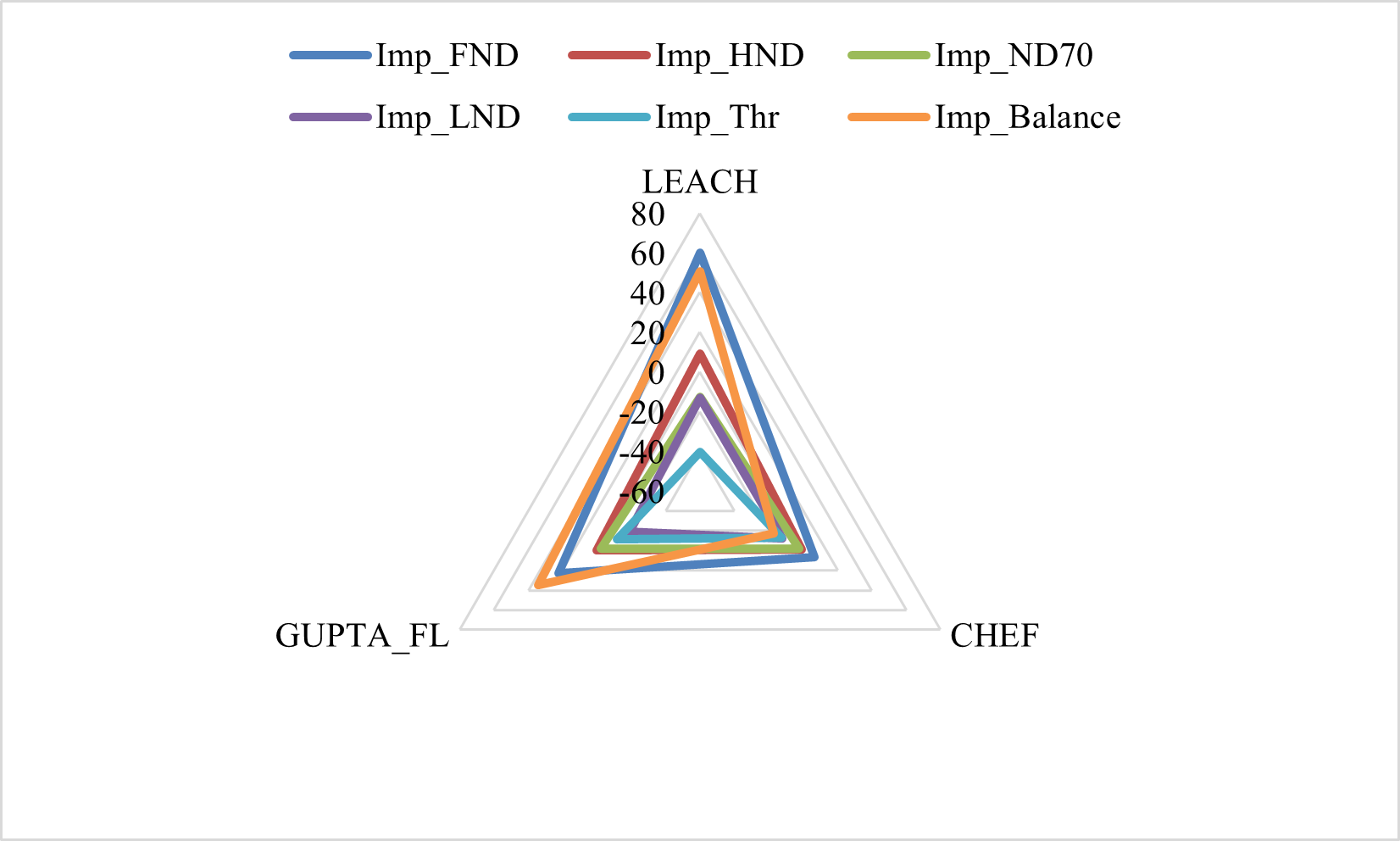
Figure 10. Percentage Improvement of the Proposed IT2F Protocol over LEACH, CHEF, and Gupta-FL in Scenario #3
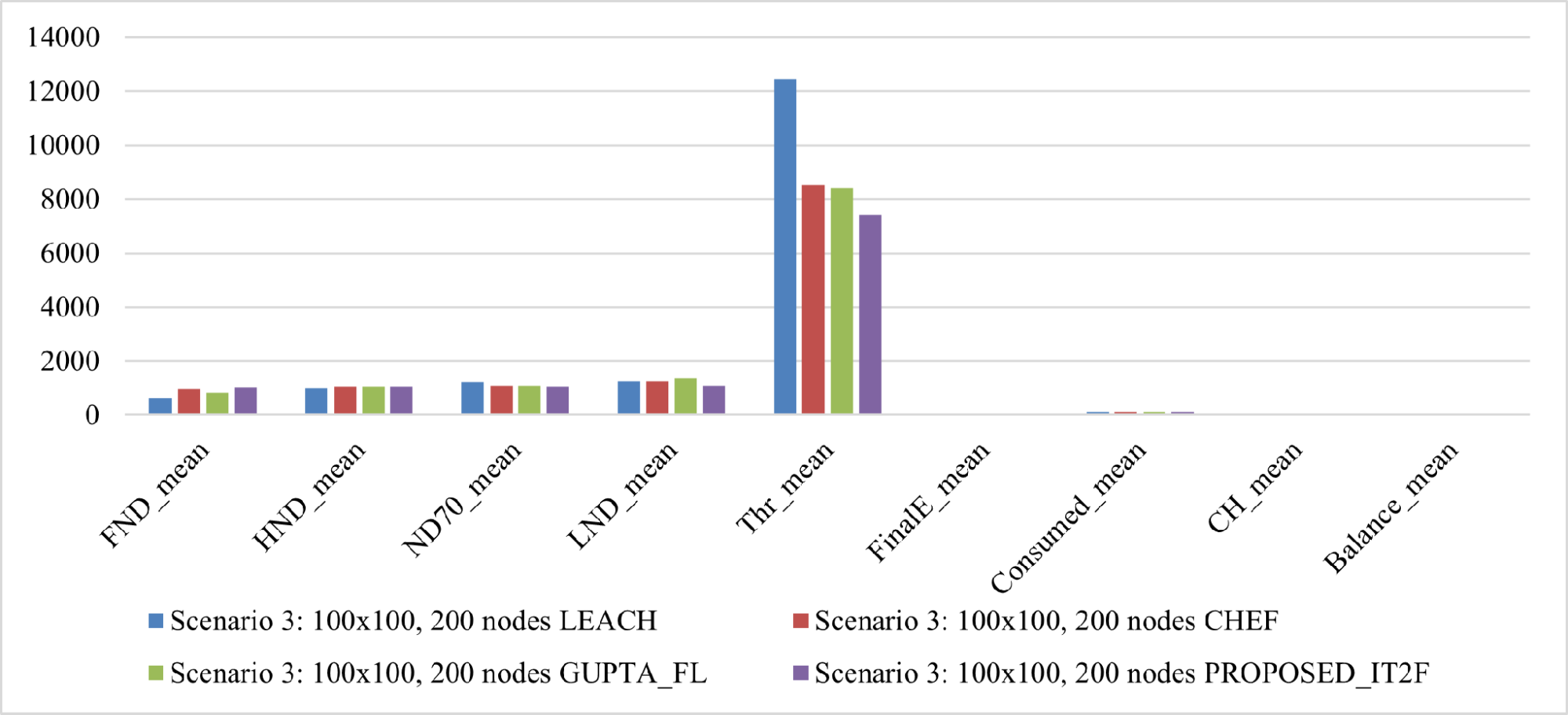
Figure 11. Comparative Performance Metrics of LEACH, CHEF, Gupta-FL, and the Proposed IT2F Protocol in Scenario#3
Runtime and Computational-Overhead Analysis
In addition to the network performance assessment, the computational needs of the suggested IT2F-UC-SMH-AR algorithm were evaluated against LEACH, CHEF, and Gupta-FL algorithms. All the protocols were simulated with the same version of MATLAB software on identical computing platforms with the same network settings, simulation conditions, and random seeds. Simulations were conducted on the computer with Intel(R) Core(TM) i7-1065G7 CPU @ 1.30GHz, 15.75 GB RAM and Microsoft Windows 11 Home Single Language, Version 10.0.26200, utilizing MATLAB R2023a, Version 9.14.0.2206163. In each network scenario, each algorithm was assessed with 25 Monte Carlo simulation runs containing 2,000 simulations per run. The same generated node topology and random initialization were used within each simulation run for all the protocols to maintain fairness in the computational needs assessment.
The following five metrics were used in order to measure the computational cost based on the earlier stated experimental settings: overall execution time of simulation, mean execution time per round, mean re-clustering time per event, maximal usage of workspace-memory, and runtime relative to LEACH. Total simulation execution time was defined as the period from the beginning of initialization of the network till the end of all rounds of simulations. Mean execution time per round was calculated as the ratio between total execution time and total rounds of simulations. As for re-clustering time, it was recorded in cases when cluster head elections and clusters reconstructions took place, and the presented result is the average of all re-clustering events. Maximal workspace memory usage was defined as the maximum memory which was used while executing the protocol. The relative runtime of protocol , based on LEACH as the reference protocol, can be expressed by:
| 
| (39) |
where  is referring to the average execution time of protocol , and the
  is referring to the corresponding average execution time of LEACH. The percentage computational overhead relative to LEACH was calculated as follows:
| 
| (40) |
The running time is presented as an average value with a standard deviation, based on 25 simulations via Monte Carlo method. As can be seen from Table 10, LEACH needs the minimum computation power since the election of cluster heads in this protocol is random, and it does not include multi-criteria scoring and relay assessment. The CHEF protocol and Gupta-FL require extra computational resources due to fuzzy logic application for the evaluation of cluster heads. The developed protocol IT2F-UC-SMH-AR requires extra computation since it includes evaluation of the interval-membership values, the calculation of uncertainty penalty, unequal clustering, load-conscious member association and selective relay selection. However, since the adaptive re-clustering technique is applied, there is no need to reconstruct the clusters during every iteration and the same cluster configurations can be used.
Table 10. Runtime and computational-overhead comparison of the evaluated protocols
Scenario | Protocol | Execution time per simulation, mean ± SD (s) | Execution time per round, mean ± SD (ms) | Re-clustering time per event, mean ± SD (ms) | Peak memory, mean ± SD (MB) | Relative runtime | Overhead relative to LEACH (%) |
Scenario #1: 100 × 100 m², 100 nodes | LEACH | 0.741368 ± 0.066151 | 0.370684 ± 0.033075 | 0.024962 ± 0.003749 | 0.252061 ± 0.000125 | 1.0000 | 0.00 |
CHEF | 0.886809 ± 0.018869 | 0.443405 ± 0.009434 | 0.018439 ± 0.002313 | 0.254081 ± 0.001535 | 1.1962 | 19.62 |
Gupta-FL | 0.830741 ± 0.025281 | 0.415370 ± 0.012640 | 0.016912 ± 0.001477 | 0.253925 ± 0.001998 | 1.1206 | 12.06 |
Proposed IT2F-UC-SMH-AR | 1.347918 ± 0.091288 | 0.673959 ± 0.045644 | 0.053013 ± 0.009071 | 0.279604 ± 0.000140 | 1.8181 | 81.81 |
Scenario #2: 200 × 200 m², 100 nodes | LEACH | 0.508815 ± 0.044934 | 0.254408 ± 0.022467 | 0.025748 ± 0.002360 | 0.249035 ± 0.000288 | 1.0000 | 0.00 |
CHEF | 0.640190 ± 0.038267 | 0.320095 ± 0.019133 | 0.018853 ± 0.002231 | 0.253399 ± 0.000424 | 1.2582 | 25.82 |
Gupta-FL | 0.578084 ± 0.047646 | 0.289042 ± 0.023823 | 0.018042 ± 0.001418 | 0.253513 ± 0.000464 | 1.1361 | 13.61 |
Proposed IT2F-UC-SMH-AR | 1.143688 ± 0.088468 | 0.571844 ± 0.044234 | 0.051660 ± 0.004665 | 0.282118 ± 0.000605 | 2.2477 | 124.77 |
Scenario #3: 100 × 100 m², 200 nodes | LEACH | 1.697011 ± 0.135346 | 0.848505 ± 0.067673 | 0.048817 ± 0.004382 | 0.264030 ± 0.000219 | 1.0000 | 0.00 |
CHEF | 1.936377 ± 0.098642 | 0.968189 ± 0.049321 | 0.026415 ± 0.002199 | 0.265085 ± 0.000321 | 1.1411 | 14.11 |
Gupta-FL | 1.729605 ± 0.073911 | 0.864803 ± 0.036955 | 0.021500 ± 0.001389 | 0.265838 ± 0.000428 | 1.0192 | 1.92 |
Proposed IT2F-UC-SMH-AR | 3.032303 ± 0.173233 | 1.516152 ± 0.086617 | 0.068200 ± 0.004964 | 0.293223 ± 0.000603 | 1.7868 | 78.68 |
CONCLUSION
This paper introduced a novel protocol called the IT2F-UC-SMH-AR protocol, which stands for an Interval Type-2 fuzzy inspired unequal clustering and selective multi-hop routing with adaptive re-clustering to enhance the energy efficiency and robustness of WSNs. The protocol combines an interval type-2 fuzzy-based cluster head selection criteria, unequal clustering, load-aware member allocation, selective multi-hop relay forwarding, and energy-aware re-clustering into one routing paradigm. In doing so, it manages to overcome some weaknesses of traditional clustering protocols by simultaneously considering factors such as residual energy, proximity to the base station, node centrality, local node density, distance, and traffic loads. The protocol in question was tested using three different deployment scenarios and was compared to LEACH, CHEF, and Gupta-FL. The obtained results show that IT2F-UC-SMH-AR proves especially efficient in terms of delaying early node death, controlling the number of cluster-heads, and achieving energy-aware stable network performance. The main feature of IT2F-UC-SMH-AR was its efficiency in the First Node Dies scenario, which means that it provided more stability at the very beginning of the test run and a lower chance of early degradation of the network. The controlled number of cluster-heads shows how efficient it is to use adaptive re-clustering in order not to reconstruct clusters and decrease the communication overhead involved. This aspect is especially important for energy-limited and Big Data WSNs where nodes need to remain alive and transmit their information to the base station. These results highlight a trade-off between stability-based energy conservation and throughput optimization as well. While the suggested protocol demonstrates better network stability at the initial stages, cluster formation, and balanced energy usage, it is not always better than LEACH when it comes to overall throughput and performance metrics towards the end of the lifetime of the network in compact or dense settings. Consequently, the proposed approach is especially appropriate in cases when reliable coverage, late failure of nodes, energy balancing, and constant data gathering are preferred to high-throughput packet delivery. Future research directions from the recognized drawbacks and findings of the current study will include:
- Deployment and validation of the suggested scheme through practical WSN devices and setups.
- Performance analysis of the scheme in scenarios involving dynamic mobility of nodes as well as mobile sinks.
- Evaluating the robustness of the proposed protocol under the dynamic traffic loads, packet losses, link-quality variations, interference, and unexpected sensor-node failures.
- Learning of fuzzy inspired weights, width of uncertainty, threshold for re-clustering, and relay parameters.
- Comparison with schemes based on deep reinforcement learning and graphs under dynamic and large-scale scenarios.
REFERENCES
- Z. Shafeeq Bakr, R. Hassan, S. Al-Tahir, N. Basil, A. Ma’arif, and H. Marhoon, “A comparative study of fuzzy logic controller, ANFIS, and HHOPSO algorithms in the LEACH protocol for optimising energy efficiency and network longevity in wireless sensor networks,” International Journal of Robotics and Control Systems, vol. 5, no. 3, pp. 1678–1700, 2025, https://doi.org/10.31763/ijrcs.v5i3.1918.
- Z. Wang and J. Duan, “An unequal clustering and multi-hop routing protocol based on fuzzy logic and Q-learning in WSNs,” Entropy, vol. 27, no. 2, p. 118, 2025, https://doi.org/10.3390/e27020118.
- D. K. and S. Santhosh Kumar, “Comprehensive survey on cluster-based energy-efficient routing protocols in wireless sensor networks,” Wireless Personal Communications, vol. 146, pp. 4115–4144, 2026, https://doi.org/10.1007/s11277-026-12133-x.
- A. Zaier, I. Lahmar, M. Yahia, and J. Lloret, “Interval type 2 fuzzy unequal clustering and sleep scheduling for IoT-based WSNs,” Ad Hoc Networks, vol. 175, p. 103867, 2025, https://doi.org/10.1016/j.adhoc.2025.103867.
- W. Luo, Y. Yu, L. Zeng, D. Lin and Y. L. Guan, "ECAEP: An Energy-Efficient Clustering Approach Based on Wireless Energy Provision Mechanism for the Wireless Sensor Network," in IEEE Transactions on Mobile Computing, vol. 25, no. 8, pp. 13291-13306, Aug. 2026, https://doi.org/10.1109/TMC.2026.3673482.
- I. Daanoune and A. Baghdad, “Intelligent energy-aware routing in IoT-based WSNs by reinforcement learning,” Ad Hoc Networks, vol. 176, p. 104244, 2026, https://doi.org/10.1016/j.adhoc.2026.104244.
- H. Hu, X. Fan, and C. Wang, “Energy efficient clustering and routing protocol based on quantum particle swarm optimization and fuzzy logic for wireless sensor networks,” Scientific Reports, vol. 14, p. 18595, 2024, https://doi.org/10.1038/s41598-024-69360-0.
- S. K. Pandey, A. Sinha, and B. Singh, “Fuzzy-based optimized cluster head selection with energy prediction for unequal clustering in wireless sensor networks,” International Journal of Distributed Sensor Networks, vol. 2026, p. 4635198, 2026, https://doi.org/10.1155/dsn/4635198.
- R. Kumar, A. Dwivedi, S. Kumari, S. Joshi, V. Rohilla, and N. Kashyap, “Improved sensor network lifetime using fuzzy scheduling and hybrid goshawk hunger games optimization,” IETE Journal of Research, pp. 1–12, 2026, https://doi.org/10.1080/03772063.2026.2672006.
- S. L. Ullo and G. R. Sinha, “Advances in smart environment monitoring systems using IoT and sensors,” Sensors, vol. 20, no. 11, p. 3113, 2020, https://doi.org/10.3390/s20113113.
- N. Basil, N. Cherif, M. B. Alhamadani, H. Hasan, and T. F. Agajie, “Comparative analysis of LSTM, HHOSOA, COAESPSO, and XGBoost models for time series load forecasting,” IJCEAI, vol. 1, no. 1, pp. 10–20, Jun. 2026, https://ijceai.org/index.php/ijceai/article/view/13.
- N. Merabtine, D. Djenouri, and D.-E. Zegour, “Towards energy efficient clustering in wireless sensor networks: A comprehensive review,” IEEE Access, vol. 9, pp. 92688–92705, 2021, https://doi.org/10.1109/ACCESS.2021.3092509.
- N. Ajmi, A. Helali, P. Lorenz, and R. Mghaieth, “Multi weight chicken swarm based genetic algorithm for energy efficient clustered wireless sensor network,” Sensors, vol. 21, no. 3, p. 791, 2021, https://doi.org/10.3390/s21030791.
- A. Rodríguez, C. Del-Valle-Soto, and R. Velázquez, “Energy-efficient clustering routing protocol for wireless sensor networks based on yellow saddle goatfish algorithm,” Mathematics, vol. 8, no. 9, p. 1515, 2020, https://doi.org/10.3390/math8091515.
- V. Cherappa, T. Thangarajan, S. S. M. Sundaram, F. Hajjej, A. K. Munusamy, and R. Shanmugam, “Energy-efficient clustering and routing using ASFO and a cross-layer-based expedient routing protocol for wireless sensor networks,” Sensors, vol. 23, no. 5, p. 2788, 2023, https://doi.org/10.3390/s23052788.
- M. R. Reddy, M. L. R. Chandra, P. Venkatramana, and R. Dilli, “Energy-efficient cluster head selection in wireless sensor networks using an improved grey wolf optimization algorithm,” Computers, vol. 12, no. 2, p. 35, 2023, https://doi.org/10.3390/computers12020035.
- Q. Feng et al., “Energy-efficient clustering mechanism of routing protocol for heterogeneous wireless sensor network based on bamboo forest growth optimizer,” Entropy, vol. 24, no. 7, p. 980, 2022, https://doi.org/10.3390/e24070980.
- G. Natesan, S. Konda, R. P. de Prado, and M. Woźniak, “A hybrid mayfly–Aquila optimization algorithm-based energy-efficient clustering routing protocol for wireless sensor networks,” Sensors, vol. 22, no. 17, p. 6405, 2022, https://doi.org/10.3390/s22176405.
- M. A. Khodeir, J. I. Ababneh, and B. S. Alamoush, “Manta ray foraging optimization-based energy-efficient cluster head selection algorithm for wireless sensor networks,” Journal of Electrical and Computer Engineering, vol. 2022, p. 5461443, 2022, https://doi.org/10.1155/2022/5461443.
- J. Amutha, S. Sharma, and S. K. Sharma, “An energy efficient cluster based hybrid optimization algorithm with static sink and mobile sink node for wireless sensor networks,” Expert Systems with Applications, vol. 203, p. 117334, 2022, https://doi.org/10.1016/j.eswa.2022.117334.
- Y. Liu et al., “QEGWO: Energy-efficient clustering approach for industrial wireless sensor networks using quantum-related bioinspired optimization,” IEEE Internet of Things Journal, vol. 9, no. 23, pp. 23691–23704, 2022, https://doi.org/10.1109/JIOT.2022.3189807.
- N. Malisetti and V. K. Pamula, “Energy efficient cluster based routing for wireless sensor networks using moth levy adopted artificial electric field algorithm and customized grey wolf optimization algorithm,” Microprocessors and Microsystems, vol. 93, p. 104593, 2022, https://doi.org/10.1016/j.micpro.2022.104593.
- H. Altaee Naman and Z. Jaffar Mohammed Ameen, “Optimised rotating energy-efficient clustering for wireless sensor devices by sewing training-based optimisation,” Acta Polytechnica, vol. 64, no. 4, pp. 314–321, 2024, https://doi.org/10.14311/AP.2024.64.0314.
- S. H. Gopalan, D. G. Takale, B. Jayaprakash, and V. Pandiya Raj, “An energy efficient routing protocol with fuzzy neural networks in wireless sensor network,” Ain Shams Engineering Journal, vol. 15, no. 10, p. 102979, 2024, https://doi.org/10.1016/j.asej.2024.102979.
- S. El Khediri, A. Selmi, R. U. Khan, T. Moulahi, and P. Lorenz, “Energy efficient cluster routing protocol for wireless sensor networks using hybrid metaheuristic approaches,” Ad Hoc Networks, vol. 158, p. 103473, 2024, https://doi.org/10.1016/j.adhoc.2024.103473.
- H. Wang, K. Liu, C. Wang, and H. Hu, “Energy-efficient, cluster-based routing protocol for wireless sensor networks using fuzzy logic and quantum annealing algorithm,” Sensors, vol. 24, no. 13, p. 4105, 2024, https://doi.org/10.3390/s24134105.
- K. Vijayakumar and P. Thirumaraiselvan, “A unified hybrid framework for energy-aware clustering and intelligent routing in Internet of Things-based wireless sensor microsystem networks,” Microsystem Technologies, vol. 32, p. 80, 2026, https://doi.org/10.1007/s00542-026-06074-5.
- D. B. Aeggegn and S. D. Hamdi, “Comparative performance analysis of Dijkstra, Bellman–Ford, and Floyd–Warshall routing algorithms in MANETs,” International Journal of Smart Control and Electrical Engineering Systems, vol. 1, no. 1, pp. 19–22, 2026, https://ijscees.org/index.php/pub/article/view/10.
- K. Mohaideen Pitchai, “Energy-efficient cluster-based routing in wireless sensor networks using fuzzy-reinforcement whale optimization,” International Journal of Communication Systems, vol. 39, no. 11, p. e70536, 2026, https://doi.org/10.1002/dac.70536.
- M. Abdel-Salam, W. A. Gab-Allah, E. M. Eldaydamony, et al., “An improved human memory algorithm with multi-directional and chaotic approaches for global optimization and energy-efficient cluster head selection in WSNs,” Sci. Rep., vol. 16, p. 22414, 2026, https://doi.org/10.1038/s41598-026-61131-3.
- E. Alsolami, “Energy-efficient cluster-based routing in wireless sensor networks using a hybrid grey wolf and whale optimization algorithm,” Sustainable Computing: Informatics and Systems, p. 101408, 2026, https://doi.org/10.1016/j.suscom.2026.101408.
- P. S. Mehra, “E-FUCA: enhancement in fuzzy unequal clustering and routing for sustainable wireless sensor network,” Complex & Intelligent Systems, vol. 8, no. 1, pp. 393–412, 2022, https://doi.org/10.1007/s40747-021-00392-z.
- C. Chen et al., “D2CRP: A novel distributed 2-hop cluster routing protocol for wireless sensor networks,” IEEE Internet of Things Journal, vol. 9, no. 20, pp. 19575–19588, 2022, https://doi.org/10.1109/JIOT.2022.3148106.
- M. U. Farooq et al., “POWER: Probabilistic weigh-based energy-efficient cluster routing for large-scale wireless sensor networks,” The Journal of Supercomputing, vol. 78, pp. 12765–12791, 2022, https://doi.org/10.1007/s11227-022-04372-z.
- P. Rawat, P. Kumar, and S. Chauhan, “Fuzzy logic and particle swarm optimization-based clustering protocol in wireless sensor network,” Soft Computing, vol. 27, no. 9, pp. 5177–5193, 2023, https://doi.org/10.1007/s00500-023-07833-6.
- V. Narayan, A. K. Daniel, and P. Chaturvedi, “E-FEERP: Enhanced fuzzy-based energy efficient routing protocol for wireless sensor network,” Wireless Personal Communications, vol. 131, pp. 371–398, 2023, https://doi.org/10.1007/s11277-023-10434-z.
- R. Kumar and D. Sinha, “Quantum-inspired genetic algorithm-based energy-efficient cluster head placement in cluster-based wireless sensor networks,” SN Computer Science, vol. 7, p. 612, 2026, https://doi.org/10.1007/s42979-026-05196-x.
- R. Manchanda et al., “Energy-efficient wireless sensor network for urban groundwater level monitoring using machine learning and sink mobility,” Scientific Reports, vol. 16, p. 9474, 2026, https://doi.org/10.1038/s41598-026-39435-1.
- S. C. K., B. Ramesh and J. Chandrika, “An energy-aware cluster-head selection for improving network lifetime in wireless sensor networks using machine learning techniques,” Engineering, Technology & Applied Science Research, vol. 16, no. 1, pp. 31887–31894, 2026, https://doi.org/10.48084/etasr.15963.
- Z. U. Khan, H. Gao, J. Ma, and M. Aman, “Quantum swarm-optimized DV-Hop algorithm for accurate localization of weak nodes in wireless sensor networks,” Scientific Reports, vol. 16, p. 9029, 2026, https://doi.org/10.1038/s41598-026-38364-3.
- F. A. Mohamed et al., “Optimizing energy efficiency in wireless sensor networks through advanced cluster-based routing protocols,” Sci. Rep., vol. 16, p. 20793, 2026, https://doi.org/10.1038/s41598-025-11382-3.
- M. I. Niranjana and N. Kumareshan, “Energy-efficient secure routing in wireless sensor networks using fuzzy inference clustering and attention-based multi-scale deep learning,” Scientific Reports, 2026, https://doi.org/10.1038/s41598-026-55944-5.
- G. T. Santhosh et al., “Quantum-swarm cognitive routing framework using neuro-fuzzy reinforced meta-optimization for ultra-reliable VANETs,” Iranian Journal of Science and Technology, Transactions of Electrical Engineering, 2026, https://doi.org/10.1007/s40998-026-01055-w.
- G. Liu, “QPSODRL: An improved quantum particle swarm optimization and deep reinforcement learning based intelligent clustering and routing protocol for wireless sensor networks,” Scientific Reports, vol. 16, p. 5526, 2026, https://doi.org/10.1038/s41598-026-35365-0.
- A. Chu, T. Zhang, and C. Wang, “LEACH protocol evolution in WSN: A review of energy consumption optimization and security reinforcement,” Sensors, vol. 26, no. 7, p. 2272, 2026, https://doi.org/10.3390/s26072272.
- M. Xu, Y. Zu, and J. Zhou, “Energy-efficient clustering routing for WSNs based on multiobjective quantum adaptive gray wolf optimization,” IEEE Sensors Journal, vol. 25, no. 8, pp. 14080–14098, Apr. 2025, https://doi.org/10.1109/JSEN.2025.3544543.
- Y. Qu et al., “Intelligent unequal clustering in wireless sensor networks using a game-theoretic and evolutionary strategy,” Scientific Reports, vol. 15, p. 32992, 2025, https://doi.org/10.1038/s41598-025-17758-9.
- S. Phoemphon, C. So-In, P. Aimtongkham, and T. G. Nguyen, “An energy-efficient fuzzy-based scheme for unequal multihop clustering in wireless sensor networks,” Journal of Ambient Intelligence and Humanized Computing, vol. 12, pp. 873–895, 2021, https://doi.org/10.1007/s12652-020-02090-z.
- S. R. V. P. Reddy, M. B. M., D. S. Rajesh, C. Sujatha, and V. Gosty, “Adaptive energy stability and link-aware routing protocol for energy-efficient wireless sensor networks,” in Proc. 4th Int. Conf. Integrated Circuits and Communication Systems (ICICACS), pp. 1–8, 2026, https://doi.org/10.1109/ICICACS68679.2026.11578494.
- R. Manchanda et al., “Energy-efficient clustering and routing for IoT-enabled healthcare using adaptive fuzzy logic and hybrid optimization,” Scientific Reports, vol. 15, p. 34619, 2025, https://doi.org/10.1038/s41598-025-18243-z.
- J. Alotaibi, “FuzOptRoute: A fuzzy logic-integrated optimization-based energy-efficient cluster routing framework with edge computing for mobile communication networks,” The Journal of Supercomputing, vol. 81, p. 1186, 2025, https://doi.org/10.1007/s11227-025-07673-1.
- M. Aissa, B. Bouhdid, A. Ben Mnaouer, B. Ouni, M. Abdelhafidh, M. Al-Bahri, and K. ALmayah, “FQL: A fuzzy Q-learning framework for reinforcement-driven clustering in flying Ad Hoc networks,” Cluster Computing, vol. 29, p. 512, 2026, https://doi.org/10.1007/s10586-026-06239-x.
Ammar Dawood Jasim (Big Data Acquisition in Wireless Sensor Networks Using an AI-Based Interval Type-2 Fuzzy Unequal Clustering and Selective Multi-Hop Routing Framework)