Buletin Ilmiah Sarjana Teknik Elektro ISSN: 2685-9572
Vol. 8, No. 5, October 2026, pp. 1374-1392
Fuzzy Logic-Based Distributed and Centralized MPPT Architectures for Photovoltaic Systems: A Comparative Study under Dynamic Irradiance and Partial Shading Conditions
Waleed Mahmood Abdullah Al-Darraji 1, Waladdin Mezher Shaher 2, Yousif Azzawi Hachim 3,
Abdulbari Talib Naser 4
1, 2, Department of Petroleum Systems Control Engineering, College of Petroleum Processes Engineering,
Tikrit University, Tikrit 34001, Iraq.
3 Department of Electrical Engineering, College of Engineering, Tikrit University, Tikrit 34001, Iraq.
4 Department of Medical Instrumentation Engineering, Al-Yarmouk University College, Diyala 32010, Iraq
ARTICLE INFORMATION |
| ABSTRACT |
Article History: Received 07 April 2026 Revised 18 July 2026 Accepted 21 September 2026 |
| 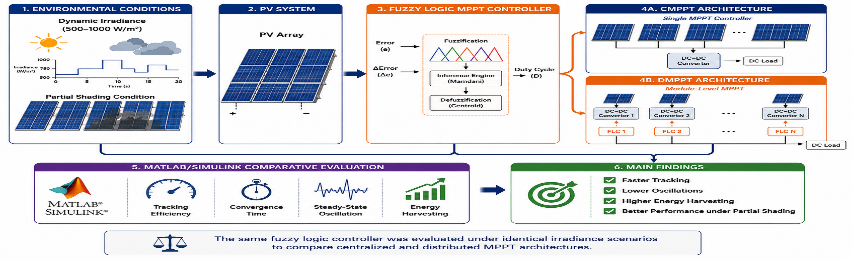
Maximum Power Point Tracking (MPPT) is very important to enhance the energy harvesting capability of photovoltaic (PV) systems under various environmental conditions. But, under dynamic irradiance and partial shading conditions, conventional MPPT architectures may be plagued by poor tracking performance and energy extraction. This study investigates the use of a fuzzy logic controller (FLC) for MPPT and evaluates its performance in both Centralized Maximum Power Point Tracking (CMPPT) and Distributed Maximum Power Point Tracking (DMPPT) architectures. The key outcome of the present study is the comparison of FLC based CMPPT and DMPPT configurations under dynamic irradiance. MATLAB/Simulink based models are established to evaluate the performance measurement with irradiance profiles of 500-1000 W/m2. The assessment included tracking efficiency, convergence behavior, steady state oscillations and recuperating energy capability under various operating scenarios. The simulation results demonstrate that the proposed FLC exhibits a faster response to changes and better tracking capability compared to the baseline MPPT methods considered in this study. The controller achieved tracking performance up to 97% and reduced stable-state oscillations by above 60%. The DMPPT configuration with fuzzy logic control harvested significantly greater amounts of energy than the respective CMPPT configuration under partial shading conditions. The results show that the use of fuzzy logic control with distributed MPPT architectures can improve the robustness and energy harvesting in irregular irradiance conditions, and therefore, this method can be applied to modern photovoltaic systems. |
Keywords: Photovoltaic Systems; Maximum Power Point Tracking (MPPT); Fuzzy Logic Control; Distributed MPPT; Centralized MPPT; Partial Shading |
Corresponding Author: Waladdin Mezher Shaher, Department of Petroleum Systems Control Engineering, College of Petroleum Processes Engineering, Tikrit University, Tikrit 34001, Iraq. Email: walamezher@tu.edu.iq |
This work is licensed under a Creative Commons Attribution-Share Alike 4.0 
|
Document Citation: W. M. A. Al-Darraji, W. M. Shaher, Y. A. Hachim, and A. T. Naser, “Fuzzy Logic-Based Distributed and Centralized MPPT Architectures for Photovoltaic Systems: A Comparative Study under Dynamic Irradiance and Partial Shading Conditions,” Buletin Ilmiah Sarjana Teknik Elektro, vol. 8, no. 5, pp. 1374-1392, 2026, DOI: 10.12928/biste.v8i5.16356. |
- INTRODUCTION
- Background and Motivation
Format In recent years, there has been a global shift to the use of renewable energy, culminating in the adoption of photovoltaic (PV) systems because of their ecological advantages, their building-block structure, and their low and decreasing prices [1]-[3]. PV systems bring multiple advantages and the promotion of eco-friendly energy, and, especially, they bring the opportunity of energy diversification. Nevertheless, PV systems have strong dependence and nonlinear sensitivity in relation to environmental factors (e.g., irradiance, temperature, and partial shading) [4]-[6]. Thus, operating constantly at the maximum power point (MPP) is increasingly difficult, and may limit the energy conversion efficiency of PV systems [7]-[9]. To adjust the MPP optimally, the maximum power point tracking (MPPT) methods are implemented to operate at the MPP. The classical methods such as Perturb and Observe (P&O) and Incremental Conductance (INC) still extremely popular because they simple and cost-effective in hardware implementation [10]-[12]. Thus, several P&O, and INC are proposed and reviewed in [13]-[15]. Lately, artificial intelligence (AI)- based MPPT methods are used to bridge the gap with classical techniques [16][17]. The AI-methods such as Fuzzy Logic Controller (FLC), and Artificial neural network (ANN) methods have been used due to they do not need a precise mathematical construct of the PV system, and they deal with uncertainty such as noisy data and approximate inputs efficiently. However, FLC imitates human logical thinking using a matrix of command language, thereby allowing more rapid and efficient tracking of the MPP value under constantly changing conditions [18][19]. The type of MPPT architecture used is a major factor in the effectiveness of photovoltaic systems, especially when operating conditions vary. Traditional centralized MPPT (Central MPPT) uses just one controller for the whole PV array or string, which is simple and cheap. However, such a controller can perform very poorly under partial shading because of mismatch losses and the existence of multiple power-voltage local maxima [20][21]. Hence, the system may just settle for a local optimum and lose a lot of energy. Distributed MPPT (DMPPT) systems, on one hand, provide each PV module or sub-module with its very own individualized MPPT controller, which allows each to operate at its own maximum power point, even in the presence of shading or mismatch. Recent studies have pointed out the increasing significance of standard submodule- and module-based DMPPT techniques for minimizing mismatch loss levels and enhancing energy harvesting under partial shading conditions [22].
This decentralized approach is highly effective in solving the multi-local maxima problem and also boosts the energy output, but leads to higher system complexity and cost. Therefore, although Central MPPT is still preferred due to its simplicity, DMPPT is a better choice in terms of performance and reliability, especially in real-world circumstances where a part shading cannot be ruled out. Such a compromise indicates the requirement for the development of innovative MPPT methods that combine the advantages of these two setups by providing accurate MPPT with simple hardware [23][24].
- Literature Review
The development of highly efficient MPPT methods for PV systems is particularly important for the management of non-uniform and time-variant PV irradiances. This section presents a review that is as concise as possible and does not repeat previous information while utilizing the same references as before. The operational simplicity and low computational needs of traditional MPPT methods, such as P&O and INC, explain their popularity [25][26]. However, these approaches are known to have poor performance dynamics during operational conditions rapid irradiance changes and partial shading characterize that, and ultimately, they result in excessive oscillatory behavior. It has been shown that system losses can be greater than 10–25% when dealing with operational conditions that contain multiple local maxima [27]. These methods have been adaptive, such as variable step-size P&O and improved INC to improve the PV performance, convergence speed and oscillatory behavior [28].
Furthermore, FLC has shown great promise as a good way to minimize the problems of the classical methods. FLC is flexible when prediction models are nonlinear and uncertain, which makes it possible to quickly and efficiently control duty cycles by making small changes based on language rules. Studies show that FLC can improve tracking efficiency to an amazing 95–98% and convergence times to 0.07 to 0.10 seconds. In addition, it has significantly reduced steady-state oscillations compared to traditional controllers [29]–[32]. The steady-state performance and convergence behavior of FLC have prompted the investigation of advanced hybrid intelligent techniques, including FLC-PSO, FLC-GA, and ANFIS-GA approaches for global maximum power point tracking under partial shading conditions [33].
Recently, neuro-fuzzy controllers have emerged as an effective intelligent solution for global maximum power point tracking in grid-connected photovoltaic systems operating under partial shading conditions. By integrating neural learning capability with fuzzy inference, these controllers provide faster convergence, improved tracking accuracy, and enhanced dynamic stability under rapidly changing irradiance conditions [34].
Type-2 fuzzy systems were proposed in [35] to improve the dynamic performance under partial shading. In [35], CMPPT uses one controller to manage the whole PV array is proposed to minimize the cost of the hardware circuit. On the other hand, several DMPPT methods are proposed in [36][37] to improve the system's overall efficiency by 10% to 35% when there is partial shading. In [38], a smart DMPPT technique was introduced to get more than 80% of the power from non-uniform irradiance. The authors in [39] presented a highly efficient-DMPPT to increase the conversion efficiency using FLC method. However, dynamic irradiance affects global MPP tracking algorithms [40]. Thus, the authors in [41] introduced a new FLC-MPPT to obtained tracking efficiency of 95-97% and achieved stability of the transient response under complex partial shading.
The authors in [42]-[44] presented adaptive FLC-MPPT methods. The PSO- fuzzy controllers are applied especially in decentralized structures to improve the performance under variability of irradiance and the fluctuating patterns of shading. Table 1 summary and comparative review of the most used MPPT methods.
Table 1. Comparative review of MPPT Algorithms and Architectures
Algorithm / Model | Study Type | Complexity | Efficiency (%) | Convergence Time (s) | Steady-State Oscillation (W) | Adaptability to Dynamic Irradiance | Scalability | Practical Challenges |
P&O [24][25] | Simulation / Lab | Low | 90-92 | 0.20-0.30 | ±12-15 | Low | High | Oscillations under fast irradiance changes. |
INC [26][27] | Simulation | Moderate | 91-93 | 0.25-0.35 | ±10 | Moderate | Moderate | Slower convergence; multi-peak confusion. |
Adaptive P&O [28] | Simulation | Moderate | 94-95 | 0.15-0.20 | ±7 | Moderate | High | Step-size tuning complexity |
FLC [29]-[33] | Simulation / Experimental | Moderate-High | 96-98 | 0.07-0.10 | ±4-5 | High | Moderate | Rule tuning requires expert knowledge |
Hybrid FLC-PSO [34]-[36] | Experimental | High | 98-99 | 0.05-0.08 | ±3 | Very High | Moderate | Computational cost |
FLC-CMPPT [35]-[38] | Simulation | Moderate | 93-95 | 0.10-0.15 | ±6 | Moderate | High | Sensitive to mismatch losses |
FLC-DMPPT [39]-[41] | Simulation / Field | High | 96-99 | 0.05-0.08 | ±2-3 | Very High | Very High | High hardware cost |
- Research Gap Contributions
Although numerous studies have investigated fuzzy logic-based MPPT techniques and several others have evaluated distributed MPPT architectures under partial shading conditions, comparatively fewer studies have been comprehensively synthesized and quantitatively compared of the same fuzzy logic control strategy across both centralized and distributed MPPT architectures under identical dynamic irradiance scenarios. Consequently, the relative impact of MPPT architecture on the dynamic behavior, tracking accuracy, convergence characteristics, and energy harvesting performance of fuzzy logic controllers remains insufficiently quantified [45].
Therefore, the objective of this study is to evaluate and compare the performance of fuzzy logic-based MPPT implemented in CMPPT and DMPPT photovoltaic architectures under dynamic irradiance and partial shading conditions using a unified MATLAB/Simulink framework. The research contributions are as follows:
- Development of a coherent simulation environment for the assessment of fuzzy logic-supported MPPT in CMPPT and DMPPT configurations.
- Quantitative comparison of tracking efficiency, convergence behavior, steady state fluctuations, and energy extraction capacity under same working circumstances.
- Analysis of the effect of MPPT design on system behavior under dynamic irradiance and partial shading conditions.
- Compare the relative advantages and limitations of centralized and distributed implementations of the identical smart control methodology.
The results offer useful design guidance for choosing appropriate MPPT architectures in solar systems that operate in uneven ambient conditions. A fully integrated MATLAB/Simulink platform was created in response to the highlighted research need in order to evaluate centered and distributed MPPT structures objectively while preserving the identical fuzzy logic controller, converter topology, and operating conditions.
- PROPOSED PV SYSTEM DESCRIPTION
In order to evaluate the effectiveness of the suggested FLC in terms of both CMPPT and DMPPT applications, this part explains the modeling of the utilized PV system components. The experiment used varied irradiance circumstances to simulate real-world shifts in the surroundings, like partial shadowing and fleeting cloud movement, using MATLAB/Simulink. Modeling the PV module, modeling the DC-DC converter, creating a fuzzy logic controller, putting the benchmark P&O into practice, and evaluating performance measurements are the five main elements of the suggested methodology [46].
- Solar PV Modeling
Modeling a PV module is essential for studying the behavior of Maximum Power Point Tracking (MPPT). Each Photovoltaic (PV) cell in the module is represented in the literature as a single-diode equivalent circuit which is made up of a photocurrent source  , a diode
  , series resistance
  , and shunt resistance
  . The output current
  of the module is given by:
| 
| (1) |
where is photocurrent ( ) proportional to irradiance,
  is diode saturation current (),
  is electron charge (1.602×10⁻¹⁹ C),
  : Boltzmann constant (1.381×10⁻²³ J/K),
  : cell temperature (
 ),
),  : diode ideality factor,
  : series and shunt resistances (
 ).
).
The photocurrent varies linearly with irradiance  and temperature as follows:
| 
| (2) |
where is the short-circuit current at standard test conditions (STC),
  is the temperature coefficient, and
  . This model provides the foundation for simulating dynamic P-V and I-V characteristics under varying irradiance.
The photovoltaic system was modeled using the conventional single-diode equivalent circuit under Standard Test Conditions (STC), corresponding to a reference irradiance of 1000 W/m² and a cell temperature of 25 °C. To improve the reproducibility of the proposed methodology, the electrical characteristics were based on a commercially available 250 W crystalline silicon photovoltaic module. The model incorporates the photocurrent, diode saturation current, diode ideality factor, series resistance, shunt resistance, and temperature coefficient according to the manufacturer's electrical specifications. The output current and voltage were calculated using the single-diode model while accounting for both irradiance and temperature variations throughout all simulation scenarios.. The main PV model parameters used in the simulation are summarized in Table 2. The electrical parameters presented in Table 2 remained unchanged throughout all comparative simulations. Only the irradiance profile and operating temperature were varied to evaluate the tracking performance of the centralized and distributed MPPT architectures under identical environmental conditions. This modeling approach ensures a consistent basis for comparing controller performance while maintaining identical photovoltaic characteristics in all simulation cases.
Table 2. PV Model Parameters Used in the Simulation
Parameter | Symbol | Value |
Reference PV module | - | Monocrystalline Silicon |
Reference irradiance | Gref | 1000 W/m² |
Reference temperature | Tref | 25 °C |
Rated power | Pmax | 250 W |
Open-circuit voltage | Voc | 44.9 V |
Short-circuit current | Isc | 7.21 A |
Voltage at maximum power | Vmpp | 36.8 V |
Current at maximum power | Impp | 6.85 A |
Number of series cells | Ns | 48 |
Series resistance | Rs | 0.39 Ω |
Shunt resistance | Rsh | 380 Ω |
Diode ideality factor | n | 1.3 |
Temperature coefficient | αIsc | 0.0045 A/°C |
Reverse saturation current | Io | 2.1×10⁻¹⁰ A |
- DC-DC Buck-Boost Converter
A DC-DC buck-boost converter was used to control the output voltage of the photovoltaic module and perform maximum power point tracking. Its input-output relationship is described by:
| 
| (3) |
| 
| (4) |
where is the duty cycle (0 < D < 1). The average inductor current  and capacitor voltage
  are governed by:
| 
| (5) |
| 
| (6) |
The converter operates in continuous conduction mode (CCM) to ensure stable regulation. The converter duty cycle  is dynamically adjusted by the controller (FLC or P&O) to maintain operation at the MPP. The inductance value was selected to satisfy the continuous conduction mode (CCM) condition throughout the investigated operating range. The resulting inductor current ripple remained below 20% of the average inductor current, ensuring continuous current conduction under all simulated operating conditions.
- Converter Design Parameters
The proposed KY-SR Buck–Boost converter operates in continuous conduction mode (CCM). The converter parameters were selected based on the design equations presented in Section 3. These parameters were used in all MATLAB/Simulink simulations and are summarized in Table 3. The switching frequency was fixed at 200 kHz for all simulations. The converter operated with a duty-cycle range of 0.375–0.60, where D<0.4 represents buck mode and D>0.4 represents boost mode. Ideal MOSFET and diode models were used in the simulation. The sampling time was set to 5  s to synchronize the controller with the PWM switching frequency.
Table 3. Simulation Parameters of the Proposed KY-SR Buck–Boost Converter.
Parameter | Symbol | Value |
Input voltage | Vin | 10–16 V |
Output voltage | Vout | 12 V |
Switching frequency | fs | 200 kHz |
Sampling time | Ts | 5 µs |
Inductor 1 | L1 | 12.4 µH |
Inductor 2 | L2 | 12.4 µH |
Capacitor 1 | C1 | 140 µF |
Capacitor 2 | C2 | 140 µF |
Output capacitor | Co | 140 µF |
Rated load current | Iload | 3 A |
Load resistance | RL | 4 Ω |
Duty-cycle range | D | 0.375–0.60 |
Switching devices | — | Ideal MOSFET / Diode |
- Fuzzy Logic Controller Design
The proposed FLC regulates the duty cycle of the buck-boost converter to maximize power extraction. It utilizes two input variables and one output variable:
- Input 1:
 - change in power relative to voltage.
 - Input 2:
 - rate of change of
  .
. - Output:
 - adjustment to the converter duty cycle.
- Inference System and Membership Functions
To improve controller smoothness and numerical stability, the input variables (error, E, and change in error, ) as well as the output variable (duty-cycle variation, ) were normalized before the fuzzification process. Five symmetrical triangular membership functions were adopted for each variable over the normalized universe of discourse, corresponding to the linguistic terms Very Low (VL), Low (L), Zero (Z), High (H), and Very High (VH). In order to enable smooth movements between adjacent fuzzy regions, minimize chattering at the operational point, and enhance tracking stability under conditions of rapidly changing irradiance, adjacent membership functions were developed with roughly 50% overlap. The chosen membership function structure provides a workable balance between strong maximum power point tracking performance, quick convergence, and computational simplicity.
- Rule-Based Design
The fuzzy rule basis was created empirically to mimic a competent MPPT controller's decision-making process in various photovoltaic operation scenarios. The signs and magnitudes of the error () and the change in error (), which show the working point's direction and the corresponding distance from the (MPP), were used to create the control guidelines. While minor rectifications are applied close to the MPP to reduce steady-state fluctuations while preserving the precision of tracking and system robustness, larger duty-cycle adjustments are produced when the operating point is further from the MPP to speed integration. This design approach offers a workable compromise between computationally straightforwardness robustness against irradiance fluctuations, and quick dynamic response. The complete fuzzy rule base is presented in Table 4.
Table 4 shows the fuzzy rule base used to adjust the duty cycle according to the error () and the change in error (). When the operating point is far from the maximum power point (MPP), a larger duty-cycle correction is applied to improve the tracking speed. As the operating point approaches the MPP, smaller duty-cycle corrections are used to reduce oscillations and maintain stable operation. This rule base enables the controller to achieve fast and stable maximum power point tracking under different irradiance conditions.
Table 4. Fuzzy Rule Matrix for altering the duty cycle
dE/E | VL | L | Z | H | VH | Range |
VL | D↑ | D↑ | D↑ | DZ | D↓ | -1 to -0.5 |
L | D↑ | D↑ | DZ | D↓ | D↓ | -0.75 to -0.25 |
Z | D↑ | DZ | DZ | DZ | D↓ | -0.5 to 0.5 |
H | D↑ | DZ | D↓ | D↓ | D↓ | 0.25 to 0.75 |
VH | DZ | D↓ | D↓ | D↓ | D↓↓ | 0.5 to 1 |
- Fuzzification and Defuzzification
The process consists of Fuzzification, whereby crisp input data, , and are made into fuzzy sets. Next, there is the Inference stage where fuzzy logic rules are applied to determine the output response. Lastly, there is Defuzzification where there is fuzzy output and a crisp control signal is made using the centroid method.
| 
| (7) |
where  is the membership degree and
  is the output singleton.
The centroid defuzzification technique was employed because it provides smooth control signals and stable duty-cycle variations suitable for photovoltaic MPPT applications. The resulting is applied to update the converter duty ratio as:
| 
| (8) |
The duty-cycle correction () is obtained using the centroid defuzzification method, which converts the aggregated fuzzy output into a single crisp value representing the control action. This crisp value is subsequently used to update the converter duty cycle according to (8) before being applied to the PWM generator for regulating the buck-boost converter.
The FLC can quickly adapt to changes in irradiance and drive the PV system to its MPP. The FLC block diagram under MATLAB/Simulink is shown in Figure 1. The proposed FLC was tested under different irradiance conditions, including uniform irradiance, dynamic irradiance variation, and partial shading. The same PV system and converter model were used for all simulation cases. The controller maintained stable MPPT operation with fast tracking and low steady-state oscillations under different operating conditions [47]-[50].
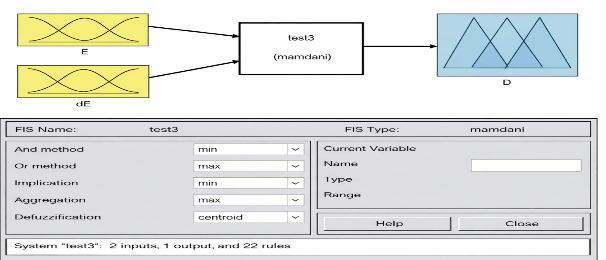
Figure 1. FLC design in MATLAB/Simulink
The diagram describes the architecture of FLC with the inputs being (change in power with respect to voltage) and dE (rate of change in power). As the Fuzzy Logic System (FLS) uses the predefined fuzzy logical rules to compute the output (which adjusts the duty cycle of the converter), the FLC Flow Control block diagram illustrates an entire system of observing the inputs and manipulating the duty cycle to showcase the functionalities of the FLC system. The approach consists of the following steps:
- Fuzzification: The process of converting clear numeric input values into fuzzy sets.
- Rule Table: The fuzzy rule base that tasks itself with applying the logic of a decider.
- Defuzzification: The process of converting fuzzy logic outputs into a clear duty cycle signal.
The structure of this system allows for FLC-based MPPT techniques to be extremely resilient considering varying external conditions, where it can readily forgo precise mathematical modeling and instead qualitatively utilize logic to mimic human reasoning. The structure of the FLC is shown in Figure 2.
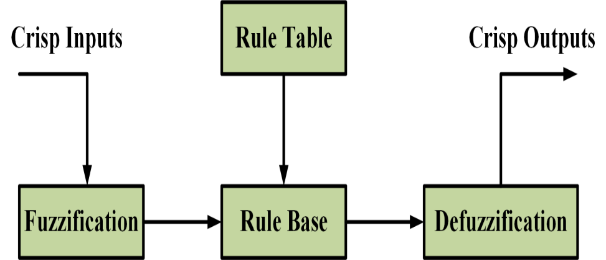
Figure 2. FLC schematic diagram
- P&O Based MPPT Method
The P&O is widely popular for its usability and serves as a baseline for comparison. However, it periodically perturbs the operating voltage  . It measures the resulting power
  . The control logic is summarized as:
| 
| (9) |
If  and
and  , increase
  , If
, If  and , decrease .
Result, the MPP will have steady-state oscillations around it. This algorithm acts as a benchmark to evaluate the tracking efficiency, convergence time, and oscillatory behavior of the proposed FLC-based system, as illustrated in Figure 3.
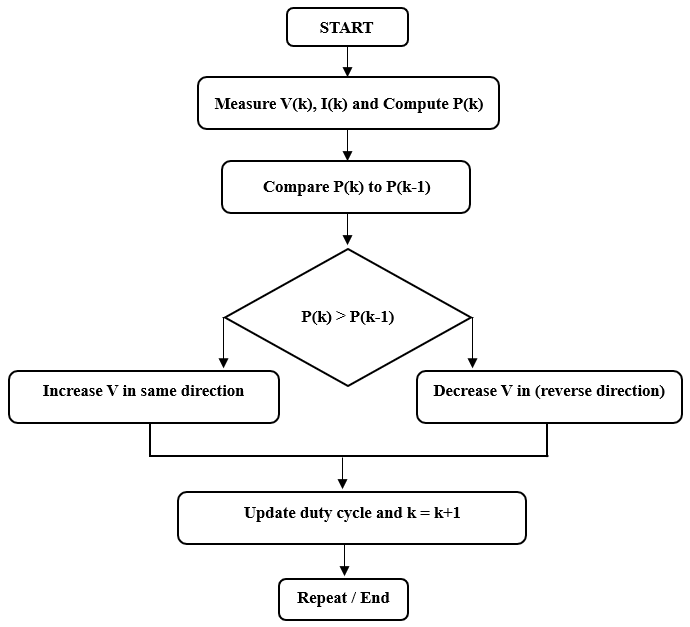
Figure 3. Typical P&O Flowchart
The following flowchart (Figure 4) illustrates how the Pattern Recognition Algorithm (P&Q) works
- Step 1: The algorithm begins by measuring the voltage V(k), and the current I(k), and calculating the instantaneous power P(k).
- Step 2: The current power P(k) is used in the power comparison with the previous power, P(k-1).
- Step 3: If P(k) is greater than P(k-1), the algorithm finds the voltage and continues increasing in the same direction, and if not, the voltage is decreased by reversing the direction.
- Step 4: The duty cycle is changed after updating and the algorithm repeats.
This flowchart exemplifies the simplicity of the P & O method, concentrating on the process of adjusting the voltage and measuring power output instantaneously in real-time.
The overall methodology consisted of PV system modeling, converter design, FLC implementation, benchmark P&O implementation, simulation under identical irradiance scenarios, and comparative evaluation using tracking efficiency, convergence time, steady-state oscillation, and harvested power.
Dynamic irradiance profiles were generated in MATLAB/Simulink using predefined step changes representing realistic cloud transients and partial shading conditions. All simulation scenarios were deterministic and identical for both CMPPT and DMPPT architectures to ensure a fair comparison.
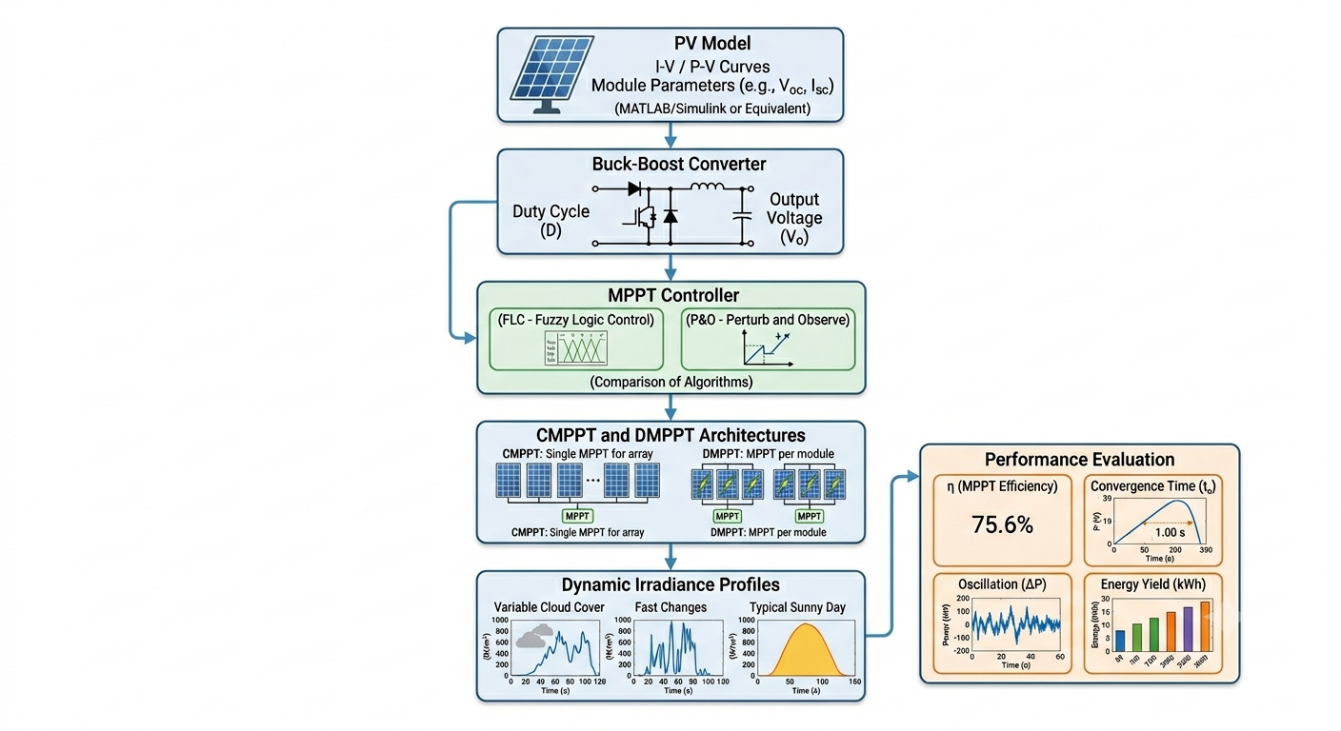
Figure 4. General outline of the methodology
- RESULT AND DISCUSSION
In this work, the different possible setups for the simulation were configurable for both centralized and distributed layouts to clear the novelty and test the suggested MPPT methods using the following:
- Centralized MPPT (CMPPT): Single controller for the whole PV array.
- Distributed MPPT (DMPPT): Autonomous controller for each PV module.
To simulate cloud cover and dynamic shading of the environment, the irradiance levels rapidly changed every 0.2s (1000 → 700 → 400 W/m²). Convergence time was defined as the time required for the PV output power to reach and remain within ±2% of the steady-state maximum power following an irradiance change. Some of the most important metrics for each of the setups included convergence time, and steady-state oscillation and the tracking efficiency ( ) as in Eq. (10).
| 
| (10) |
where  is the theoretical maximum power,
  is the tracked power by a MPPT method. Steady-state oscillation was evaluated using the peak-to-peak variation around the MPP.
Methodology consolidates PV and converter models, along with intelligent control, to FLC-based MPPT and P&O comparisons in centralized and distributed PV systems. With this configuration, the comparative performance of MPPT algorithms under distributed PV systems may be reliably and consistently evaluated. As shown in Figure 5, the performance evaluation in this section is based on simulation experiments that compare FLC and P&O algorithms in CMPPT and DMPPT settings. In order to replicate real-world settings, the simulations were run under dynamically changing and partially shadowed irradiance conditions of 1000 W/m², 700 W/m², and 400 W/m². The key performance metrics analyzed include tracking efficiency, convergence time, and steady-state oscillations.
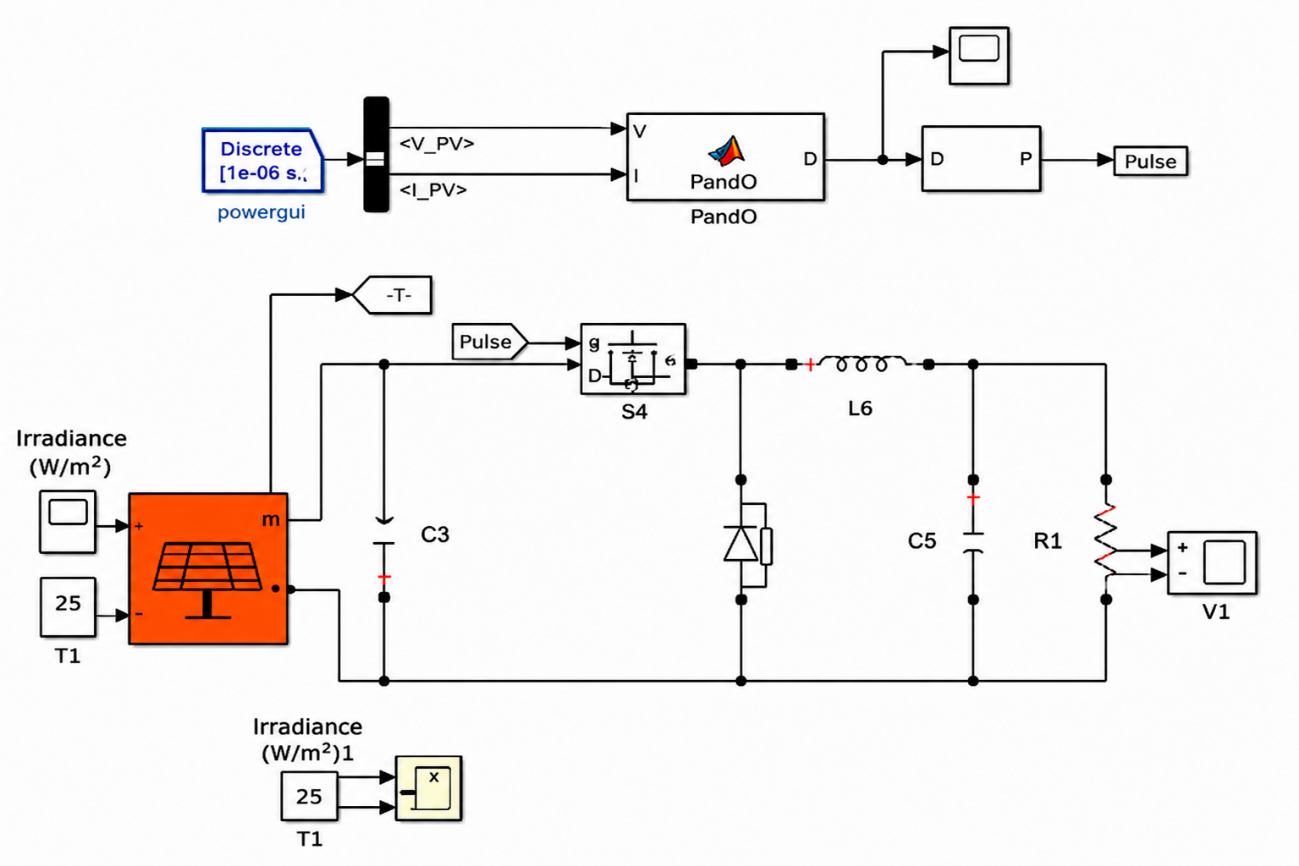
Figure 5. Simulation model in MATLAB/Simulink
- Evaluation System Using P&O-MPPT Method
At standard solar irradiance (1000 W/ ), the P&O algorithm displayed an average tracking efficiency of 91.2%, however, it did exhibit some minor oscillations around the steady-state point of 12 W. While the oscillations did converge, by the time irradiance reached the 700 and 400 W/m² thresholds, the oscillations reached approximately 15 W and increased the convergence time from 0.22 to 0.31s. The increase in convergence time demonstrates an overall lack of adaptability to rapidly changing environmental conditions. The results do show the limited dynamic response of the P&O method, as evident by the results in Table 5 and the response curve in Figure 6, which show the P&O method performance at three different levels of irradiance. Under the rapidly changing irradiance levels, the results of the P&O algorithm show the trade-off between ease of implementation and responsiveness, highlighting the issues algorithmic controllers face.
Table 5. Performance of P&O at different levels of irradiance
Irradiance (W/m²) | Power Range (W) | Avg. Power (W) | Oscillation (±W) | Convergence Time (s) | Tracking Efficiency (%) |
1000 | 217-224 | 220.5 | ±12 | 0.22 | 91.2 |
700 | 164-171 | 167.3 | ±14 | 0.27 | 89.6 |
400 | 86-99 | 92.0 | ±15 | 0.31 | 87.8 |
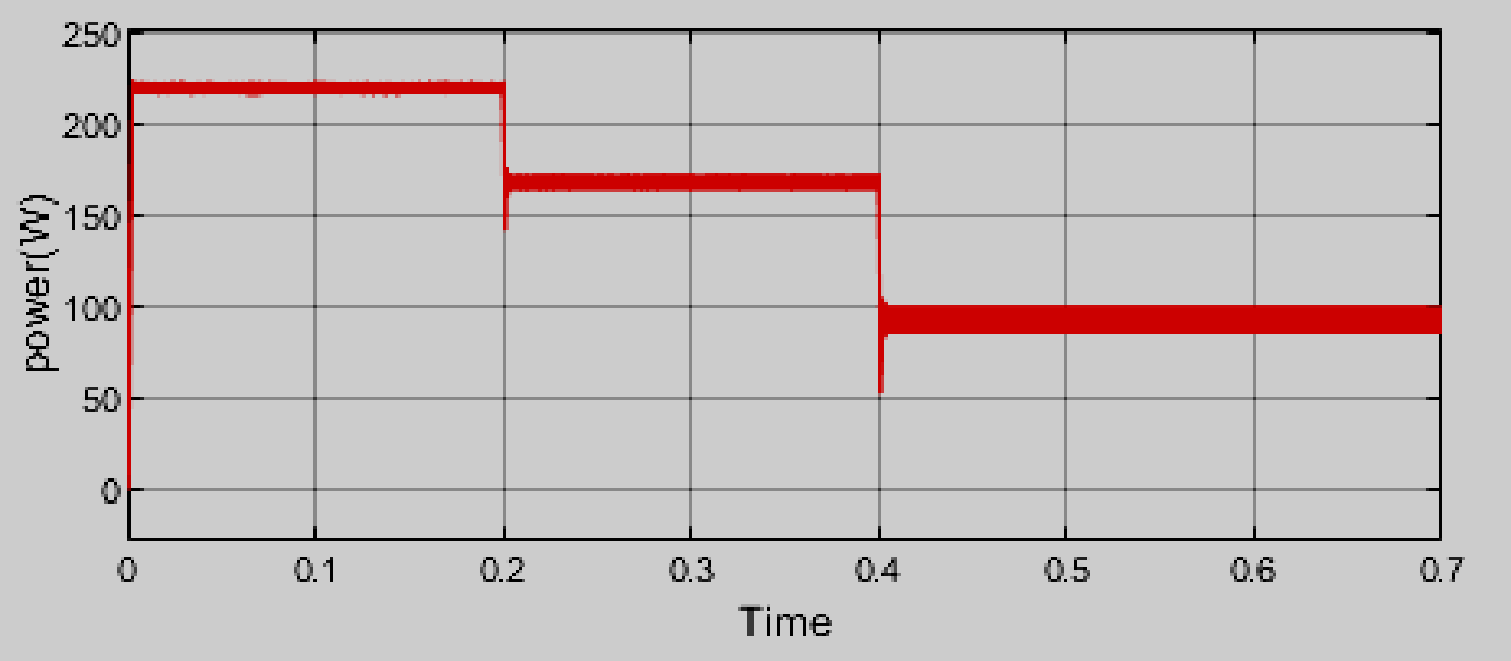
Figure 6. Dynamic response of the P&O
- Evaluation system using classical FLC-MPPT Method
Data shows that the results of the FLC outperformed every other thing in all irradiance profiles. At 1000 W/, the FLC had almost the same power output as P&O (≈223 W), but had 60% less steady-state oscillations (±5 W) and significantly less steady-state oscillations. At lower irradiances (700 W/m² and 400 W/), FLC showed significantly faster dynamic response; while tracking efficiencies improved to 96-97% and the convergence times dropped to less than 0.09s. These advancements are detailed in Table 6 and represented consequently in Figure 7. Compared to P&O, the FLC reduced convergence time by ~70% and improved efficiency by 5-8%, confirming its robustness to non-linear PV behavior under dynamic irradiance.
Table 6. Power generated by the panel using the FLC algorithm
Irradiance (W/m²) | Power Range (W) | Avg. Power (W) | Oscillation (±W) | Convergence Time (s) | Tracking Efficiency (%) |
1000 | 218-224 | 221.5 | ±5 | 0.08 | 97.4 |
700 | 165-171 | 168.0 | ±6 | 0.09 | 96.2 |
400 | 87-99 | 94.3 | ±7 | 0.09 | 95.1 |
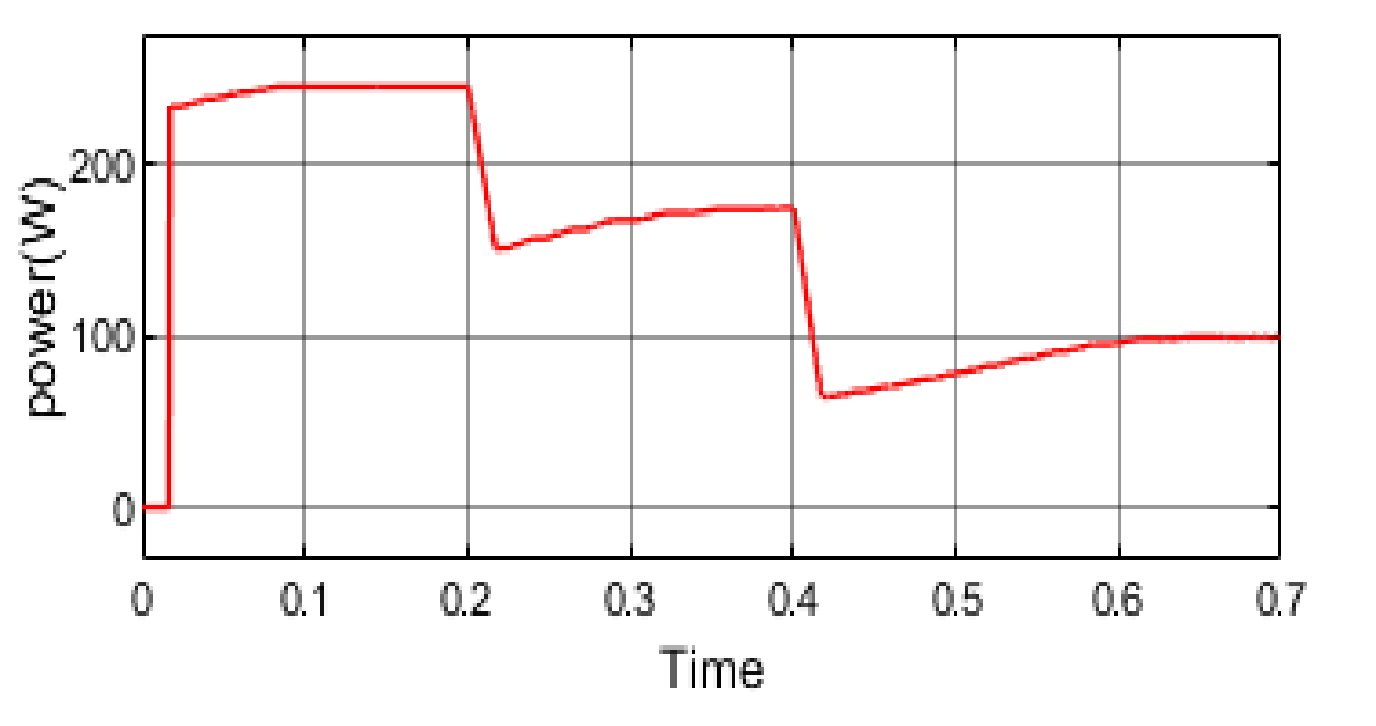
Figure 7. Dynamic response of the FLC
- Distributed (DMPPT) with Series Connection
In this section, FLC controller provided for each PV module in the distributed architecture. Due to the partial shading conditions (irradiance levels: 500, 600, 800, and 1000 W/m²), the optimized functioning of the modules operates independently, thus allowing all the modules to operate around the MPP. The distributed FLC-based architecture generated 707 W, whereas the centralized configuration produced 248 W under the same series-connected partial shading scenario. This corresponds to approximately 185% higher power output, highlighting the substantial impact of mismatch losses in centralized series-connected PV systems.. The time for the distributed FLC system to converge was 0.05 s, and the steady state oscillations were around ±3 W for each module. This was better than the centralized system under the same conditions, as shown in Table 7 and Figure 8.
Table 7. Obtained results of FLC -MPPT algorithm
Configuration | Irradiance Pattern (W/m²) | Total Power (W) | Avg. Efficiency (%) | Oscillation (±W) | Convergence Time (s) |
DMPPT-FLC (Series) | 500-600-800-1000 | 707.0 | 96.4 | ±3 | 0.05 |
CMPPT-FLC (Series) | Same as above | 248.0 | 82.1 | ±6 | 0.10 |
The large difference between CMPPT and DMPPT in the series-connected configuration is primarily attributed to mismatch losses rather than the fuzzy logic algorithm itself. In the centralized architecture, all modules operate at a common current level that is constrained by the most heavily shaded module, which significantly reduces the total extractable power. In contrast, the distributed architecture allows each module to independently track its own maximum power point, thereby mitigating mismatch losses and improving overall energy harvesting.
In the CMPPT method, the PV array is operating under partial shading (500 -600 -800-1000 W/m²) and the total power output is 248 W. This indicates a power drop of 64.9% compared to the distribution configuration. The centralized system remained stable; however, centralized systems suffer from intrinsic mismatch losses where all the panels operate at the same common current depending on the less illuminated module. Figure 9 shows the results.
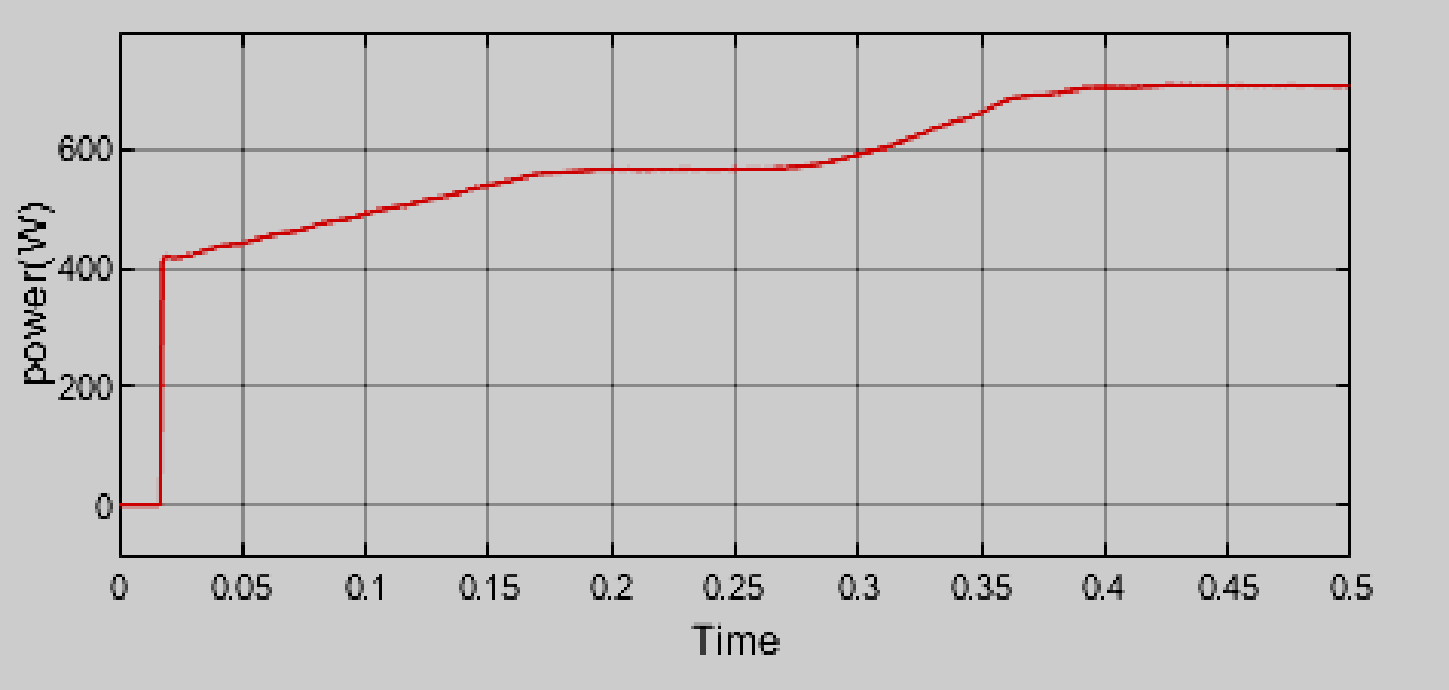
Figure 8. Power curve of the FLC-based DMPPT architecture
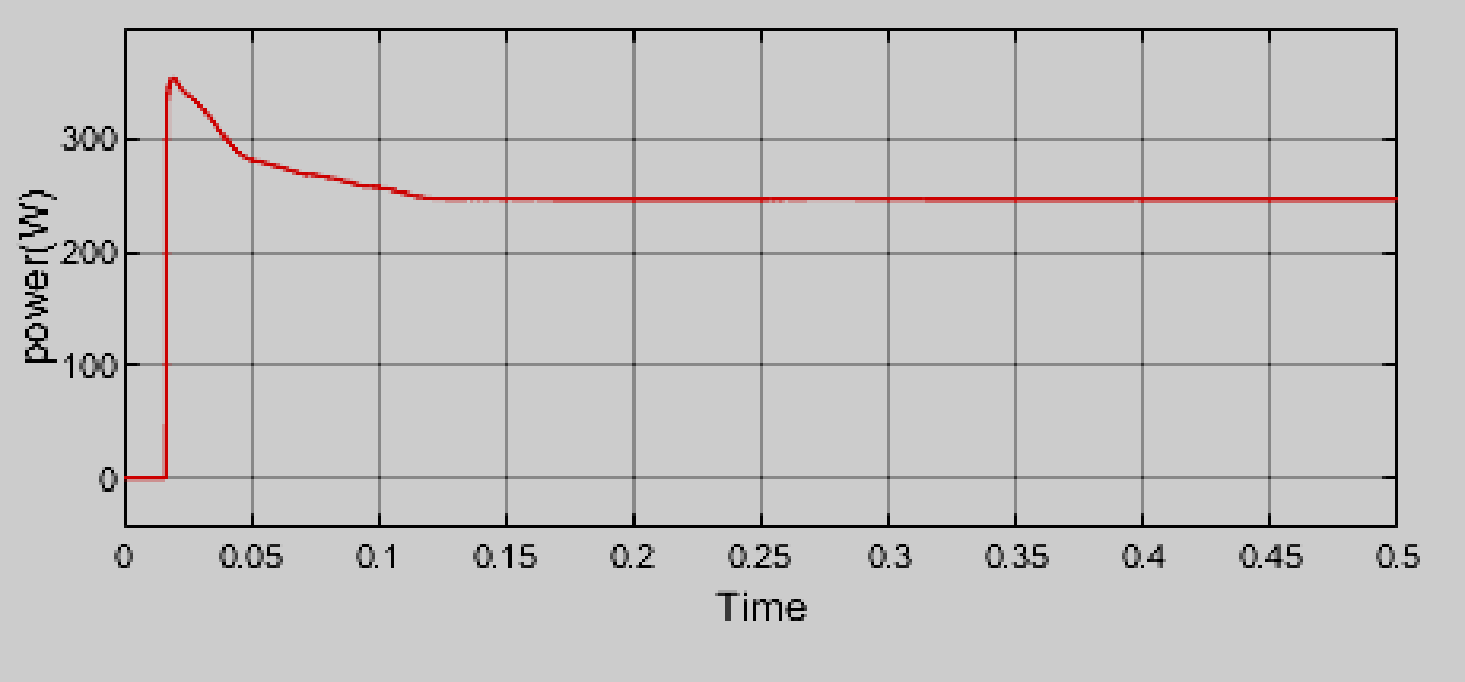
Figure 9. Power curve of the FLC-based CMPPT configuration
- Evaluation System Using DMPPT Parallel Structure
In Each PV branch had its own fuzzy MPPT controller in the parallel configuration. As a result, shading effects are reduced and the modules are independent at the voltage level. A total of 285.5 W of power was harvested, 3% more than the centralized case. The difference was smaller than in the series configurations because parallel topologies mitigate mismatch effects. Corresponding values can be seen in Figure 10. Although DMPPT achieves superior energy harvesting performance, it requires additional power converters, sensing circuits, and control hardware compared with centralized architectures, which may increase implementation complexity and system cost.
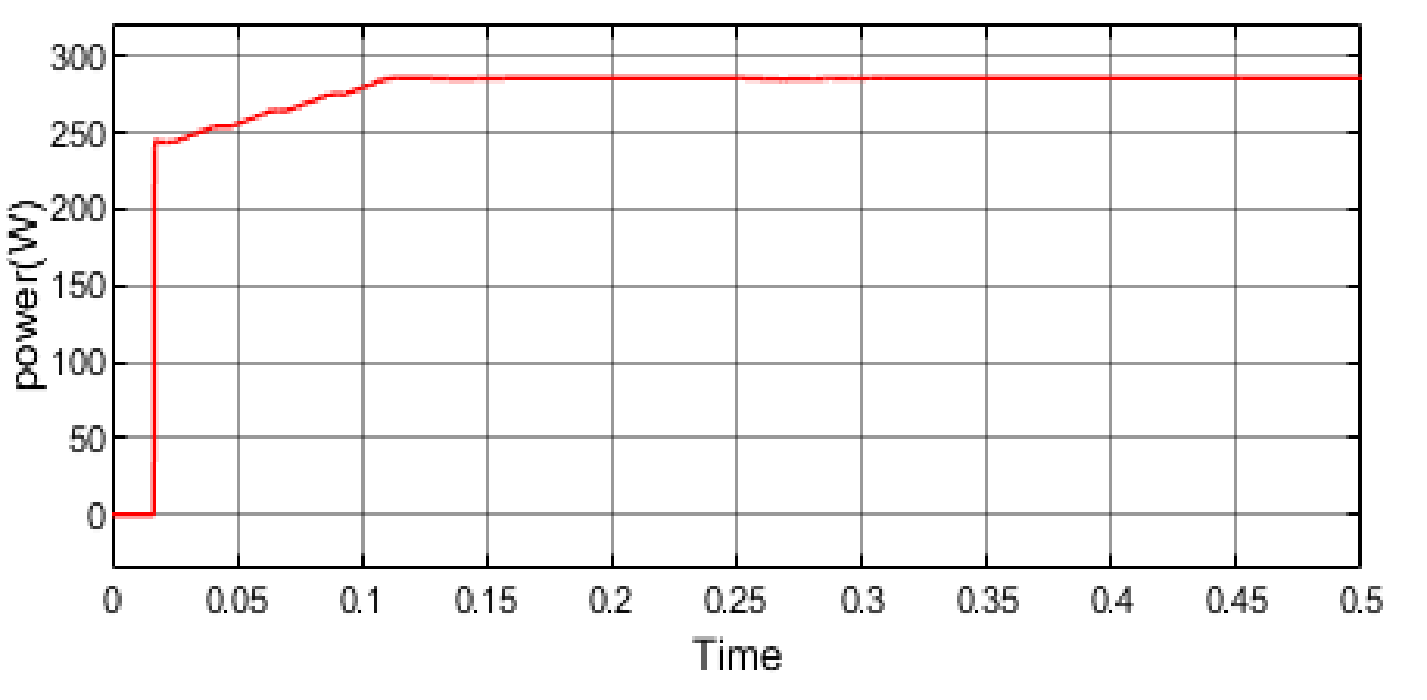
Figure 10. Power curve of FLC- DMPPT
- Centralized (CMPPT) with Parallel Connection
Fuzzy MPPTs centralized in a parallel configuration produced an average of 277 W and oscillations of ±6 W and converged in 0.12 s. It was stable. However, because it could not fine-tune an operating point for each module, the overall efficiency could be improved. The detailed outputs are reported in Figure 11.
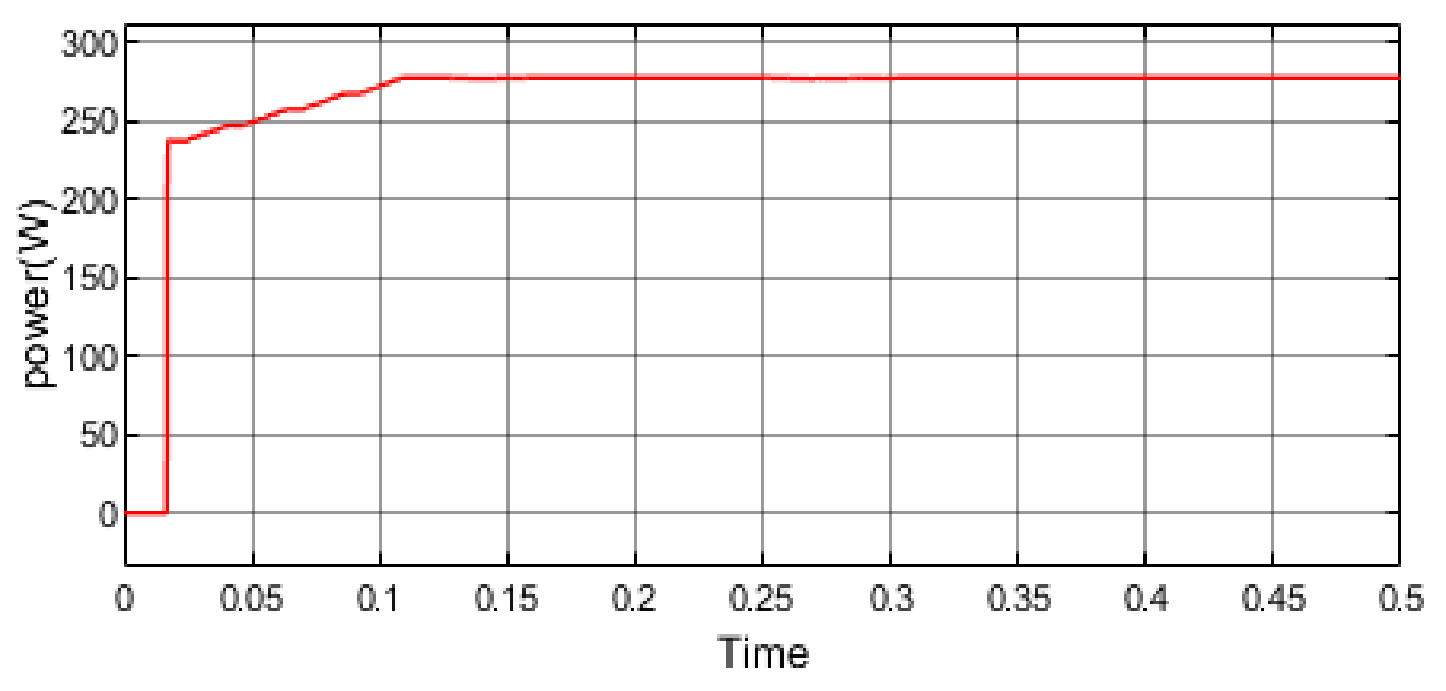
Figure 11. Power curve of FLC- CMPPT (parallel configuration)
- Discussion
Table 8 analyzes each case in terms of mean tracking efficiency, convergence speed, and steady-state oscillations to give a comprehensive picture of system behavior. The ratio of the extracted output power to the available PV power under the same operating conditions was used to calculate the tracking efficiency. The time needed to reach the maximum power point (MPP) after variations in irradiance was used to gauge the convergence speed, and the power fluctuations surrounding the MPP after the transient reaction had subsided were used to gauge the steady-state oscillation. To achieve an equitable assessment, these evaluation criteria were applied uniformly to all MPPT approaches under investigation.
Table 8. All scenarios in terms of average tracking efficiency
MPPT Strategy | Architecture | Avg. Efficiency (%) | Convergence Time (s) | Steady-State Oscillation (±W) | Relative Improvement vs. CMPPT |
P&O | Centralized | 91.2 | 0.27 | ±12 | - |
FLC | Centralized | 96.5 | 0.09 | ±5 | +5.8% |
FLC | DMPPT (Series) | 96.4 | 0.05 | ±3 | +185% power gain |
FLC | DMPPT (Parallel) | 94.2 | 0.06 | ±4 | +3% power gain |
These results confirm that the highest performance was achieved by the DMPPT-FLC system, which consistently produced the fastest convergence, minimal oscillations, and maximum energy yield, especially under partial shading. Figure 12 shows how the four systems react to a step change in irradiance beginning at 0.5s from 1000 W/ to 400 W/:
- The P&O controller had a large overshoot of about 10 W and then took 0.3s to stabilize.
- The Centralized FLC had a much quicker time to stabilize in 0.1s while having moderate oscillations of about 5 W.
- Lastly, the DMPPT-FLC had the quickest time of 0.05s to respond with an extremely low overshoot of less than 2 W.
The results confirm how much better the FLC-DMPPT system is when conditions change than the rest.
From the results of the simulations, evidence strongly suggests that
- Under steady-state and dynamic conditions, Fuzzy Logic Control (FLC) is better than P&O as it is 7% more efficient and has a 70% faster convergence time.
- The Distributed MPPT (DMPPT) design greatly increases the system’s robustness and energy output and can provide as high as 185% more energy production than the system’s output potential for a given amount of solar energy when in partially shaded conditions.
- The FLC-based DMPPT has the best combination of accuracy, consistency, and flexibility and is therefore the best option for smart-grid and rooftop PV installations when solar irradiation is highly distributed.
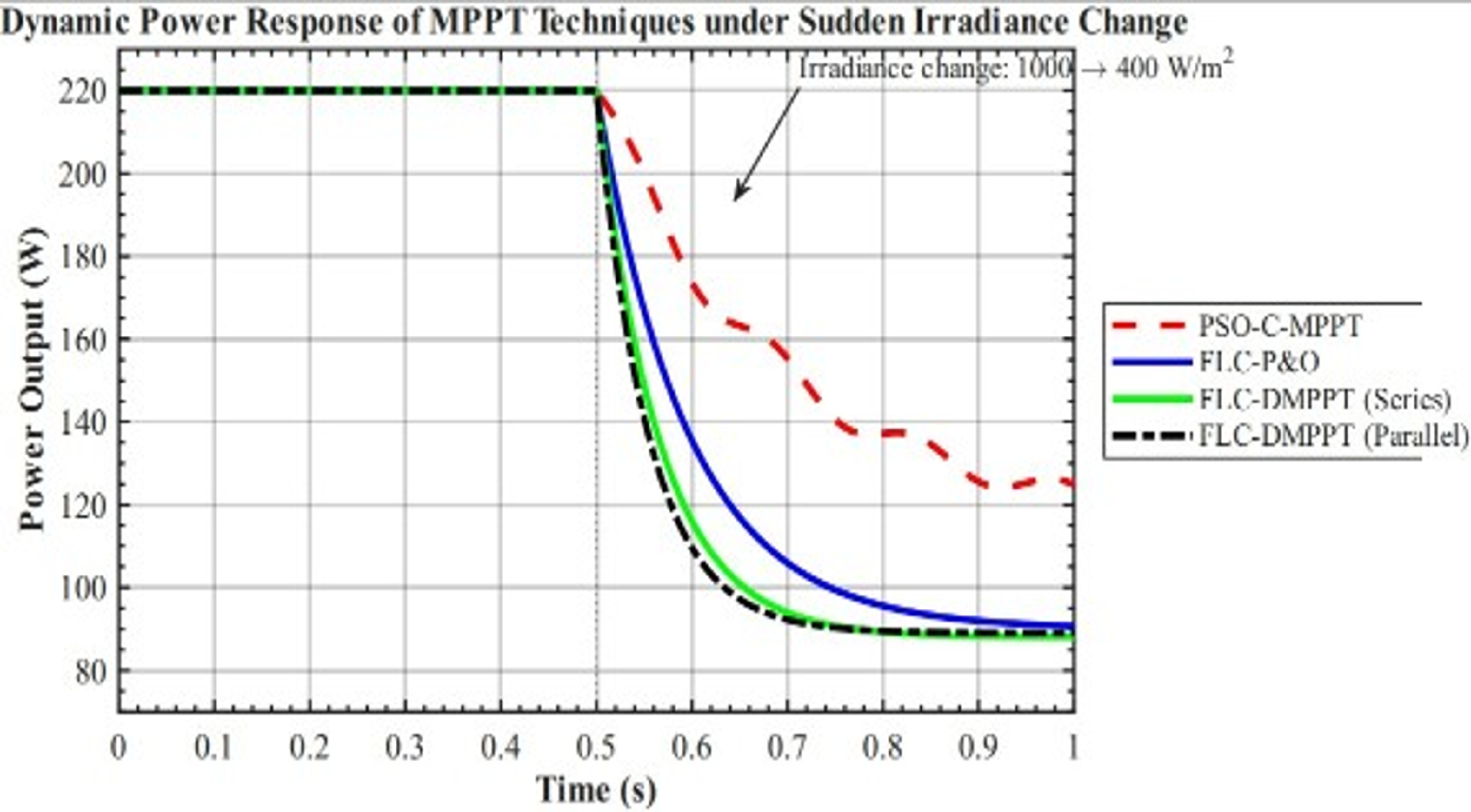
Figure 12. Transient response of P&O, CMPPT-FLC, and DMPPT-FLC under rapid irradiance transitions (1000 → 700 → 400 W/)
- Main Findings
Under stable conditions, the P&O algorithm exhibits steady-state oscillations of ±12W around a 1000 W/ operating point. In contrast, the FLC utilizes non-linear rule-based mapping to suppress oscillations to approximately 5W, achieving 97% efficiency. During sudden irradiance transitions 1000 → 700 → 400 W/m2, P&O requires 0.22–0.31s to settle, whereas FLC responds within < 0.09 s. This rapid response is attributed to the FLC's dual-input structure, which minimizes overshoot and accelerates tracking the DMPPT-FLC series arrangement produces 707W under partial shadowing, while the centralized FLC produces 248W. This 185% enhancement results from the fact that DMPPT removes anomaly losses by independent module tracking, converging within 0.05s, while centralized solutions restrict array current to the poorest module. Because parallel architectures naturally reduce current mismatch, DMPPT advantages drop to about 3% in parallel systems; however, FLC retains better transient performance and fewer oscillations. Overall, integrating DMPPT and FLC provides cooperative benefits: DMPPT eliminates structural mismatch losses, while FLC enhances localized control quality
- Comparison with Previous Studies
The data presented in Table 9 show that the FLC-DMPPT paradigm is superior to all classical MPPT techniques, outperforming them by between 5% and 10% in tracking efficiency, and converging at rates 4-6 times faster than P&O and INC techniques and, in the presence of partial shadowing, is the most efficient of the methods compared in energy extraction. These results are indicative of the fact that the assimilation of distributed MPPT with fuzzy logic provides the best possible level of performance, which cannot be achieved with the single-controller or centralized structures.
Table 9. Comparative Performance of FLC-DMPPT against traditional MPPT Algorithms
Reference | method | irradiance profile | Complexity | Training Data Required | Integration Capability | Efficiency (%) | Adaptability to Environmental Changes |
[23] | Fuzzy Logic (DMPPT) | 500-1000 W/m² | High | Moderate | High | 91.5% | Moderate |
[29] | Soft Computing (DMPPT) | 600-1000 W/m² | High | Moderate | Moderate | 94.3% | High |
This Study | Fuzzy Logic (DMPPT) | 500-1000 W/m² | Moderate | Low | High | 96.4% | Very High |
- Implications of the Results
The obtained results suggest that improvements in MPPT performance are influenced not only by the control algorithm but also by the selected PV system architecture. While fuzzy logic control enhanced tracking efficiency and reduced convergence time compared with the conventional P&O method, the adoption of a distributed MPPT architecture provided additional benefits under partial shading conditions by mitigating mismatch losses between PV modules. From a practical standpoint, the results suggest that DMPPT layouts might be especially useful for rooftop solar systems and urban settings where shade from surrounding structures, trees, or other obstructions commonly results in inconsistent irradiance circumstances. Conversely, centralized architectures may remain suitable for uniformly illuminated PV systems because of their lower implementation complexity and reduced hardware requirements. The findings also show that integrating distributed platforms with intelligent control strategies can enhance energy extraction capacity and responsiveness to systems in the face of quickly evolving environmental circumstances. These results could help system designers choose suitable MPPT configurations based on the anticipated operating circumstances and performance specifications of solar arrays.
- Limitation
There are several issues with the study's reliance on modeling simulations. Changes in external variables (such as temperature fluctuations, aging impacts, and converter thermal restrictions) may have an impact on FLC-DMPPT performance. Additionally, communication delays in field-scale installations may also have an impact. An essential step for future development is to test the simulation using Hardware-in-the-Loop (HIL) to verify its viability. In order to boost the system's responsiveness to diverse environments and its capacity to adjust to changing circumstances over time, HIL will enable the integration of new hybrid MPPT approaches that integrate fuzzy logic with contemporary fast AI systems like reinforcement learning and deep neural networks. A possible direction for future research could be to assess the financial sustainability of decentralized MPPT systems using a lifecycle expense analysis. Realizing the long-term financial benefits of DMPPT in large-scale PV systems would be very helpful, especially in areas with high sunlight levels where the substantial original expenditure has been a hurdle.
- CONCLUSIONS
The present research used an integrated MATLAB/Simulink platform to compare fuzzy logic-driven (MPPT) implemented in centralized (CMPPT) and distributed (DMPPT) photovoltaic designs considering variable irradiance and partially shaded situations. The goal was to examine how system architecture affected the effectiveness of the same fuzzy logic control method rather than to present a novel MPPT algorithm. The simulation results showed that under different irradiance settings, the fuzzy logic controller outperformed the traditional Perturb and Observe (P&O) method in terms of tracking efficiency, convergence speed, and steady-state oscillations. Additionally, by lowering mismatch losses and allowing each PV module to run closer to its own maximum power point, the DMPPT architecture demonstrated an important benefit in series-connected partial shading circumstances. The dispersed arrangement produced about 185% more electricity than the similar centralized setup under the conditions under investigation. The improvement was less noticeable in parallel-connected combinations, suggesting that the advantages of DMPPT rely on the PV system's electrical architecture and shading properties. By offering a methodical architecture-specific assessment of CMPPT and DMPPT systems using the same fuzzy logic controller under identical operating conditions, the results add to the body of current literature. The findings imply that MPPT performance might be strongly impacted by architectural choice, especially in situations with non-uniform irradiance. There are a few restrictions to be aware of. The study does not specifically take into account converter losses, sensor noise, communication delays, PV aging effects, economic issues, or real-time implementation constraints because it is only based on simulation models. Additionally, the conclusions are limited to the system topologies and irradiance patterns that were examined. Further investigations should concentrate on techno-economic assessment of a distributed MPPT implementation in realistic photovoltaic systems, evaluation under broader environmental conditions, incorporation of converter non-idealities, and empirical verification using hardware test models or Hardware-in-the-Loop (HIL) environments.
DECLARATION
Supplementary Materials:
No supplementary materials are provided for this article.
Author Contribution:
All authors contributed equally to the main contribution to this paper. All authors read and approved the final paper.
Funding:
This research received no external funding.
Conflicts of Interest:
The authors declare no conflict of interest.
REFERENCES
- T. Zhu, J. Dong, X. Li, and S. Ding, "A Comprehensive Study on Maximum Power Point Tracking Techniques Based on Fuzzy Logic Control for Solar Photovoltaic Systems," Frontiers in Energy Research, vol. 9, p. 727949, 2021, https://doi.org/10.3389/fenrg.2021.727949.
- M. Khan et al., "Conventional and artificial intelligence based maximum power point tracking techniques for efficient solar power generation," Engineering Reports, vol. 6, no. 1, p. e12963, 2024, https://doi.org/10.1002/eng2.12963.
- L. Guanghua et al., "Maximum power point tracking strategies for solar PV systems: A review of current methods and future innovations," Results in Engineering, vol. 28, p. 107227, 2025, https://doi.org/10.1016/j.rineng.2025.107227.
- H. Z. Al Garni, A. Sundaram, A. Awasthi, R. Chandel, S. Tajjour, and S. S. Chandel, "A comprehensive review of most competitive maximum power point tracking techniques for enhanced solar photovoltaic power generation," Journal of Renewable Energy and Environment, vol. 11, no. 3, pp. 60-80, 2024, https://doi.org/10.30501/jree.2024.408699.1638.
- A. Verma, S. Chandra, and S. V. A. V. Prasad, "Asymmetrical interval type-2 fuzzy logic control based MPPT tuning for PV system under partial shading condition," ISA Transactions, vol. 100, pp. 251-263, 2020, https://doi.org/10.1016/j.isatra.2020.01.009.
- L. Tang, X. Wang, W. Xu, C. Mu, and B. Zhao, "Maximum power point tracking strategy for photovoltaic system based on fuzzy information diffusion under partial shading conditions," Solar Energy, vol. 220, pp. 523-534, 2021, https://doi.org/10.1016/j.solener.2021.03.047.
- C. Napole, M. Derbeli, and O. Barambones, "Fuzzy Logic Approach for Maximum Power Point Tracking Implemented in a Real Time Photovoltaic System," Applied Sciences, vol. 11, no. 13, p. 5927, 2021, https://doi.org/10.3390/app11135927.
- W. H. Azmi, M. F. N. Tadjuddin, M. Z. Aihsan, and N. M. Noh, "Fuzzy logic control based maximum power point tracking technique in standalone photovoltaic system," International Journal of Power Electronics and Drive Systems, vol. 14, no. 2, pp. 1110-1120, 2023, https://doi.org/10.11591/ijpeds.v14.i2.pp1110-1120.
- N. Magaji, M. S. Hassan, and M. W. Mustafa, "Application of type-2 fuzzy for maximum power point tracking in photovoltaic systems," Processes, vol. 10, no. 8, p. 1530, 2022, https://doi.org/10.3390/pr10081530.
- R. C. N. Pilawa-Podgurski and D. J. Perreault, "Submodule Integrated Distributed Maximum Power Point Tracking for Solar Photovoltaic Applications," IEEE Transactions on Power Electronics, vol. 28, no. 6, pp. 2957-2967, 2013, https://doi.org/10.1109/TPEL.2012.2220861.
- A. Boudia, A. Messai, and A. Mellit, "Type-2 fuzzy logic controller-based maximum power point tracking for photovoltaic systems," Electrical Engineering & Electromechanics, no. 1, pp. 16-22, 2025, https://doi.org/10.20998/2074-272X.2025.1.03.
- M. K. Mohaisen, S. S. Mardan, and W. M. Shaher, "A hybrid technique for reducing PAPR in ACO-OFDM systems based on DHT," Journal of Optics, pp. 1-9, 2025, https://doi.org/10.1007/s12596-025-02820-6.
- M. Bennoui, A. Boukhari, A. Belkaid, and M. A. Hamida, "Experimental Evaluation of a Hybrid Fuzzy-Gradient MPPT Algorithm under Multiple PV Fault Scenarios and Irradiance Dynamics," e-Prime - Nexus of Electrical, Electronic, and Intelligent Engineering, vol. 15, p. 201203, 2026, https://doi.org/10.1016/j.prime.2026.201203.
- T. T. Jara, A. O. Salau, E. D. Markus, C. O. Omeje, and T. T. Tin, "Optimization of a fuzzy-based MPPT controller for a PV water pumping system through a PSO-based approach," Mathematical Modelling of Engineering Problems, vol. 11, no. 9, pp. 2418-2424, 2024, https://doi.org/10.18280/mmep.110914.
- R. López-Erauskin, A. González, G. Petrone, G. Spagnuolo, and J. Gyselinck, "Multi-variable Perturb and Observe Algorithm for Grid-Tied PV Systems With Joint Central and Distributed MPPT Configuration," IEEE Transactions on Sustainable Energy, vol. 12, no. 1, pp. 360-367, 2021, https://doi.org/10.1109/TSTE.2020.2996089.
- M. N. Gaafar, E. M. Ahmed, M. Orabi, and M. A. Gaafar, "Multi-input transformer-less four-wire microinverter with distributed MPPT for PV systems," International Journal of Circuit Theory and Applications, vol. 49, no. 6, pp. 1704-1725, 2021, https://doi.org/10.1002/cta.2942.
- M. E. Başoğlu, "Comprehensive review on distributed maximum power point tracking: Submodule level and module level MPPT strategies," Solar Energy, vol. 241, pp. 85-108, 2022, https://doi.org/10.1016/j.solener.2022.05.039.
- S. Barcellona and L. Piegari, "MMC-based PV single-phase system with distributed MPPT," Energies, vol. 13, no. 15, p. 3964, 2020, https://doi.org/10.3390/en13153964.
- A. Mohamed et al., "Global MPPT controllers for enhancing dynamic performance of PV systems under partial shading condition," e-Prime - Advances in Electrical Engineering, Electronics and Energy, vol. 9, p. 100638, 2024, https://doi.org/10.1016/j.prime.2024.100638.
- V. Samano-Ortega, J. J. Rodriguez-Rivas, V. M. Hernandez-Guzman, and R. V. Carrillo-Serrano, "Hardware in the loop platform for testing photovoltaic system control," Applied Sciences, vol. 10, no. 23, p. 8690, 2020, https://doi.org/10.3390/app10238690.
- C. González-Castaño, C. Restrepo, S. Kouro, and J. Rodriguez, "Hardware-in-the-loop to test an MPPT technique of solar photovoltaic system: A support vector machine approach," Sustainability, vol. 13, no. 6, p. 3000, 2021, https://doi.org/10.3390/su13063000.
- W. M. Shaher, A. Al-Darraji, W. Mahmood, and M. H. Ibrahim, "Comparative Assessment of PV Power Models under Semiarid Conditions," Journal of Renewable Energy and Environment, vol. 13, no. 3, pp. 158-167, 2026, https://doi.org/10.30501/jree.2026.565798.2735.
- M. Melhaoui, M. Rhiat, M. Oukili, A. El Aroudi, and E. B. Smail, "Hybrid fuzzy logic approach for enhanced MPPT control in PV systems," Scientific Reports, vol. 15, no. 1, p. 19235, 2025, https://doi.org/10.1038/s41598-025-03154-w.
- M. F. El-Khatib, M.-N. Sabry, M. I. Abu El-Sebah, and S. A. Maged, "Hardware-in-the-loop testing of simple and intelligent MPPT control algorithm for an electric vehicle charging power by photovoltaic system," ISA Transactions, vol. 137, pp. 656-669, 2023, https://doi.org/10.1016/j.isatra.2023.01.025.
- I. Contreras-Carmona, A. Y. Pineda-Tapia, H. R. Hernandez-De-Leon, and C. A. Torres-Cantero, "A novel strategy for the MPPT in a photovoltaic system via dung beetle optimization algorithm and hardware-in-the-loop plus real-time control," PLOS ONE, vol. 19, no. 7, p. e0311831, 2024, https://doi.org/10.1371/journal.pone.0311831.
- K. Ullah, A. Haque, V. S. B. Kurukuru, and M. A. Khan, "Fuzzy-based maximum power point tracking (MPPT) control system for photovoltaic power generation system," Results in Engineering, vol. 20, p. 101466, 2023, https://doi.org/10.1016/j.rineng.2023.101466.
- K. Sabri, O. El Maguiri, and A. Farchi, "Comparative study of different MPPT algorithms for photovoltaic systems under partial shading conditions," in Proceedings of the 9th International Renewable and Sustainable Energy Conference (IRSEC), pp. 1-7, 2021, https://doi.org/10.1109/IRSEC53969.2021.9741164.
- M. Melhaoui, M. Rhiat, M. Oukili, I. Atmane, K. Hirech, B. Bossoufi, M. M. Almalki, T. A. H. Alghamdi, and M. Alenezi, "Hybrid fuzzy logic approach for enhanced MPPT control in PV systems," Scientific Reports, vol. 15, no. 1, p. 19235, 2025, https://doi.org/10.1038/s41598-025-03154-w.
- K. Y. Yap, C. R. Sarimuthu, and J. M.-Y. Lim, "Artificial Intelligence Based MPPT Techniques for Solar Power System: A review," Journal of Modern Power Systems and Clean Energy, vol. 8, no. 6, pp. 1043-1059, 2020, https://doi.org/10.35833/MPCE.2020.000159.
- C. H. Hussaian Basha and C. Rani, "Performance Analysis of MPPT Techniques for Dynamic Irradiation Condition of Solar PV," International Journal of Fuzzy Systems, vol. 22, no. 8, pp. 2577-2598, 2020, https://doi.org/10.1007/s40815-020-00974-y.
- M. Z. Yousaf, M. A. Koondhar, Z. A. Zaki, E. M. Ahmed, Z. M. Alaas, I. Mahariq, and J. M. Guerrero, "Improved MPPT of solar PV systems under different environmental conditions utilizing a novel hybrid PSO," Renewable Energy, vol. 244, p. 122709, 2025, https://doi.org/10.1016/j.renene.2025.122709.
- F. Çakmak, Z. Aydoğmuş, and M. R. Tür, "Analyses of PO-based fuzzy logic-controlled MPPT and incremental conductance MPPT algorithms in PV systems," Energies, vol. 18, no. 2, p. 233, 2025, https://doi.org/10.3390/en18020233.
- N. K. Pandey, R. K. Pachauri, S. Choudhury, and R. K. Sahu, "Asymmetrical interval Type-2 Fuzzy logic controller based MPPT for PV system under sudden irradiance changes," Materials Today: Proceedings, vol. 80, pp. 710-716, 2023, https://doi.org/10.1016/j.matpr.2022.11.074.
- V. S. Venkatanarayana and A. C. Rosalina, "A new MPPT mechanism based on multi-verse optimization algorithm tuned FLC for photovoltaic systems," Scientific Reports, vol. 14, no. 1, p. 16046, 2024, https://doi.org/10.1038/s41598-024-79554-1.
- S. R. Kiran and A. M. Alsaif, "A novel advanced hybrid fuzzy MPPT controllers for renewable energy systems," Scientific Reports, vol. 14, no. 1, p. 21104, 2024, https://doi.org/10.1038/s41598-024-72060-4.
- X. Zhang, Y. Wang, Z. Liu, and H. Chen, "An improved RIME optimization algorithm based maximum power point tracking method for photovoltaic system under partially shading condition," Scientific Reports, vol. 15, no. 1, p. 1234, 2025, https://doi.org/10.1038/s41598-025-01586-y.
- K. Ding, X. Gao, H. Liu, and T. Peng, "A MATLAB/Simulink-Based PV Module Model and Its Application Under Conditions of Nonuniform Irradiance," IEEE Transactions on Energy Conversion, vol. 27, no. 4, pp. 864-872, 2012, https://doi.org/10.1109/TEC.2012.2216529.
- A. R. Atiya, M. A. Naser, and A. A. Kareem, "Integration of fuzzy logic and neural networks for enhanced MPPT in PV systems under partial shading conditions," Iraqi Journal for Electrical and Electronic Engineering, vol. 21, no. 1, pp. 1-15, 2025, https://doi.org/10.37917/ijeee.21.1.1.
- N. Hadjidj, A. Chellali, M. A. Kheldoun, and S. Kouro, "Global maximum power point tracking method for photovoltaic systems using Takagi-Sugeno fuzzy models and ANFIS approach," Electrical Engineering & Electromechanics, no. 3, pp. 27-36, 2025, https://doi.org/10.20998/2074-272X.2025.3.04.
- A. R. Youssef, M. M. Hefny, and A. I. M. Ali, "Investigation of single and multiple MPPT structures of solar PV-system under partial shading conditions considering direct duty-cycle controller," Scientific Reports, vol. 13, no. 1, p. 19051, 2023, https://doi.org/10.1038/s41598-023-46165-1.
- A. A. Al-Samawi, A. S. Atiyah, and A. H. Al-Jrew, "Power optimization of partially shaded PV system using interleaved boost converter-based fuzzy logic method," Eng, vol. 6, no. 8, p. 201, 2025, https://doi.org/10.3390/eng6080201.
- Y. Alharbi, A. Darwish, and X. Ma, "A Comprehensive Review of Distributed MPPT for Grid-Tied PV Systems at the Sub-Module Level," Energies, vol. 16, no. 14, p. 5468, 2023, https://doi.org/10.3390/en16145468.
- A. Al-Smadi and L. Mahmoud, "Photovoltaic Module Cascaded Converters for Distributed Maximum Power Point Tracking: A Review," IET Renewable Power Generation, vol. 14, no. 16, pp. 3120-3135, 2020, https://doi.org/10.1049/iet-rpg.2020.0582.
- J. M. Enrique, J. M. Andújar, and M. A. Bohórquez, "A Reliable, Fast and Low-Cost Maximum Power Point Tracker for Photovoltaic Applications," Solar Energy, vol. 84, no. 1, pp. 79-89, 2010, https://doi.org/10.1016/j.solener.2009.10.011.
- S. Qin, S. T. Cady, A. D. Domínguez-García, and R. C. N. Pilawa-Podgurski, "A Distributed Approach to Maximum Power Point Tracking for Photovoltaic Submodule Differential Power Processing," IEEE Transactions on Power Electronics, vol. 30, no. 4, pp. 2024-2040, 2015, https://doi.org/10.1109/TPEL.2014.2330335.
- M. S. Endiz and H. Kalay, "A review of traditional and advanced MPPT approaches for photovoltaic systems," Applied Sciences, vol. 15, no. 3, p. 1031, 2025, https://doi.org/10.3390/app15031031.
- D. Vinnikov, A. Chub, R. Kosenko, V. Sidorov, and A. Lindvest, "Implementation of Global Maximum Power Point Tracking in Photovoltaic Microconverters: A Survey of Challenges and Opportunities," IEEE Journal of Emerging and Selected Topics in Power Electronics, vol. 11, no. 2, pp. 2259-2280, 2023, https://doi.org/10.1109/JESTPE.2021.3137521.
- M. H. Tanha, H. Shad, H. A. Khanavandi, A. Aranizadeh, and B. Vahidi, "Neuro-Fuzzy AC/DC Inverter Control for Power Regulation in Grid-Connected PV Systems Under Dynamic Irradiance Conditions," Solar Energy, vol. 314, p. 114683, 2026, https://doi.org/10.1016/j.solener.2026.114683.
- K. Ishaque, Z. Salam, and G. Lauss, "The Performance of Perturb and Observe and Incremental Conductance Maximum Power Point Tracking Method Under Dynamic Weather Conditions," Applied Energy, vol. 119, pp. 228-236, 2014, https://doi.org/10.1016/j.apenergy.2013.12.054.
- M. A. Elgendy, B. Zahawi, and D. J. Atkinson, "Assessment of Perturb and Observe MPPT Algorithm Implementation Techniques for PV Pumping Applications," IEEE Transactions on Sustainable Energy, vol. 3, no. 1, pp. 21-33, 2012, https://doi.org/10.1109/TSTE.2011.2168245.
AUTHORS BIOGRAPHY

| Waleed Mahmood Abdullah Al-Darraji, holds a Master's degree in Electrical and Electronics Engineering from Gaziantep University, Turkey, in 2019. Worked as an engineer in the Energy Distribution Directorate, and in the Electrical Grid Control Department, RTU Department. Currently working as a lecturer at Tikrit University, College of Petroleum Operations Engineering, and Department of Petroleum Systems Control. Gives lectures on the fundamentals of electrical engineering, power electronics, electronics, and electrical machines. Participates in laboratory work and supervises undergraduate students in the laboratory. Research interests in the field of power electronics, electronics, power systems, networks, alternative energy (solar cells and hybrid energy), and artificial intelligence in energy systems. A research PhD student in (Power Systems and Energy Conversion) at the Faculty of Electrical and Electronics Engineering, University Science Malaysia (USM). Email: waleed.m@tu.edu.iq Email: waleed.mahmood@student.usm.my https://orcid.org/0009-0005-6018-0714 |
|
|

| Waladdin Mezher Shaher, was born in Falluja, Alanbar, Iraq, in 1979. He received a B.Sc. degree in electrical engineering from the University of Technology, Baghdad, Iraq, in 2004. and the M.Sc. degree in electrical engineering - Power Systems from the Department of Electrical Engineering - Faculty of Technical Engineering - Islamic Azad University – South Tehran Branch, Tehran, Iran, in 2023. Since 2024, he has been pursuing a Ph.D. degree in power systems and energy conversion at the School of Electrical and Electronic Engineering, Universiti Sains Malaysia (USM), Pulau Penang, Malaysia. He has been working as an Assistant Lecturer in the Department of Petroleum Systems Control Engineering, College of Petroleum Processes Engineering, Tikrit University, Salahaddin, delivering lectures on Principles of Electrical Engineering, Electronics, Electrical machines, and Power Electronics. Participates in laboratory work and supervises undergraduate students in the laboratory. His research interests include Power systems, Power electronics, photovoltaic cells, renewable energy, control, IoT, networks, alternative energy (solar cells and hybrid energy), and AI. Email: walamezher@tu.edu.iq Email: walamezher@student.usm.my https://orcid.org/0009-0001-7941-7479 |
|
|

| Yousif Azzawi Hachim, was born in Salah ALdin-Iraq on the twenty-eighth of February 1995. He received his BSc. Electrical Engineering Department at Tikrit University - Salah ALdin - Iraq in 2017. He received his M.Sc. Electrical Engineering - Electrical field from Tikrit University, Tikrit - Iraq in 2021. He is a faculty member in the Department of Electrical Engineering at Tikrit University. He has authored of several papers in international / national Journals and proceedings of conferences. His research interests in Communication and Microwave Engineering. Email: yousifazzawi@st.tu.edu.iq https://orcid.org/0009-0007-3993-6585 |
|
|

| Abdulbari Talib Naser, received the B.Sc. degree in electrical engineering from Diyala University, Diyala, Iraq, in 2011, and the M.Sc. degree in industrial electrical and electronic from the Universiti Gaziantep, Turkey, in 2017. He has the PhD. degree with the Universiti Tenaga Nasional (UNITEN), Malaysia. He current research interests include in Metaheuristic Algorithms, Control of Converters for Solar Energy, and Renewable Energy. Email: abdilbareetalib@gmail.com https://orcid.org/0009-0002-3974-6910 |
Waleed Mahmood Abdullah Al-Darraji (Fuzzy Logic-Based Distributed and Centralized MPPT Architectures for Photovoltaic Systems: A Comparative Study under Dynamic Irradiance and Partial Shading Conditions)