ISSN: 2685-9572 Buletin Ilmiah Sarjana Teknik Elektro
Vol. 8, No. 3, June 2026, pp. 887-900
Sliding Mode based Circle Search Algorithm for Inventory Control with Extended State Observer
Neamah D. Farhan 1, Raya K. Naji 2, Muntaha K. Musa 3, Huda A. Kanber 4, Wafaa H. Abdul Hadi 5,
Aws M. Abdullah 6, Hussien Dulaimi 7, Huthaifa Al-Khazraji 8
1, 2, 3, 4, 5, 6 University of Baghdad, Baghdad, Iraq
7, 8 University of Technology-Iraq, Baghdad, Iraq
ARTICLE INFORMATION |
| ABSTRACT |
Article History: Received 22 March 2026 Revised 23 June 2026 Accepted 26 June 2026 |
| 
The efficient utilization of inventory systems has become increasingly important in modern industrial practice due to its substantial contribution to cost reduction, resource optimization, and overall operational efficiency. Sliding mode control (SMC) is presented in this study for management and optimization of the inventory systems. First, the differential equations of inventory system are developed. Then, the SMC is employed for the improvement of the performance of the inventory system under time varying demands, by minimizing tracking error and improving reference following. Moreover, an extended state observer (ESO) is introduced to compensate for the lack of direct access to the system state variables by estimating the unavailable states while simultaneously providing demand estimation. Furthermore, circle search algorithm (CSA) is used for optimizing the SMC and the ESO because of its outstanding global optimization potential and to provide a good balance between exploitation of the obtained solutions and exploration of new ones during the search process by means of the integral of absolute error (IAE). The efficacy of the ESO to estimate the states of the system and the profile of the unknown demand has been validated by computer simulation in the MATLAB. Additionally, The proposed ESO-SMC is examined with the proportional, integral, derivative (PID) controller of the stochastic demand. This test shows the ESO-SMC to be superior in their performance enhancement, especially the reduction of inventory costs. |
Keywords: Production-Inventory System; Sliding Mode Control; Extended State Observer; Circle Search Algorithm; Proportional-Integral-Derivative Controller |
Corresponding Author: Aws M. Abdullah, University of Baghdad, Baghdad, Iraq. Email: aws.abd@cois.uobaghdad.edu.iq |
This work is open access under a Creative Commons Attribution-Share Alike 4.0 
|
Document Citation: N. D. Farhan, R. K. Naji, M. K. Musa, H. A. Kanber, W. H. A. Hadi, A. M. Abdullah, H. Dulaimi, and H. Al-Khazraji, “Sliding Mode based Circle Search Algorithm for Inventory Control with Extended State Observer,” Buletin Ilmiah Sarjana Teknik Elektro, vol. 8, no. 3, pp. 887-900, 2026, DOI: 10.12928/biste.v8i3.16220. |
INTRODUCTION
As the business process became complex, it put a great pressure on the decision-manager, who was trying to understand the dynamics of the business process. Even if the product is so simple, it still has a global process in the supply chain. For example, the automotive industry's supply chain accounts for a substantial portion of corporate value; therefore, ensuring its resilience to even minor delivery disruptions while maintaining optimal performance is of critical importance [1]. Supply chain an organized of suppliers, manufacturing plants, warehouses, manufacturers and distributors working together and committed to the efficient supply of finished products to the end consumer. On this context, production–inventory control systems are implemented to ensure effective coordination among raw materials, work-in-process, and finished goods inventories, thereby maximizing customer service levels and reducing overall costs [2]. The aforementioned objective can be attained through the efficient coordination of information and product flows across the supply chain between manufacturing facilities and retailers [3]. Furthermore, growing competition in the business world has driven production-inventory management practitioners towards looking for room to improve the profitability of their business [4]. To reduce cost and to make the system more profitable, the inventory levels can be reduced to a minimum [5]. Uncertainties in customer demand and manufacturing conditions pose significant challenges to the effective control of production–inventory systems, making it difficult for manufacturing companies to maintain sustainable and cost-efficient operational strategies.
To solve the production-inventory problems the system performance method has been successfully studied for decades using control engineering practices as another method for system performance solution [6] [7]. This kind of model was found to be appropriate model to represent the industrial behavior and is applicable in real use by the managers to select what their order rates they need for fluctuated the market. Research and solution techniques that encompass a variety of studies and means of control, applicable to production-inventory related topics may be found in [8]-[11]. Towill [12] was also interested in the possibility to improve the production-inventory system performance by using the proportional controller. Building upon Towill's work, Jonn et al. [13] integrated additional feedback information into the system, while AL-Khazraji et al. [14] further expanded the framework by incorporating supplementary feedback loops. It was demonstrated by Towill et al. [15] that Proportional plus Integral (PI) controller was able to remove the inventory deficit in the production inventory system. A proportional-integral-differential (PID) controller was implemented by Tosetti et al. [16] and White and Censlive [17]. Sarir and Abderhmane [18] introduced a PID controller augmented with fuzzy logic. In their approach, Ant Colony Optimization (ACO) is utilized to automatically fine-tune the controller gains, using the integral of square error (ISE) as the objective function. A modified version of the PID, named integral minus proportional derivative (I-PD) was examined and analyzed by Al-Khazraji [19]. Cuckoo search optimization (CSO) and its improved variant (ICSO) are two optimization techniques employed to tune the adjustable parameters of an I–PD controller. Two simulation scenarios have been developed, assuming a step changing in demand was first and the stochastic demand was the second. The simulation outcomes presented indicate improvement in the tuning process for the I-PD controller using the ICSO approach, compared to the conventional CSO approach. However, the aforementioned studies do not explicitly address robustness against demand uncertainties, which may limit their effectiveness under varying and unpredictable demand conditions.
The second method to controller design is very strict and powerful method called sliding mode control (SMC) [20], which is suitable for the design of various systems including regulating the ball's position of the magnetic levitation system [21], improve power maximization of the wind turbine system [22], stabilize of the overhead crane system [23] and speed control of the induction motor [24]. Based on the effective regulation performance demonstrated by the presented controller, it would be possible to extend and apply it to other dynamic systems having similar requirements. This paper is motivated to develop a SMC approach for improving the inventory responsiveness in the context of bounded time varying demand. SMC is a model based control approach and the complete knowledge of the system is needed. In many types of control systems, not all of the states of the systems are easily measurable. Therefore, the implementation of SMC is not feasible without auxiliary state estimation techniques. This challenge can be addressed through the use of state observers, which provide estimates of the unavailable system states [25][26]. Besides, the inventory system has a time variant demand and in order to deal with these challenges it has been equipped with an Extended State Observer (ESO) which can approximate the state and the demand trajectory. The use of meta-heuristic optimization algorithms in modern research is often based on the need to establish parameters of the controllers and observers as they have better performance during the process of establishing the parameters, compared to the main ad hoc tuning processes [27]-[29]. In this regard, the circle search algorithm (CSA) is introduced to solve the parameter-selection problem in this research. It nature-inspired metaheuristic algorithm and used to solve complex optimization problems with an effective balance of exploration and exploitation [30].
METHODOLOGY
The basic goal in managing an inventory system desired to maintain the level of the inventory at the desired level by changing the order rate [31]. In this paper, the overall control strategy is divided into four stages as follows: Firstly, the differential equations of the inventory system are built to determine the strategy. Then, the control design using the sliding mode control (SMC) is given in order to ensure the desired inventory response is achieved. The third stage involves the development of an extended state observer (ESO) for estimating the system state variables and the time-varying demand. Based on the Integral of Absolute Error (IAE), the fourth stage is concerned with optimization of the adjustable design parameters of the SMC and the ESO using circle search algorithm (CSA).
Inventory System
The inventory system is a crucial chain unit that integrates orders decision, production process with the inventory taking in the account the demand rates. The demand rate d is time-varying and bounded. Let’s  be the inventory level. The state
  is the rate of production. After the production is completed, the manufactured products are put into stock or sent out to the customers to meet the market demand. These activities are suitable modelled using an exponential transfer function. In other words, it becomes first order lag with the time constant
  . Time constant to the production process is the time that has to be spent between the order and delivery of the delivery of the product in the form of a complete product [32]. The control input of the system is the order rate
 . There are two types of representation of Production-inventory systems: Continuous-time System and Discrete-time System. For instance, Comparisons can be drawn between data from continuous review production rates and inventory data as well as periodic review production and inventory schemes [33]. Conditioned upon this, here the present model is realised as a continuous-time. The system of equations is written in the form [19]:
| 
| (1) |
| 
| (2) |
Sliding Mode Control
There are multiple systems that are able to be implemented by feedback control technique that can help to improve the system performance [34]-[40]. Sliding mode control (SMC) is a well-known as robustness and systematic feedback controller. It has two stages. The first step of defining the surfaces of slides that is necessary for achieving the desired performance, to keep the system in the sliding surface is the second step [41][42]. Define the tracking error  as the difference between the actual inventory level and the desired inventory level, given by
| 
| (3) |
Taking the derivative of the error gives:
| 
| (4) |
Substituting Eq. (1) into Eq. (4) obtains:
| 
| (5) |
Differentiate the error second time yields:
| 
| (6) |
Substitute Eq. (2) in Eq. (6) obtains:
| 
| (7) |
The sliding surface is defined as:
| 
| (8) |
where  is a tuning parameter.
Taking the first derivative of the sliding surface yields:
| 
| (9) |
Substitute Eq. (6) and Eq. (2) in Eq. (9) obtains:
| 
| (10) |
The second part of the control law in the SMC is the switching control. The switching control is also present in the SMC, as a discontinuous control law that causes the surface sliding of the system [43]. In order to make the system move on the surface, the first derivative of the surface it moves on ought to be equivalent to the switching control. As such, the switching control must choose appropriately to prevent the chattering effects that are present in SMC [44]. The discontinuous sign function switches abruptly between  , causing high-frequency control switching near the sliding surface. In this direction, the power rate reaching law is used for the switching control which is given by [45]:
| 
| (11) |
where  is sign function,
  is adjusted parameter
  ,
,  is adjusted parameter between [0,1]. The switching gain in the power rate reaching law becomes smaller when the trajectory is close to the sliding surface. Consequently, the control action is less aggressive near
  , reducing oscillations around the surface.
The final  is determined by setting Eq. (10) and is equal to Eq. (11) which gives:
| 
| (12) |
Rearrange Eq. (12) to find the control law of the SMC as:
| 
| (13) |
It can be seen that the control law need the derivative of the demand and the extended state observer (ESO) will be used to estimate the demand.
Extended State Observer
The procedure to establish of an extended state observer (ESO) for the inventory control system is presented in this subsection. The fundamental design principle involves augmenting the system by treating disturbances and uncertainties as extended state [46][47]. The measured and the estimated output signal of the system are used to reconstruct the remaining system states. Moreover, the total disturbance is estimated and compensated in real time through feedback control [48]. Therefore, the model of the inventory system is reconstructed as given in Eq. (14), Eq. (15) and Eq. (16). The third state  represents the lumped total uncertainty and disturbance inherited in the system.
The ESO can be therefore synthesized as given in:
In this case, the observer states,  and
and  are estimation of the states and , respectively. The third observer state,
  will be used to estimate the time varying demand.
  ,
,  , and
, and  are design gains of the observer.
Circle Search Algorithm
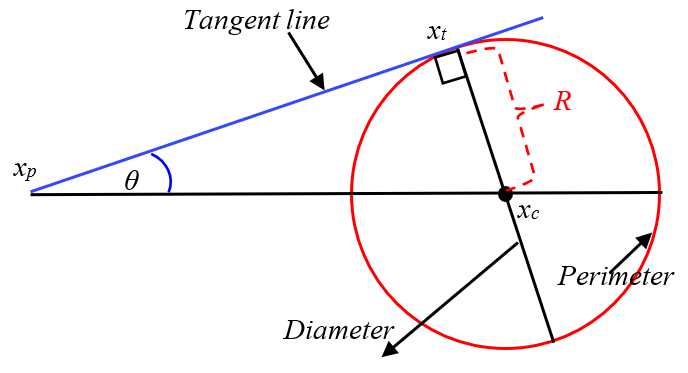
Optimization algorithms are methods used to find the optimal solution among all of the potential solutions. In the context of engineering domain, optimization-algorithms are now become a useful sportive tool in solving numerous engineering problems [49]-[53]. Furthermore, determining the optimal values for controller design variables in order to produce control signals that enable the system to track the desired dynamic performance is a significant challenge. In this context, many researchers are turning to optimization algorithms instead of traditional trial-and-error methods to obtain the best adjustable controller parameters [54]-[61]. Qais et al. [30] presented a swarm optimization algorithm called circle search algorithm (CSA) which was inspired by geometrical characteristics of circles. The circle is characterized by several geometric elements, including the diameter, centre, and circumference, in addition to the line’s tangent to it. Any set of points located in a certain geometric plane that form a closed curve so that they are equidistant from a central point (the centre of the circle), is called a geometric circle. Such a closed curve is called the circumference of the circle. In Figure 1, a circle whose centre is ( ). The diameter of a Circle (
 ) can be defined as a straight segment connecting two distinct points located on the circumference of the circle, while the radius (
 ) is a straight segment connecting any point located on the circumference of the circle to its centre. Suppose that a tangent line connecting the points (
 ,
, ) touches the circle at a point (), which represents the unique point of tangency between the line and the circumference of the circle, so it is well known that it is perpendicular to the radius () according to the geometric properties of the tangent. It can also be seen that the tangent (
 , ) intersects the line segment (, ) passing through the centre. A right triangle will then be formed, and using trigonometric ratio functions, the tangent function of angle (
 ) will be [62][63]:
| 
| (20) |
While  , this gives:
Figure 1. Terminologies of the geometric circle
From the general mathematical principles of circles given in Figure 1, it is clear that as the radius of the circle decreases, the tangent angle will have decreased so that the tangent gradually will approach to the centre of the circle, as shown in Figure 2(a). In the CSA algorithm, it is assumed that the centre of the circle is the target point for the optimal solution and any random point is the tangential point (). The random point's approach to the solution is achieved by decreasing the tangent line angle ( ), as illustrated in Figure 2(b), the tangential point () serves as the search agent for the CSA, while () is conceptualized as the optimal solution of the algorithm.
It is obvious from Figure 3 that; the CSA search agent continuously adjusts the tangential point’s position in the direction of the centre point. However, to prevent the CSA from becoming trapped within the boundaries of a local solution, the contact point is randomly altered by varying the angle in a stochastic manner. The steps of the CSA can be described as follows [64]:
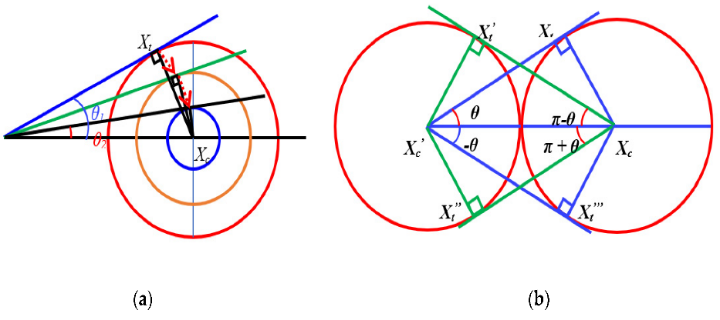
Figure 2. The sequence of the CSA: (a) exploitation and (b) exploration
Step 1: Initialization: It is an essential step that must be implemented in CSA to ensure equal randomness of all dimensions of the search agent. In the previously published code, it may be possible to obtain very surprising and unexpectedly fast results from algorithms due to the fact that most of them randomly distribute dimensions unevenly. Subsequently, the search agents are initialized within the bounds of the search space, specifically between the upper limit values ( ) and lower limit values (
 ), as defined in Eq. (25):
| 
| (25) |
where  is any real random number between 0 and 1.
Step 2: Reposition the search agent to a new location: The search agent () takes a new location according to the best evaluated location (), as shown in Eq. (26):
| 
| (26) |
The angle () has a significant impact on exploring and employing the CSA and can be calculated as follows [65][66]:
where  is an arbitrary value within the range of (
 ), Iter is the iteration counter, Maxiter is the maximum iterations number, and c is a constant within the range of (), which proportion of the maximum of iterations. According to Eq. (29), the variable a can be chosen in the range from (
 ), whereas the variable p, as indicated in Eq. (30), can vary from (
 ). Consequently, the changing in the angle
  is from (
 ).
).
Two different cases for accomplished the CSA which are: In the case of  : the angle
  is determined by (
 ) for all the time, which is used to enhance the exploration search of the CSA. On the other hand, if
  , in this case, the angle is determined by (
 ) for all time, which is employed to enhance the process of exploitation search.
COMPUTER SIMULATION RESULTS
The evaluation of the extended state observer (ESO) for estimating the states of the system and the time varying demand needed by the system were analysed and the behaviour of the sliding mode control (SMC) to control the inventory level was designed. Thus, a computer simulation is performed based on MATLAB-program. The dynamics of the production-inventory system which are given in Eq. (1) and Eq. (2) have been programming to simulate the inventory system. The time constant of of the inventory system is set to be one day. The period of the simulation was set to 4-months. To confirm the scheme suggested in the solution on the realistic demand scenarios the demand is simulated using the concept of a stationary independently distributed random process. The production inventory model used is also linear meaning that the demand that cannot be met may be back-ordered hence any negative value of the inventory level is equivalent to the back-order quantity. Additionally, production capacity is assumed to be unlimited, and order rates cannot be negative.
From an algorithm designing perspective for production-inventory control, one of the most critical questions is the selection of an adequate assessment criterion that affects the system efficiency, value delivery to customers and system assignments for a project for organization objectives. This paper evaluates the proposed control algorithm using absolute error (AE) for error quantification and the integral of absolute error (IAE) for overall performance assessment. The IAE metric penalizes positive and negative errors equally, implying that the costs of excess inventory and inventory shortages are weighted identically. In other words, if this is the case, the cost of carrying too much inventory will be the same from the cost of carrying too little inventory. Goods level control design parameters of the ESO-SMC (as mentioned in Eq. (31) [67]-[69]) are computed by circle search algorithm (CSA).
| 
| (31) |
We use  to refer to the simulating time, and e to refer to the error between the real inventory and the target inventory. Minimum IAE implies that the system is more responsive in this level of inventory and so, less expensive in terms of inventory. If the desired inventory level is considered to be zero as it is in the current research, it means that Just-in-Time (JIT) strategy
The system states estimation and estimation of the demand profile using the close loop simulation is considered. The initial values for the system states ( and ) were both set to zero. Using the CSA, the ESO parameters are determined as follows: ,
,  and
and  . The design parameter of the SMC is computed as follows:
  ,
,  . Figure 3 shows the states and the estimation of the states.
Figure 4 shows the estimation of the demand. The various figures show that the ESO is able to estimate all the states of the system, and the demand. Figure 5 and Figure 6 plot the estimation error of , and  . Based on Figure 5 and Figure 6, it can be seen that the estimation errors converge quickly to near zero.
In the following case, the performance of the proposed ESO-SMC compared with that of classical PID control is shown. From the CSA, the PID is calculated as following:  ,
,  , and
, and  . The result of the simulation performed for the inventory level and production rates in both the controlled system is shown in Figure 7. The proposed ESO-SMC has a better regulating performance to maintain the inventory near the zero as shown in Figure 7 as compared to the PID controller. Moreover, it can be seen for Table 1 that the IAE of the system based on the ESO-SMC (9.05) in comparison with the IAE of the system based on the PID controller (60.87) is less.
For further evaluation of the ESO-SMC, additional simulation with another stationary identically and independently distributed random demand is also carried out. The tunable parameters of the ESO-SMC and the PID controller are kept as the previous simulation. The estimating of the system state and its demand are represented in the Figure 8 and Figure 9 respectively. Moreover, the estimation error of , and is demonstrated in Figure 10, Figure 11 respectively. The inventory level and production rates of the two controlled systems are simulated as indicated in Figure 12.
From Figure 12, the proposed ESO-SMC achieves better performance to maintain the inventory level near zero compared to PID controller. Further, it can be observed from Table 2 that the IAE of the system based on ESO-SMC is less than that of the system using PID controller. The results of the two scenarios indicate that it is possible to estimate with precision the state and the unknown demand with the help of the ESO. Furthermore, a good regulation of the inventory control can be obtained within the ESO-SMC.
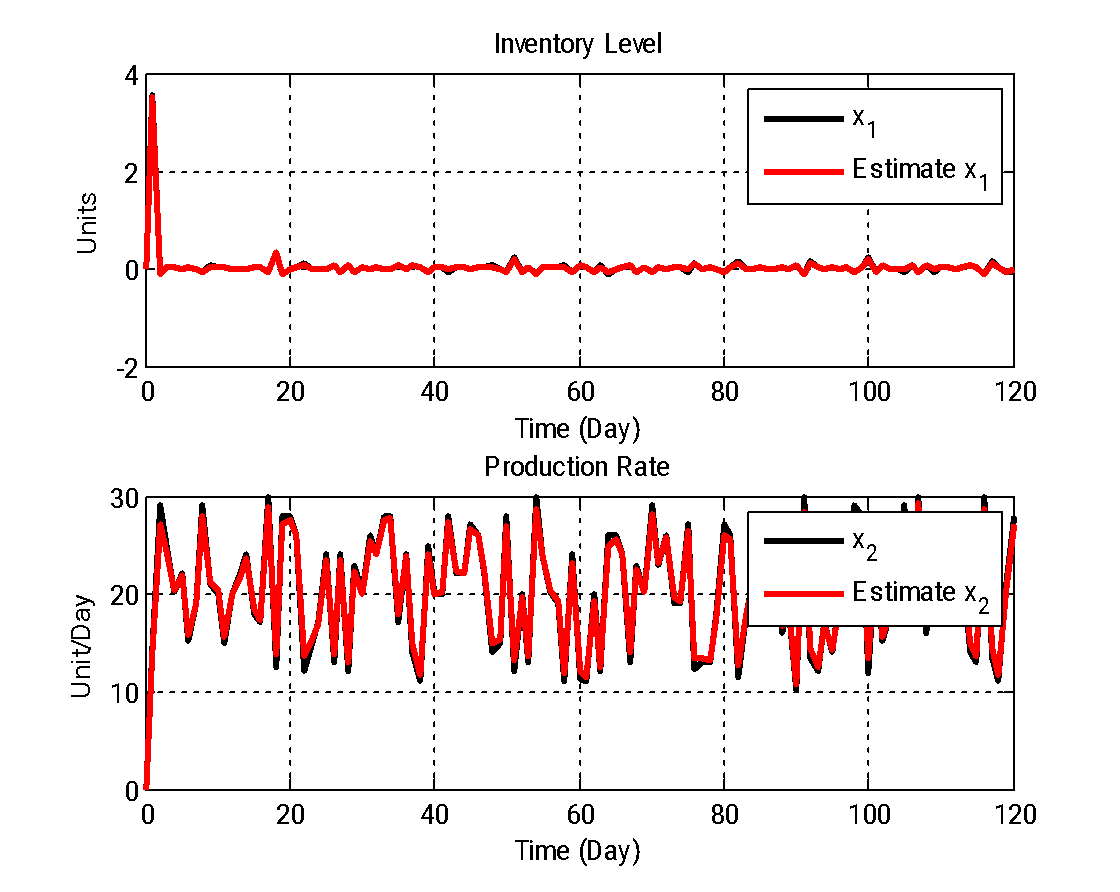
Figure 3. Estimation of and
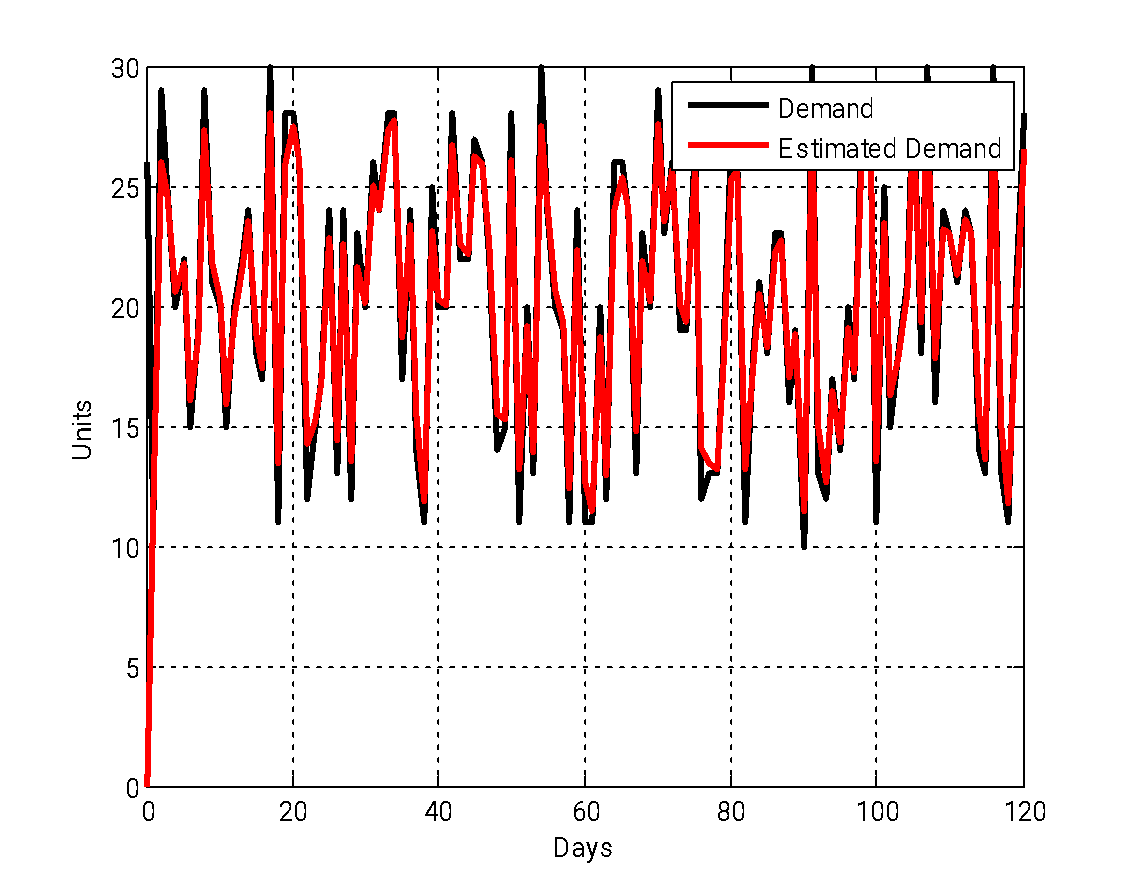
Figure 4. Estimate of demand
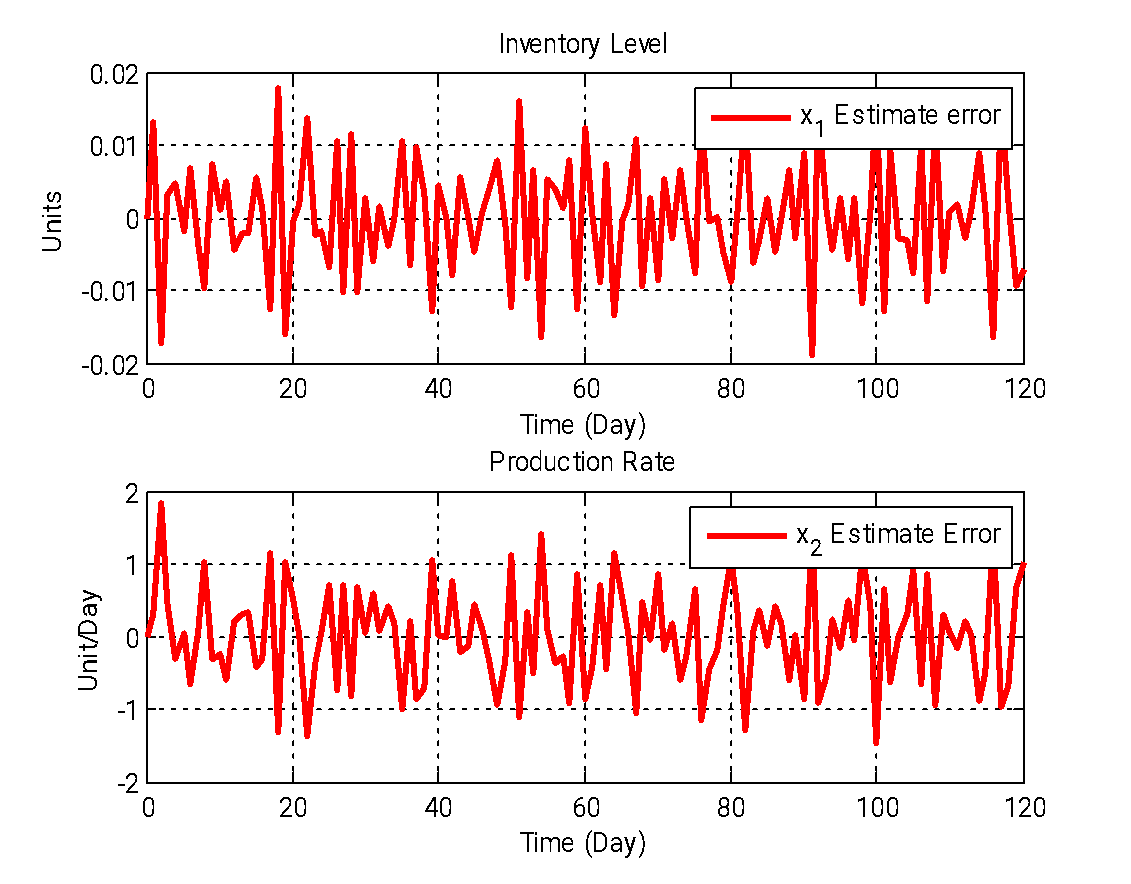
Figure 5. Estimate error of and
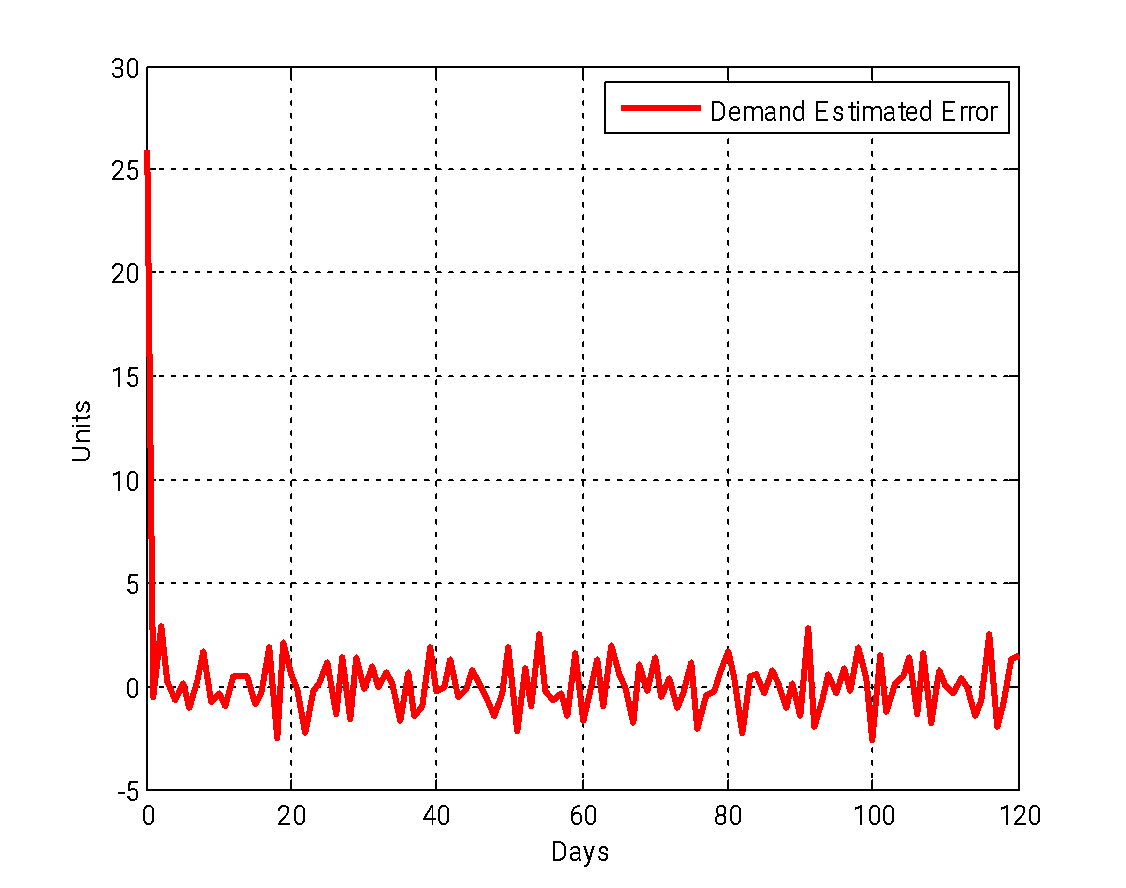
Figure 6. Estimate error of demand
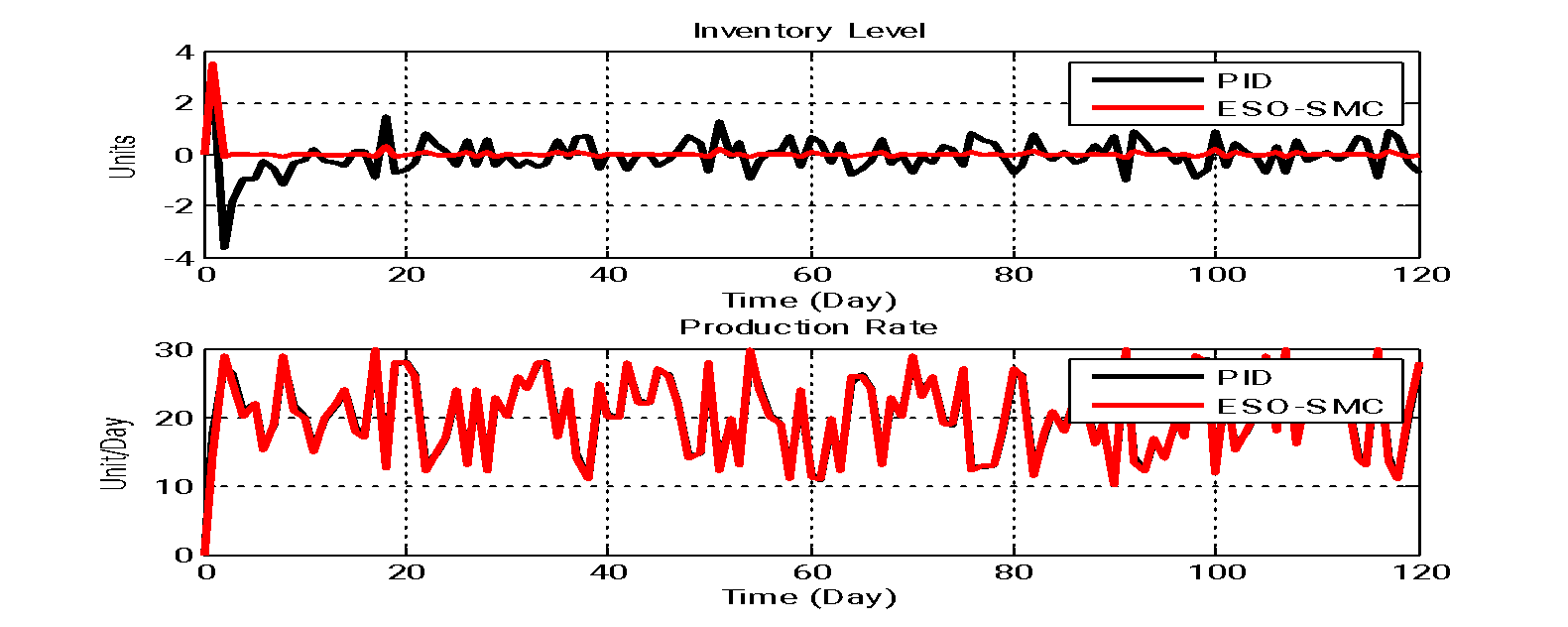
Figure 7. Inventory response based on ESO-SMC and PID
Table 1. Performances evaluation
Controller | IAE |
ESO-SMC | 9.05 |
PID | 60.87 |
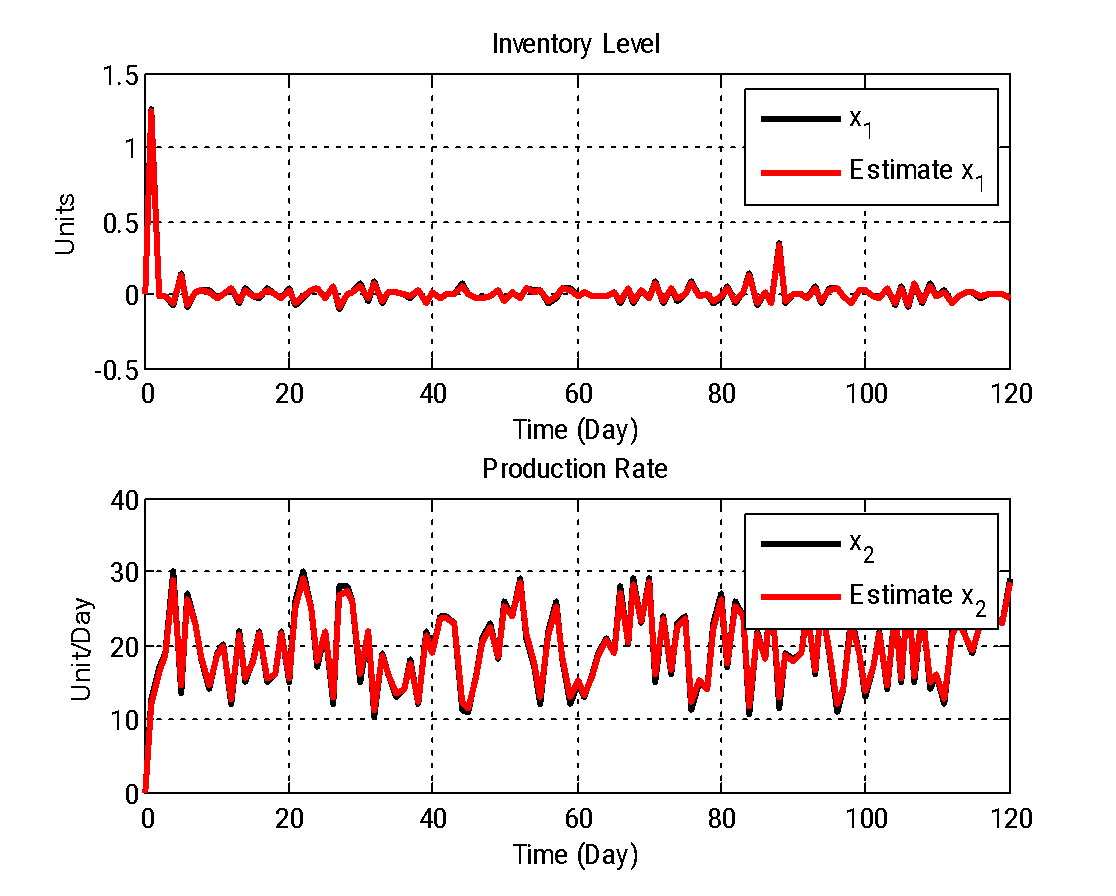
Figure 8. Estimation of and
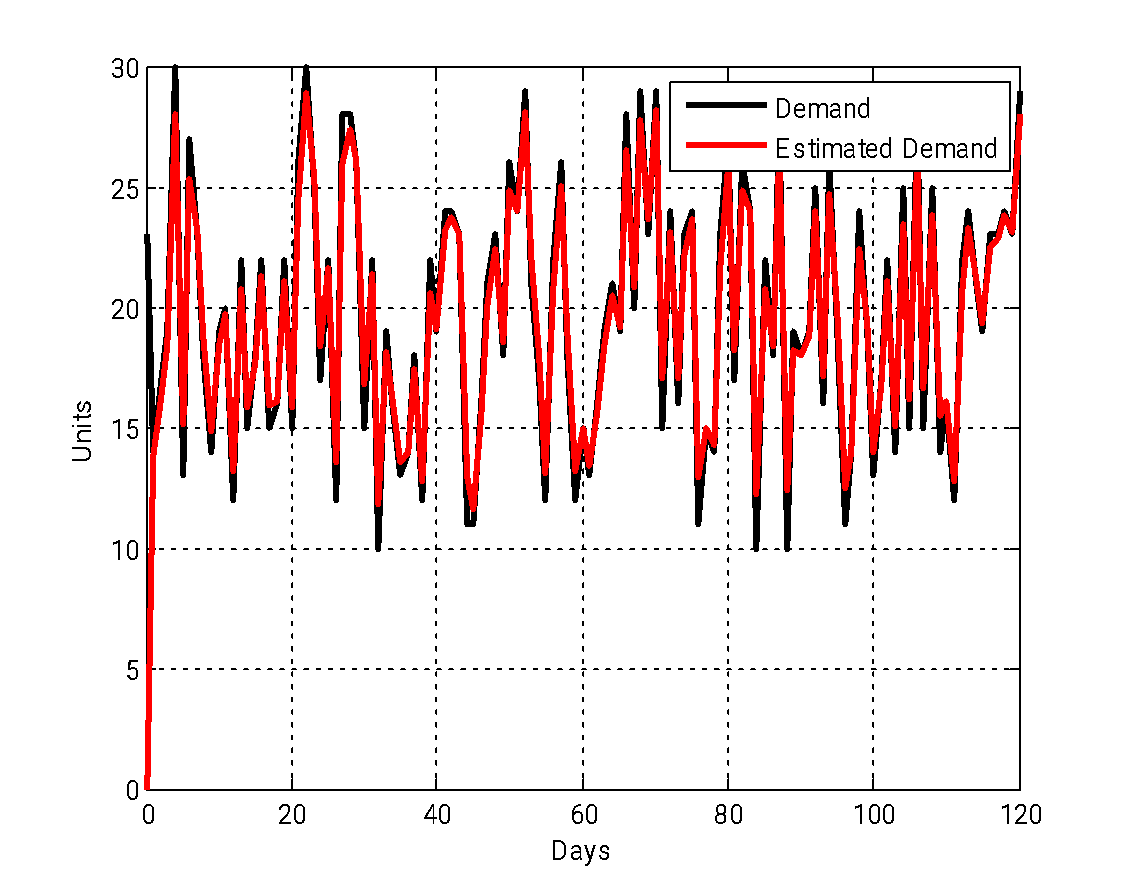
Figure 9. Estimation of demand
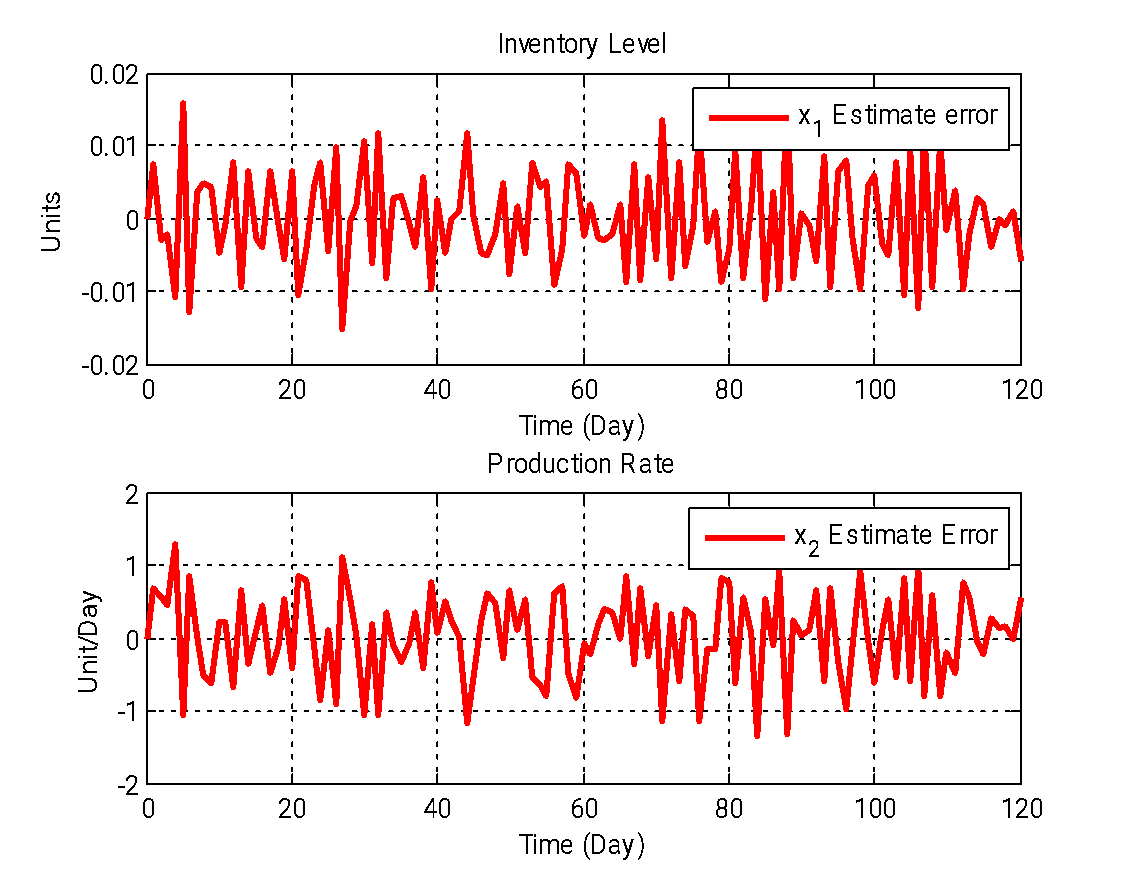
Figure 10. Estimation error of and
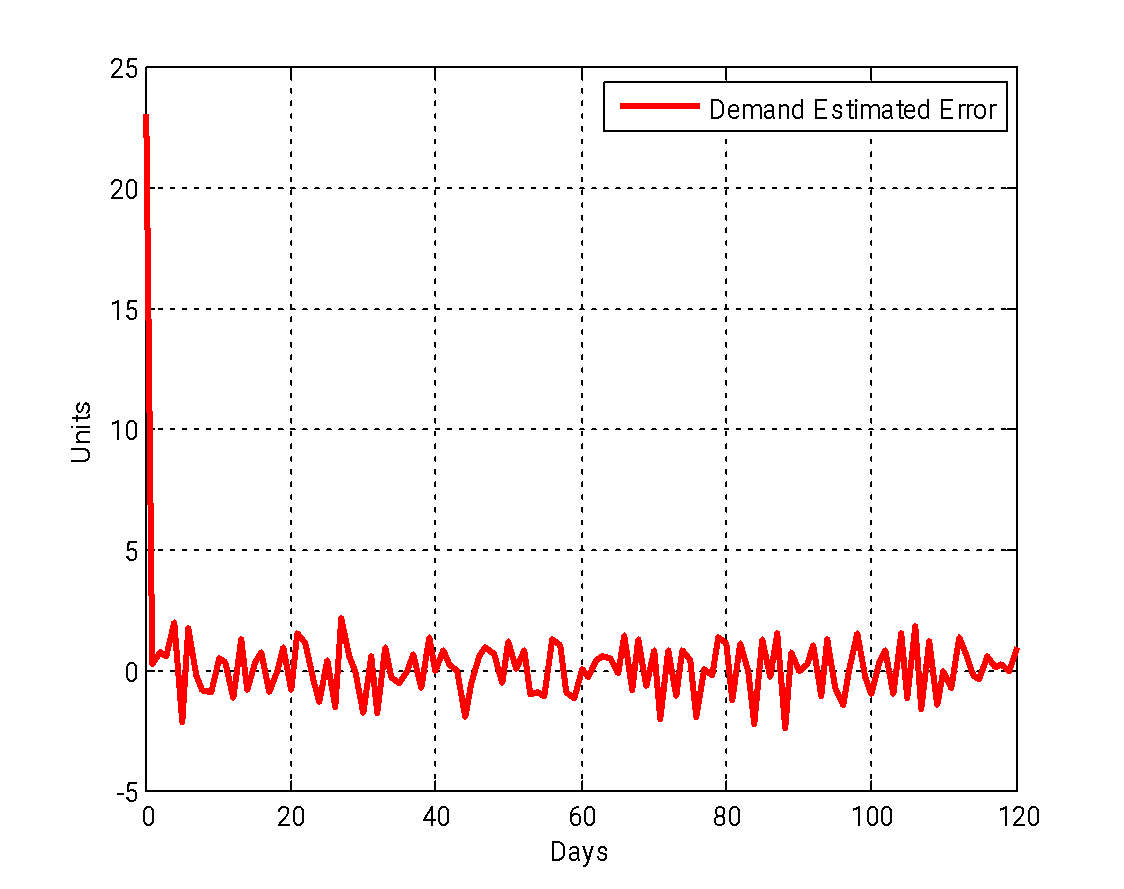
Figure 11. Estimate error of demand
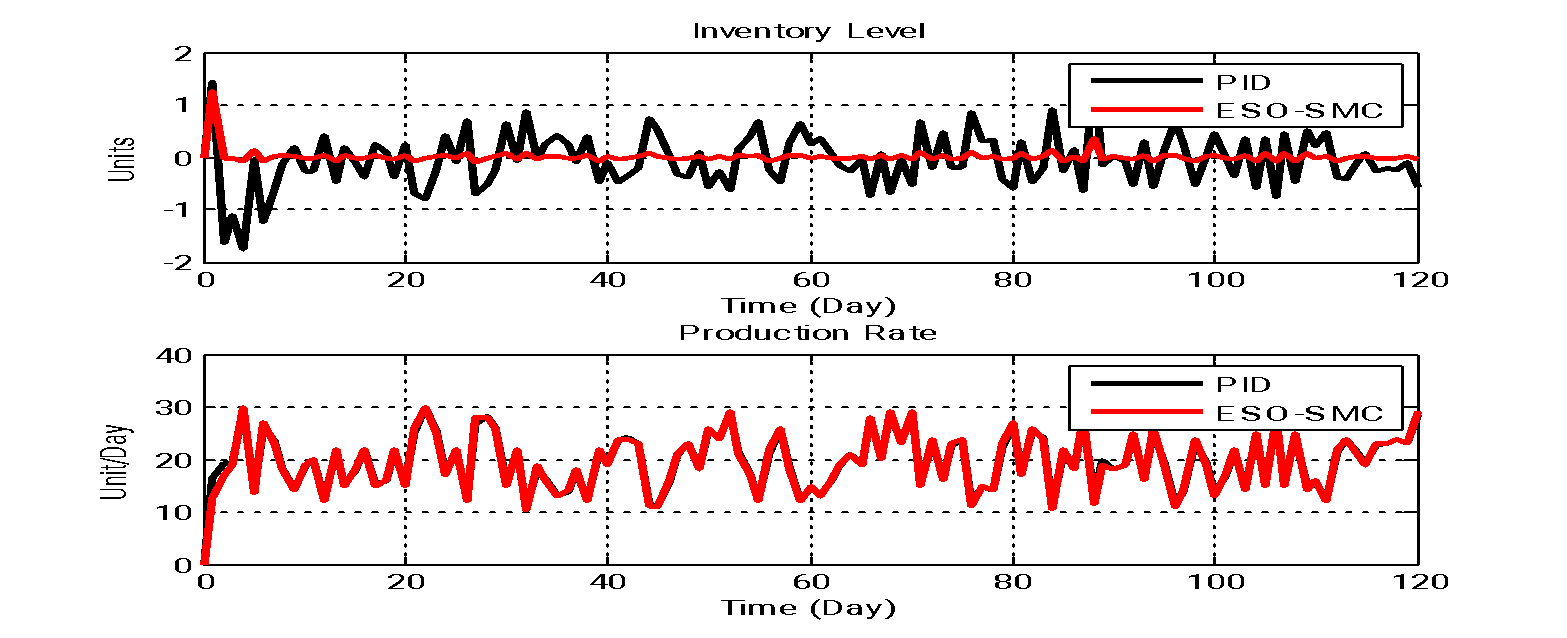
Figure 12. Inventory response based on ESO-SMC and PID
Table 2. Performances evaluation
Controller | IAE |
ESO-SMC | 6.01 |
PID | 49.7 |
CONCLUSIONS
Inventory management is a critical component of optimized supply chain networks. This paper proposes effective and powerful inventory management system. The major difficulties are that the demand is unpredictable and time variant demanding a strong and stable policy of control. For this purpose one new methodology is proposed: the combination of an extended state observer with sliding mode control (ESO-SMC) is recommended to keep the level of inventory at the desired value. The Searching parameters for the observer-controller are tuned by circle search algorithm (CSA). The simulation and testing of the obtained control scheme is carried out with MATLAB simulation results, and it is found that the control law provides accurate reference tracking control of the inventory variables in the presence of uncertainty of the demand. Analysis and comparison of simulated with the PID controller are also evidence of the effectiveness of the suggested strategy. Two scenarios with different time-varying random demand are used for evolution. The reduction in IAE is approximately 85% and 88% in the two scenarios. However, further research is needed to address uncertainties in production lead times and optimize the handling of perishable goods to prevent spoilage. Additionally, this study could be extended to incorporate production capacity constraints. Integrating these physical limitations is essential for industrial applications, ensuring that the model's recommendations are both feasible and directly implementable on the factory floor.
REFERENCES
- A. S. White and M. Censlive, "An alternative state-space representation for APVIOBPCS inventory systems," Journal of Manufacturing Technology Management, vol. 24, no. 4, pp. 588-614, 2013, https://doi.org/10.1108/17410381311327413.
- A. S. Jaboob, A. M. B. Awain, K. A. M. Ali, and A. M. Mohammed, "Introduction to operation and supply chain management for entrepreneurship," In Applying Business Intelligence and Innovation to Entrepreneurship, pp. 52-80, 2024, https://doi.org/10.4018/979-8-3693-1846-1.ch004.
- J. D. Schwartz and D. E. Rivera, "A process control approach to tactical inventory management in production-inventory systems," International Journal of Production Economics, vol. 125, no. 1, pp. 111-124, 2010, https://doi.org/10.1016/j.ijpe.2010.01.011.
- B. Ponte, J. Costas, J. Puche, R. Pino and D. de la Fuente, "The value of lead time reduction and stabilization: A comparison between traditional and collaborative supply chains," Transportation Research Part E: Logistics and Transportation Review, vol. 111, pp.165-185, 2018, https://doi.org/10.1016/j.tre.2018.01.014.
- S. Tosetti, D. Patino, F. Capraro and A. Gambier, "A new inventory level APIOBPCS-based controller," In 2008 American Control Conference [IEEE], pp. 2886-2891, 2008, https://doi.org/10.1109/ACC.2008.4586933.
- E. Aggelogiannaki, P. Doganis and H. Sarimveis, "An adaptive model predictive control configuration for production–inventory systems," International Journal of Production Economics, vol. 114, no. 1, pp. 165-178, 2008, https://doi.org/10.1016/j.ijpe.2008.01.003.
- H. AL-Khazraji, C. Cole and W. Guo, "Analysing the impact of different classical controller strategies on the dynamics performance of production-inventory systems using state space approach," Journal of Modelling in Managemen, vol. 13, pp. 211–235, 2018, https://doi.org/10.1108/JM2-08-2016-0071.
- M. Ortega and L. Lin, "Control theory applications to the production–inventory problem: a review," International Journal of Production Research, vol. 42, no. 11, pp. 2303-2322, 2004, https://doi.org/10.1080/00207540410001666260.
- H. Sarimveis, P. Patrinos, C.D. Tarantilis and C.T. Kiranoudis, "Dynamic modeling and control of supply chain systems: A review," Computers & operations research, vol. 35, no. 11, pp. 3530-3561, 2008, https://doi.org/10.1016/j.cor.2007.01.017.
- D. N. Nya and H. Abouaïssa, "Model-Free Control for Dynamic Inventory Management in Supply Chain Planning," 2024 10th International Conference on Control, Decision and Information Technologies (CoDIT), pp. 2863-2868, , 2024, https://doi.org/10.1109/CoDIT62066.2024.10708379.
- A. Zemzam, M. E. Maataoui, M. Hlyal, J. E. Alami and N. E. Alami, "Inventory management of supply chain with robust control theory: literature review," International Journal of Logistics Systems and Management, vol. 27, no. 4, pp.438-465, 2017, https://doi.org/10.1504/IJLSM.2017.085223.
- D. R. Towill, "Dynamic analysis of an inventory and order based production control system," The international journal of production research, vol. 20, no. 6, pp. 671-687, 1982, https://doi.org/10.1080/00207548208947797.
- F. M. Kasie, G. Bright, and A. Walker, “Decision support systems in manufacturing: a survey and future trends,” Journal of Modelling in Management, vol. 12, no. 3, pp. 432-454, 2017, https://doi.org/10.1108/JM2-02-2016-0015.
- H. AL-Khazraji, C. Cole and W. Guo, "Dynamics analysis of a production-inventory control system with two pipelines feedback," Kybernetes, vol. 46, no. 10, pp.1632-1653, 2017, https://doi.org/10.1108/K-04-2017-0122.
- D. R. Towill, G. N. Evans and P. Cheema, "Analysis and design of an adaptive minimum reasonable inventory control system," Production Planning & Control, vol. 8, no. 6, pp.545-557, 1997, https://doi.org/10.1080/095372897234885.
- S. Tosetti, D. Patino, F. Capraro and A. Gambier, "Control of a production-inventory system using a PID controller and demand prediction," IFAC Proceedings, vol. 41, no. 2, pp.1869-1874, 2008, https://doi.org/10.3182/20080706-5-KR-1001.00319.
- A. S. White and M. Censlive, "Using control theory to optimise profit in APVIOBPCS inventory systems," Journal of Manufacturing Systems, vol. 32, no. 4, pp.680-688, 2013, https://doi.org/10.1016/j.jmsy.2013.06.002.
- H. Sarir, and B. Abderhmane, "Smart inventory control by using PID ACO controller and fuzzy logic controller," In 2022 14th International Colloquium of Logistics and Supply Chain Management (LOGISTIQUA), pp. 1-7, 2022, https://doi.org/10.1109/LOGISTIQUA55056.2022.9938044.
- H. Al-Khazraji, W. Guo, and A. J. Humaidi, "Improved cuckoo search optimization for production inventory control systems," Serbian Journal of Electrical Engineering, vol. 21, no. 2, pp.187-200, 2024, https://doi.org/10.2298/SJEE2402187A.
- A. Camacho-Ramirez, J. C. Avila-Vilchis, M. Jimenez-Lizarraga, B. Saldivar, A. H. Vilchis-Gonzalez, and J. M. Jacinto-Villegas, “Tracking and Stiffness Control Based on Sliding Modes Design for a Wrist-Elbow Rehabilitator,” International Journal of Precision Engineering and Manufacturing, vol. 26, no. 3, pp. 583-597, 2025, https://doi.org/10.1007/s12541-024-01130-4.
- R. Uswarman, A. I. Cahyadi, and O. Wahyunggoro, "Design and implementation of a magnetic levitation system controller using global sliding mode control," Journal of Mechatronics, Electrical Power, and Vehicular Technology, vol. 5, no. 1, pp. 17-26, 2014, https://doi.org/10.14203/j.mev.2014.v5.17-26.
- O. Barambones, P. Alkorta, and M. De La Sen, "Wind turbine output power maximization based on sliding mode control strategy," In 2010 IEEE International Symposium on Industrial Electronics, pp. 364-369, 2010, https://doi.org/10.1109/ISIE.2010.5637694.
- L. A. Tuan, and S. G. Lee, "Sliding mode controls of double-pendulum crane systems," Journal of Mechanical Science and Technology, vol. 27, no. 6, pp.1863-1873, 2013, https://doi.org/10.1007/s12206-013-0437-8.
- S. Lekhchine, T. Bahi, H. Bouzeria, and S. Lachtar, "Robust sliding mode speed controller for induction motor drive system," International Journal of Industrial Electronics and Drives, vol. 2, no. 2, pp.84-90, 2015, https://doi.org/10.1504/IJIED.2015.069779.
- N. S. Mahmood, A. J. Humaidi, R. S. Al-Azzawi, and A. Al-Jodah, "Extended state observer design for uncertainty estimation in electronic throttle valve system," International Review of Applied Sciences and Engineering, vol. 15, no. 1, pp.107-115, 2024, https://doi.org/10.1556/1848.2023.00662.
- H. Marwan, A. J. Humaidi, and H. Al-Khazraji, "Fractional Order Extended State Observer Enhances the Accuracy of Estimation for Flexible Joint Single-link Robot," Journal of Robotics and Control (JRC), vol. 6, no. 3, pp.1332-1339, 2025, https://doi.org/10.18196/jrc.v6i3.26318.
- G. Yang, F. Lu, L. Wu, and J. Xu, "Design of particle swarm optimization adaptive sliding mode controller based on an extended state observer for the longitudinal motion of a supercavitating vehicle with input saturation," Journal of Sensors, vol. 2023, no. 1, p.2938089, 2023, https://doi.org/10.1155/2023/2938089.
- L. T. Rasheed, and M. K. Hamzah, "Design of an optimal backstepping controller for nonlinear system under disturbance," Engineering and Technology Journal, vol. 39, no. 3, pp. 465-476, 2021, https://doi.org/10.30684/etj.v39i3A.1801.
- F. R. Yaseen, M. Q. Kadhim, H. Al-Khazraji, A. J. Humaidi, "Decentralized Control Design for Heating System in Multi-Zone Buildings Based on Whale Optimization Algorithm," Journal Européen des Systèmes Automatisés, vol. 57, no. 4, pp. 981 – 989, 2024, https://doi.org/10.18280/jesa.570406.
- M. H. Qais, H. M. Hasanien, R. A. Turky, S. Alghuwainem, M. Tostado-Véliz, and F. Jurado, "Circle search algorithm: A geometry-based metaheuristic optimization algorithm," Mathematics, vol. 10, no. 10, p.1626, 2022, https://doi.org/10.3390/math10101626.
- D. N. Nya, and H. Abouaïssa, "An efficient framework for tactical management in supply chain systems," In 2022 14th International Colloquium of Logistics and Supply Chain Management (LOGISTIQUA), pp. 1-6, 2022, https://doi.org/10.1109/LOGISTIQUA55056.2022.9938109.
- A. S. White, and M. Censlive, "Analysis of the robustness of a single-tier pipeline inventory model," International Journal of Inventory Research, vol. 5, no. 4, pp.339-362, 2020, https://doi.org/10.1504/IJIR.2020.109779.
- M. Rahaman, R. M. Abdulaal, O. A. Bafail, M. Das, S. Alam, and S. P. Mondal, “An insight into the impacts of memory, selling price and displayed stock on a retailer’s decision in an inventory management problem,” Fractal and Fractional, vol. 6, no. 9, p. 531, 2022, https://doi.org/10.3390/fractalfract6090531.
- A. M. Abdullah, H., Hasan, A. Al-Qassar, S. Al-Samarraie, “Comparative Analysis of Two Robust Strategies for an Angular Velocity Control System" Iraqi Journal of Computers, Communications, Control & Systems Engineering (IJCCCE), vol. 24, no. 3, pp.86-103, 2024, https://doi.org/10.33103/uot.ijccce.24.3.7.
- A. S. Malik, I. Ahmad, A. U. Rahman and Y. Islam, "Integral Backstepping and Synergetic Control of Magnetic Levitation System," in IEEE Access, vol. 7, pp. 173230-173239, 2019, https://doi.org/10.1109/ACCESS.2019.2952551.
- A. Alkamachi, “Robust Speed Control of Permanent Magnet DC Motors Using an Arctic Puffin Optimized PI Controller and Nonlinear Disturbance Observer,” Buletin Ilmiah Sarjana Teknik Elektro, vol. 8, no. 3, pp. 684–698, 2026, https://doi.org/10.12928/biste.v8i3.15723.
- A. A. Flaih, E. H. Karam, and Y. A. Mohammed, “Optimal PID Controller Based on Different Modified Grasshopper Optimization Algorithm for Nonlinear Single-Input Single-Output System,” Buletin Ilmiah Sarjana Teknik Elektro, vol. 7, no. 4, pp. 756–773, 2025, https://doi.org/10.12928/biste.v7i4.14394.
- N. Salman and S. K. Kadhim, “Improving Performance and Safety in Mechanical Ventilation: A Robust Control Approach for Airway Pressure and Patient Flow,” Buletin Ilmiah Sarjana Teknik Elektro, vol. 7, no. 4, pp. 807–822, 2025, https://doi.org/10.12928/biste.v7i4.14283.
- Fahmizal, A. Mayub, L. F. Rafanah, and S. Latifa, “Fuzzy-PID Control for Balancing a Two-Wheeled Inverted Pendulum Robot,” Journal of Fuzzy Systems and Control, vol. 4, no. 1, pp. 58–64, 2026, https://doi.org/10.2139/ssrn.5175320.
- A. Ma’arif, O. Wahyunggoro, A. Cahyadi, "Super-twisting sliding mode control of magnetic levitation systems under disturbance and parametric uncertainty: A comparative study with nonlinear controller," Ain Shams Engineering Journal, vol. 17, no. 7, pp. 1-12, 2026, https://doi.org/10.1016/j.asej.2026.104227,
- S. K. Hasan and A. K. Dhingra, “ Development of a sliding mode controller with chattering suppressor for human lower extremity exoskeleton robot,” Results in Control and Optimization, vol. 7, p. 100123, 2025, https://doi.org/10.1016/j.rico.2022.100123.
- A. A. Ebrahim, "Modeling of a sliding mode controller to control the tracking system for solar panels with two degrees of freedom," Control Systems and Optimization Letters, vol. 4, no. 1, pp.91-100, 2026, https://doi.org/10.59247/csol.v4i1.277.
- S. A. AL-Samarraie, S. M. Mahdi, T. M. M. Ridha, and M. H. Mishary, "Sliding mode control for electro-hydraulic servo system," Iraqi Journal Computer Communication Control System Engineering, vol. 15, no. 3, pp.1-10, 2015, https://doi.org/10.33103/2617-3352.1296.
- A. K. Ahmed and H. Al-Khazraji, “Optimal Control Design for Propeller Pendulum Systems Using Gorilla Troops Optimization,” Journal Européen des Systèmes Automatisés, vol. 56, no. 4, pp. 575-582, 2023, https://doi.org/10.18280/jesa.560407.
- H. Al-Khazraji, R. M. Naji, and M. K. Khashan, “Optimization of Sliding Mode and Back-Stepping Controllers for AMB Systems Using Gorilla Troops Algorithm,” Journal Européen des Systèmes Automatisés, vol. 57, no. 2, pp. 417-424, 2024, https://doi.org/10.18280/jesa.570211.
- X. Yang, and Y. Huang, "Capabilities of extended state observer for estimating uncertainties," In 2009 American control conference, pp. 3700-3705, 2009, https://doi.org/10.1109/ACC.2009.5160642.
- B. Z. Guo and Z. I. Zhao, "On the convergence of an extended state observer for nonlinear systems with uncertainty," Systems & Control Letters, vol. 60, no. 6, pp.420-430, 2011, https://doi.org/10.1016/j.sysconle.2011.03.008.
- C. Liu, H. Wang, X. Qiu, K. Nie, Q. Duan, and Y. Mao, "The RSLQR control method based on the linear extended state observer in the electro-optical tracking system," IEEE Photonics Journal, vol. 16, no. 2, pp.1-11, 2024, https://doi.org/10.1109/JPHOT.2024.3356581.
- M. Neroni, A. A. Juan, and M. Bertolini, “A multistart biased‐randomized algorithm for solving a three‐dimensional case picking problem with real‐life constraints,” International Transactions in Operational Research, vol. 31, no. 4, pp. 2154-2177, 2024, https://doi.org/10.1111/itor.13421.
- S. Khlil, H. Al-Khazraji, and Z. Alabacy, "Solving assembly production line balancing problem using greedy heuristic method," in IOP Conference Series: Materials Science and Engineering, vol. 745, no. 1, pp. 1-7, 2020, https://doi.org/10.1088/1757-899X/745/1/012068.
- A. Dafid, “Optimizing K-Nearest Neighbors with Particle Swarm Optimization for Improved Classification Accuracy,” Jurnal Ilmiah Teknik Elektro Komputer dan Informatika (JITEKI), vol. 11, no. 2, pp. 238–250, 2025, https://doi.org/10.26555/jiteki.v11i2.30775.
- S. Tahcfulloh, D. Maulianawati, and D. Wiharyanto, “Optimizing 2.4GHz Wireless Networks in Shrimp Ponds with Particle Swarm Optimization,” Jurnal Ilmiah Teknik Elektro Komputer dan Informatika, vol. 10, no. 4, pp. 817–832, 2024, https://doi.org/10.26555/jiteki.v10i4.30236.
- S. Jabber, S. Hashem, S. Jafer, "Analytical and Comparative Study for Optimization Problems," Iraqi Journal of Computers, Communications, Control and Systems Engineering, vol. 23, no. 4, 46-57, 2023, https://doi.org/10.33103/uot.ijccce.23.4.5.
- R. J. Salman, H. M. Alwan, M. A. Yousif, A. M. Abdullah, "Computed torque-NN-GWO dynamic hybrid control of manipulator robotic arm," Iraqi Journal of Computers, Communications, Control and Systems Engineering, vol. 24, no. 2, pp. 1-16, 2024, https://doi.org/10.33103/uot.ijccce.24.2.1.
- F. R. Al-Ani, O. F. Lutfy, and H. Al-Khazraji, "Optimal Backstepping and Feedback Linearization Controllers Design for Tracking Control of Magnetic Levitation System: A Comparative Study," Journal of Robotics and Control (JRC), vol. 5, no. 6, pp.1888-1896, 2024, https://doi.org/10.18196/jrc.v6i1.24452.
- M. Jabari A. Rad, "Optimization of speed control and reduction of torque ripple in switched reluctance motors using metaheuristic algorithms based PID and FOPID controllers at the edge," Tsinghua Science andTechnology, vol. 30, no. 4, pp. 1526-38, 2025, https://doi.org/10.26599/TST.2024.9010021.
- M.Q. Kadhim, F. R. Yaseen, H. Al-Khazraji and A. J. Humaidi, "Application of Terminal Synergetic Control Based Water Strider Optimizer for Magnetic Bearing Systems," Journal of Robotics and Control (JRC), vol. 5, no. 6, pp.1973-1979, 2024, https://doi.org/10.18196/jrc.v5i6.23867.
- Q. Wang, H. Xi, F. Deng, M. Cheng, and G. Buja, “Design and analysis of genetic algorithm and BP neural network based PID control for boost converter applied in renewable power generations,” IET renewable power generation, vol. 16, no. 7, pp. 1336-1344, 2022, https://doi.org/10.1049/rpg2.12320.
- V.C. Bui, V.Q. Le, A.N. Ngo, and C.H. Canh, “Firefly Algorithm-Based PID Optimization for Active Suspension Systems in Electric Vehicles”, Journal of Fuzzy Systems and Control, vol. 3, no. 2, pp. 142–148, 2025, https://doi.org/10.59247/jfsc.v3i2.311.
- F. R. Yaseen, and H. Al-Khazraji, "Optimized Vector Control Using Swarm Bipolar Algorithm for Five-Level PWM Inverter-Fed Three-Phase Induction Motor," International Journal of Robotics & Control Systems, vol. 5, no. 1, pp. 333-347, 2025, https://doi.org/10.31763/ijrcs.v5i1.1713.
- M. N. Ajaweed, A. H. Issa, and M. T. Muhssin, "Design and Implementation of an OFOPID Controller for Iraqi Two Areas Power System Using Ant-Colony Optimization Algorithm," Iraqi Journal of Computers, Communications, Control and Systems Engineering, vol. 26, no. 1, pp.83-100, 2026, https://doi.org/10.33103/2617-3352.1519.
- M. H. Qais, H. M. Hasanien, S. Alghuwainem, K. H. Loo, M. A. Elgendy, and R. A. Turky, "Accurate three-diode model estimation of photovoltaic modules using a novel circle search algorithm," Ain Shams Engineering Journal, vol. 13, no.3, p.101824, 2022, https://doi.org/10.1016/j.asej.2022.101824.
- G. A. Ghazi, E. A. Al-Ammar, H. M. Hasanien, W. Ko, S. M. Lee, R. A. Turky, M. Tostado-Véliz, and F. Jurado, "Circle search algorithm-based super twisting sliding mode control for MPPT of different commercial PV modules," IEEE Access, vol. 12, pp. 33109-33128, 2024, https://doi.org/10.1109/ACCESS.2024.3372412.
- R. A. Mahmod, R. A. Kadhima, M. Nawfal, and H. Al-Khazraji, "High Gain Observer Based Backstepping Control Design for Nonlinear Single-Axis Driven Systems," International Journal of Robotics and Control Systems, vol. 5, no. 3, pp.1886-1899, 2025, https://doi.org/10.31763/ijrcs.v5i3.1984.
- M. Qais, M. Hasanien, R. A. Turky, S. Alghuwainem, H. Loo, and M. Elgendy, "Optimal PEM fuel cell model using a novel circle search algorithm," Electronics, vol. 11, no. 12, p.1808, 2022, https://doi.org/10.3390/electronics11121808.
- D. J. K. Kishore, M. R. Mohamed, K. Sudhakar, P. Kurukuri, "Application of circle search algorithm for solar PV maximum power point tracking under complex partial shading conditions," Applied Soft Computing, vol. 165, pp. 112030, 2024, https://doi.org/10.1016/j.asoc.2024.112030.
- P. Anbarasu, N. Loganathan, A. Narendran and K. Rameshkumar, "Design and intelligent tuning of a proportional–integral–derivative controller for an armature-controlled DC motor," International Journal of Advanced Technology and Engineering Exploration. vol. 13, no. 134, pp. 85-101, 2026, https://doi.org/10.19101/IJATEE.2025.121220008.
- I. Ahmed, M. H. Suid, M. A. Ahmad, S. Ahmad, M. F. M. Jusof, and Z. M. Tumari, "Optimization of a robust sigmoid PID controller for automatic voltage regulation using the nonlinear sine-cosine algorithm with amplifier feedback dynamic weighted (AFDW) system," International Journal of Robotics and Control Systems, vol. 5, no. 3, pp.1975-1997, 2025, https://doi.org/10.31763/ijrcs.v5i3.1930.
- S. Salim, M. Rahmat, L. Abdullah, S. Shamsudin, K. Kamaludin, and M. Ibrahim, "Comparative insights into nonlinear PID-based controller design approaches for industrial applications," IAES International Journal of Robotics and Automation, vol. 14, no. 2, pp. 191-203, 2025, https://doi.org/10.11591/ijra.v14i2.pp191-203.
Neamah D. Farhan (Sliding Mode based Circle Search Algorithm for Inventory Control with Extended State Observer)