ISSN: 2685-9572 Buletin Ilmiah Sarjana Teknik Elektro
Vol. 8, No. 3, June 2026, pp. 925-940
Maximization Very Short-Term Forecasting of Power Photovoltaic System Using Machine Learning Based on Clearness Index Model
Unit Three Kartini 1, L. Endah Cahya Ningrum 2 M. Nur Adiwana 3
1,2 Dept. Electrical Engineering, Faculty of Engineering, Universitas Negeri Surabaya, Surabaya, East Java, Indonesia
3 Dept. of Electrical Engineering, Polytechnic State Madura, Madura, East Java, Indonesia
ARTICLE INFORMATION |
| ABSTRACT |
Article History: Received 16 March 2026 Revised 29 May 2026 Accepted 02 July 2026 |
| 
The hybrid model for very short-term photovoltaic (PV) power forecasting, covering one hour ahead with 20-minute intervals, combines the k-nearest neighbour (k-NN) and multilayer backpropagation neural network (BP-NN) methods. The uniqueness of this model lies in integrating meteorological and the clarity index. the data preprocessing stage, the k-NN method is applied, while the multilayer BP-NN is used for forecasting. The k-NN Multilayer BP-NN algorithm calculates the nearest data points using Euclidean distance, and then processes the training and testing data through the multilayer BP-NN to generate PV power predictions. The simulation dataset was divided into 70% training data and 30% testing data, with a maximum PV power output of 611 W. The error statistical indicators of machine learning using k-NN-BP-NN model RMSE 27.44 W and MSE 1.5 W. These superior results are attributed to more stable weather patterns and consistent solar radiation. The simulation validity test demonstrated that the k-NN Multilayer BP-NN algorithm achieved better accuracy compared to the k-NN decomposition method. In addition, the model offers high computational efficiency and short inference time, making it highly suitable for real-time PV power forecasting systems. |
Keywords: Forecasting; Machine Learning; Clearness Index; Maximization; Photovoltaic |
Corresponding Author: Unit Three Kartini, Dept. Electrical Engineering, Faculty of Engineering, Universitas Negeri Surabaya, Surabaya, East Java, Indonesia. Email: unitthree@unesa.ac.id |
This work is open access under a Creative Commons Attribution-Share Alike 4.0 
|
Document Citation: U. T. Kartini, L. E. C. Ningrum and M. N. Adiwana, “Maximization Very Short-Term Forecasting of Power Photovoltaic System Using Machine Learning Based on Clearness Index Model,” Buletin Ilmiah Sarjana Teknik Elektro, vol. 8, no. 3, pp. 925-940, 2026, DOI: 10.12928/biste.v8i3.16181. |
- INTRODUCTION
This study discusses several ongoing studies that aim to predict the power generated by photovoltaic (PV) generation systems. This section examines and focuses on improve prediction accuracy the prediction of PV system power used as a very short-term target, utilising the availability of local PV power plant databases and employing clearness index data. In this proposed, a new method is used that employs a machine learning model combining k-nearest neighbour (k-NN) and Multi Layer BP-NN modeling, which has been designed for system power estimation. Mathematical modelling with machine learning is used for power prediction by the system at the target PV power plant by calculating the distance (k value) informed by Euclidean, then simulating and validating the data using BP-NN modeling. Previous research on power PV system prediction has presented a variety of mathematical methods based on clearness index data. It has also been research described in reference to A. Jia, et al, et al, Renold et al, A. N. Sharkawy, et al, A. Maged et al, A. Ghennioui, et al, B. Arseven, et al and C. Yeung, et al [1]-[7] presented research about the very short-term photovoltaic (PV) power estimation and forecasting can be significantly improved by utilizing hybrid machine learning and deep learning approaches. Combining cloud features, solar irradiance, time series data, and the clearness index enhances prediction accuracy compared to conventional methods. Furthermore, multivariate models and atmospheric condition analysis provide better capability to capture dynamic weather variations. Therefore, integrating multiple meteorological parameters with artificial intelligence techniques offers an effective solution for producing more accurate, stable, and reliable PV power predictions to support renewable-based power system operations. Analysis for result prediction solar irradiation using LSTM framework and fuzzy-based prediction solar PV using Particle Swarm Optimization has been described by researchers C. Zhang, et al, C. Otuka et al, D. Abdulai, et al, M Teferra, et al, and E. Wittmann, et al, for [8]-[12]. F. V. Mucomole et al, F. Wang, et al H. Wen, et al., H. Xiao, et al, H. Zang et al, and J. Yang et al [13]-[19] conducted research about The studies conclude that ultra-short-term PV power forecasting can be improved using hybrid neural networks, convolutional methods, and clear sky index modeling. These approaches enhance prediction accuracy and optimization of PV power generation under varying weather conditions. And the hybrid network models can improve short-term PV power prediction accuracy, providing more reliable forecasting for photovoltaic system operation and energy management has been described J. Yang et al, J. Zhang et al, and K. Park, et al [20]-[23]. A real-time solar power-based attention model has been described by researcher K. Park, et al [23] Model forecasting of global solar irradiance for PV power generation using LSTM and GRU has been described by researchers K. Wang et al, L. D. Riihimaki et al, L. Xu et al, M. Fathi et al., Hilal et al [24]-[28] presented about short-term estimation using LSTM-NN and meteorologi prediction. M. Walters et al, M. Jebali et al, M. Li et al and N. A Kadhim et al [29]-[32] research about optimizing PV with real-time reconfiguration planning. N. Jittratorn et al, N. Koshkarboy et al, and P. K. Ray et al [33]-[35] explain prediction and classification based on weather data for forecasting global solar insolation. The advanced forecasting techniques can improve the accuracy and reliability of short-term PV power prediction, supporting more efficient photovoltaic system operation and renewable energy management. has been researcher Q. Li et al, Q. Zhang et al, R. T Kumar, et al, S. Chen et al and S. Riyadi et al [36]-[40]. Prediction short term and power quality modul PV power using combination model has been researcher S. Wu et al, B. Abderraouf et al, W. Liang et al, and Y. Cai et al [41]-[44]. Prediction of PV power based on sky image and temperate climates has been described by researchers Y. Huang et al, Fu et al and Y. J. K Musleh et al [45]-[47]. Hierarchical energy management has been described by Y. Y Hong et al, Y. Yu et al, Z. Allal et al, Y. Yang et al [48]-[51] explain estimation of solar irradiance using a hybrid model with machine learning.
The studies mentioned above have discussed PV power generation systems in terms of power generation prediction and performance optimisation at photovoltaic power stations using hybrid modelling. However, the research conducted has not discussed very short-term of improve prediction accuracy for electrical power in photovoltaic generation systems using hybrid mathematical machine learning models with k-nearest neighbour (k-NN) and Multi Layer BP Neural Network (BP-NN) models. This study aims to optimize forecasting performance very short-term power forecasting for photovoltaic power generation systems. This section focuses on how to predict GHI hour for photovoltaic (PV) power generation systems by utilising local databases based on meteorological data. Although many studies have used the k-NN and BP-NN methods individually, particularly for photovoltaic forecasting, this study employs an integrated approach utilising the k-NN model as a pre-processing stage to select the most relevant meteorological patterns and clearness index before processing by the multilayer BP-NN. The hybrid k-NN-Multilayer BP-NN algorithm approach uses the clearness index as the primary indicator, combined with more representative meteorological data parameters, and integrates weather patterns using k-NN with the non-linear learning capabilities of the BP-NN for very short-term PV forecasting one hour ahead. The main challenge in making predictions is the fluctuating power output from PV plants due to changes in weather conditions. In this study, k-NN is used to filter historical data with similar characteristics so that the BP-NN receives variable inputs during the simulation process, there by improving the stability of the PV generation prediction results.
In this study, a new mathematical method combining hybrid machine learning modeling, namely k-nearest neighbour and back propagation neural network modelling techniques, has been optimized to maximise very short-term forecasting of the electrical power generated by PV systems. The machine learning model is used to predict the power generated by the PV power generation system with a hybrid model based on clearness index data, objectives, and then perform data testing and training. The advantage of optimize forecasting performance very short-term power generation prediction using machine learning by combining the k-nearest neighbour and backpropagation neural network (k-NN-BPNN) models is the ease of use in making predictions, as this model is very simple and utilises actual data accurately as input variables. The hybrid model uses simple mathematical calculations for short-term power prediction, and the use of this hybrid model produces electricity power predictions for the next week based on the clearness index. Using hybrid k-NN and BP-NN modeling is intended to be able to increase and fast and efficient computational analysis process for the prediction accuracy value of PV generation power which has minimal RMSE and MAE values compared to the k-NN decomposition model, or other conventional methods. The main contributions of this research are as follows:
- A new mathematical model to maximize very short-term predictions of PV power generation within one hour is innovative and adaptive to changes in input parameters, namely in the form of brightness index data variables, using machine learning using a hybrid k-NN-BP-NN machine learning model.
- This study uses a hybrid model based on the clarity index to maximize PV generation power forecasting, with input variables based on brightness index data that take into account the comparison between global horizontal solar radiance and solar irradiance
- The results of the study are compared with another conventional model, namely the hybrid k-NN decomposition model. The machine learning model (k-NN-BP-NN) is expected to achieve high accuracy with evaluation values of RMSE and MSE of at least 10%.
This study aims to test the hybrid k-NN and BP-NN algorithm models are able to improve the accuracy of very short-term PV power predictions compared to the k-NN Decomposition model and conventional methods, especially in conditions of dynamic and constantly fluctuating meteorological changes. The research contribution is the development of a hybrid k-Nearest Neighbor (k-NN) and multilayer Backpropagation Neural Network (BP-NN) model to improve the accuracy of very short-term photovoltaic (PV) power prediction. The proposed model is able to produce lower error values than comparable methods, thus potentially supporting more effective management and integration of PV systems in the electricity grid. The combination of machine learning models with the k-NN method as data preprocessing and BP-NN as a prediction model can reduce the prediction error value (RMSE and MAE) significantly compared to using the k-NN decomposition model. And this study is organised into several sections, as follows: Section 1 explains analysis for the background and innovative of this research, Section 2 explains the data from the PV station; machine learning by combining two models, namely k-NN and Multi Layer BP-NN, with an integrated build and hybrid model for maximising the forecasting of electrical power generated by the PV generation system, while Section 3 describes the results analysis of very short-term electrical power at PV system prediction. Finally, Section 4 explains the conclusions.
- PROBLEM FORMULATION
- Experimental Setup and Data Acquisition
The machine learning design used a hybrid k-NN-BP-NN combination method, trained on a 1-day historical data set. The PV system used is a Photovoltaic model using monocrystalline panels with an installed capacity of around 600–650 Wp installed facing north/south according to the geographical location, with a certain tilt angle to obtain optimal solar radiation. With a 1000 W inverter and using a battery with a capacity of 75 Ah. This information is important because it greatly affects the characteristics of the power utility and the predicted performance of the PV. The input variable data were acquired from meteorological data for PV generation. Specifically, for the electrical power-generation PV system, measurements were acquired from the PV system. Over the validation period, historical numerical meteorological data. The parameters for maximising electricity production by the PV generation system were projected to include global horizontal irradiance (GHI), temperature (T), humidity (H), wind speed (WS), and wind direction (WD). In addition, the clearness index value for one day was included in the dataset.
- K-Nearest Neighbor Method
Modeling with the k-Nearest Neighbour algorithm is one of the simplest and most effective machine learning algorithms, providing more accurate results. Modelling with the k-NN algorithm is more often used for prediction and classification. The k-NN model groups data into clusters or cohesive subsets and can also classify new data as input data based on its similarity to previous training data. The input data has been classified into clusters that have the closest and most neighbours. This article uses the k-NN method and a modified variant model, as well as innovations developed in previous research. In the first section, we calculate the predefined distance between the input variable data (Maximization validation for simulation sets model) and the features in the collected dataset. For the dataset of features, they should be referred to just like Eq. (1):
| 
| (1) |
In a dataset with lengths  , the distances to the historical data are computed. In the second section, for calculating k-nearest neighbours with the obtained using let S be a collection of n class-known data tuples
  , where
  represented in the form of a space vector
  and
and  is a normalization weighting representation. The k-Nearest Neighbour based formulation of the Euclidean Distance, this equation. And they should be referred to just like. Eq. (2):
| 
| (2) |
With  ,
,  is the
  matrix that contains the equivalent scenarios composed of
  feature in the baseline dataset. The process of k-NN prediction is as follows:
- Determine the value of the concrete equivalence measure and matrix from the given simulation dataset for the PV station system
- Set to effectively produce the forecasting power of the photovoltaic system
- The d-dimensional vector S and y from the historical data
 and
and  , This can be achieved by developing weights
  , for each value k-NN.
For the dataset of features, they should be referred to just like Eq. (3) and Eq. (4)
| 
| (3) |
| 
| (4) |
Where  is the power PV system generation using point
  and
and  , the , and
  is the position of the PV station system, and
  is the dimensional value of the feature vectors and identify for the value
  value as the target for the k-NN model.
- Calculation using the mathematical Kernel method, for the dataset of features, they should be referred to just like Eq. (5):
| 
| (5) |
For  is the value of the nearest neighbour method. Where d-dimensional feature vectors
- Multilayer Backpropagation Neural Network Method
The Multi Layer BP-NN consists of a structural network design model, transfer function optimization, training sample normalisation interval, learning rate selection, weight initiation, and network threshold. The novelty model in the study is used to predict the power PV station value for the next step of few hours, a prediction based on clearness index data. In this research, a multilayer backpropagation neural network model was applied to establish the network structure, and its algorithm [3] is shown in Figure 1. Where  denotes the number of neurons in the input layer, which is determined by the number of input variables for process training and testing. For
  denotes the
  neuron of the input variable. k denotes the number of neurons of the network output layer, determined
  for the value output. And
  is the network hidden layer. The
 is the output result simulation of the hidden layer neuron,
  is the weight calculation,
  is the weight value of the hidden layer neuron.
  is the threshold of the hidden layer, and
  is the threshold of the
  output layer variable.
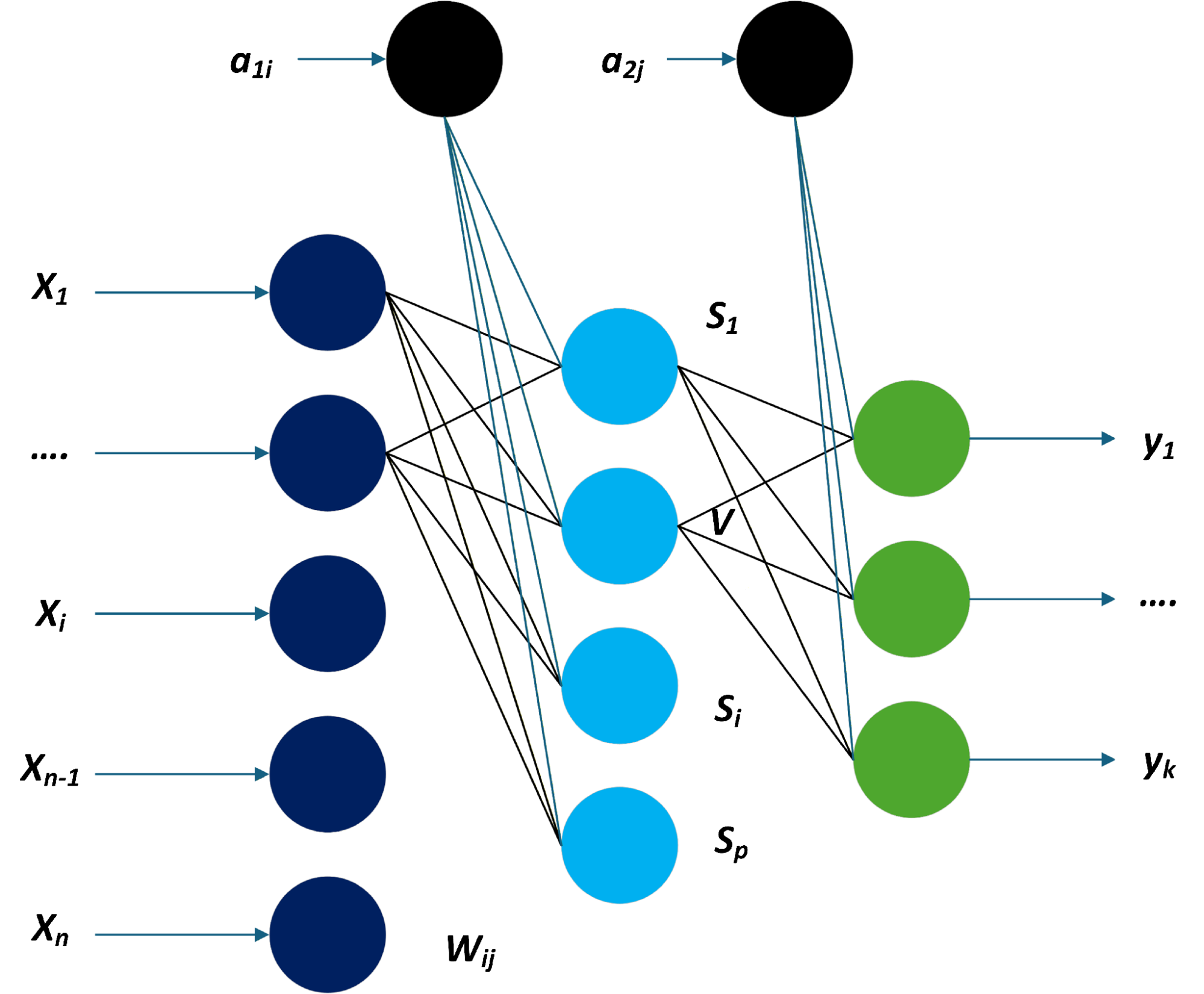
Figure 1. Algorithm of a multilayer backpropagation neural network
- Maximization Very Short-Term Power Forecasting Models Based on Clearness Index
This section discusses the results of the machine learning model with k-NN-multilayer BPNN used to maximise the forecasting of electricity generated by PV power generation systems in the future using a one-week forecasting procedure. A hybrid model using the database presented earlier, based on meteorological data, and clearness index, during the short-term forecasting process. In this research, to maximise the forecasting of electrical power generated by PV power plants, machine learning was used by combining the k-NN development model and the BP-NN. The combined machine learning model utilises the advantages of k-Nearest Neighbour (k-NN) and backpropagation-based neural networks to improve prediction accuracy, especially for non-linear and fluctuating data such as PV power forecasting. By using this technique, a correlation between the input data pattern and the target value is established. The advantages of this technique are improved model generalisation, greater accuracy compared to single models, and greater stability in the presence of data fluctuations. Therefore, the hybrid model can find solutions quickly and accurately to maximise power prediction in PV power generation systems. In this study, the k-NN method was used to generate preliminary predictions based on historical data similarities. The k-NN predictions were then used as input for a Multilayer Neural Network model, while the Backpropagation Neural Network (BP-NN) process adjusted weights and improved accuracy to achieve more optimal final predictions.
- Clearness Index Forecasting Model
The solar irradiance received at the Earth's surface will be equivalent to the irradiance fixed value minus the magnitude of atmospheric absorption under ideal atmospheric conditions. In general, solar irradiance consists of two main parameters, namely diffuse sky radiation and direct radiation. This study proposes a prediction model based on  values. Several factors are used for forecasting modelling. is defined as the global horizontal ratio at ground level divided by extraterrestrial values, as described in Eq. (6).
| 
| (6) |
Where  is the horizontal global value (measured data), and
  is the extraterrestrial value. Both variables share the same time series, so variations in horizontal global values are eliminated by division. Thus, obtaining an accurate Clearness Index (
 ) value is difficult in the morning and evening due to the appearance of diffuse radiation; the estimation model is as indicated by the height of the sun, the ratio between the horizontal global (
 ) and the extraterrestrial value (). And to obtain further results on the performance of the optimal k-NN-Backpropagation Neural Network hybrid design, the average daily clarity index () was calculated. Since it is known that obtaining accurate values is difficult in the morning and afternoon due to diffuse radiation, the forecasting model needs to be divided into several models based on the height of the sun. Insolation is then calculated based on the forecasted . The term can be calculated from the Eq. (7):
| 
| (7) |
where,  is value for the solar constant,
  is the factor correction, This parameter is used to account for variations in the Sun–Earth distance relative to its average value and
  is the linke turbidity factor,
  is obtain the relative optical air mass,
  value is calculation Rayleigh optical depth and
  is the solar altitude angle in degress.
- Very Short-Term Power Forecasting Model
A mathematical machine learning model that hybridises two methods is k-NN and multilayer BP-NN, was selected from among various machine learning (ML) models because both methods have high accuracy and excellent simulation convergence, as proven in maximising the forecasting of electrical power produced by PV generation systems. In carrying out electricity power predictions, it provides highly accurate forecasts while performace estimating errors using RMSE and MAE calculation in the predict. It has also been proven that low execution times require iterative processes for training and testing. Another advantage of the hybrid machine learning model with k-NN - BP-NN is that it is easier to manage various parameters, while for low sensitivity with small datasets, it serves as a medium for preventing overfitting. Machine Learning with the k-NN-BP-NN hybrid model is part of artificial intelligence, and, more specifically, artificial intelligence technology has the ability to learn from a series of data. This hybrid model combines the k-NN and BP-NN models. For this purpose, k-NN makes prediction decisions based on data proximity and similarity, without building an explicit mathematical model, while BP-NN learns the non-linear relationship patterns between input and output data adaptively through an error minimisation-based training process, as well as predicting complex values or patterns (Nonlinear). BP-NN is designed to model relationships that are difficult to formulate mathematically. The development of models. The k-NN and BP-NN involve several main stages that are integrated with each other to produce accurate and reliable prediction models. In the multilayer backpropagation neural network algorithm, there are three layers, namely the input layer neurons, the hidden layer neurons, and the output layer, as shown in Figure 2. The input variable for every layer represents the input value to the network, while the output layer is the electrical power estimation component by the PV generation system. This method is then used to determine the appropriate number of nodes for the hidden layer of the prediction design developed using multilayer BP-NN. In accordance with this rule, the numerical value of hidden layer nodes (Nh) must be 2/3 of the size of the input variable, and the output layer. To obtain the optimal hybrid k-NN-BP-NN model for maximising the predicted electricity output of PV power generation systems, a supervised learning method was used. Specifically, the dataset used over one week was divided into different training subsets comprising 70% of the simulation dataset, while the testing subset was maintained fixed at 30% of the total dataset for validation, the dataset is divided into several subsets, where each subset is used in turn as testing data, while the other subsets are used as training data. For the simulation process with the k-NN-BP-NN model, 500 iterations were used in the learning period. As an initial stage, a k-NN model was built based on the data. The k-NN model database contains pre-training data, which is divided into a training dataset and a validation dataset. The second stage is to conduct a validation test using the BPNN-based model. The BP-NN simulation process is based on the training data. The testing and training processes are carried out according to the target and obtain high accuracy values to obtain forecasting results. The training subset was used to analyse the impact of the simulation subset method performance and determine the maximum training duration. During this process, the testing subset was used to evaluate the performance of the design predictions and was maintained to remain in a steady state. Sequential and random-sampled dataset partitioning, various approaches were also examined to assess their impact on model prediction accuracy. Specifically, in method design for prediction simulations, the systematic sequence with based approach was used, while the random approach involved randomly selecting samples from different datasets. Finally, the estimates generated by the machine learning model with optimal k-NN-multilayer BP-NN were compared with the forecast from the k-NN Decomposition model and the measurement data. This basic BP-neural network model uses measurement load data from the day and time. This model operates on the assumption that the estimated value remains the same as the value at the previous time step.
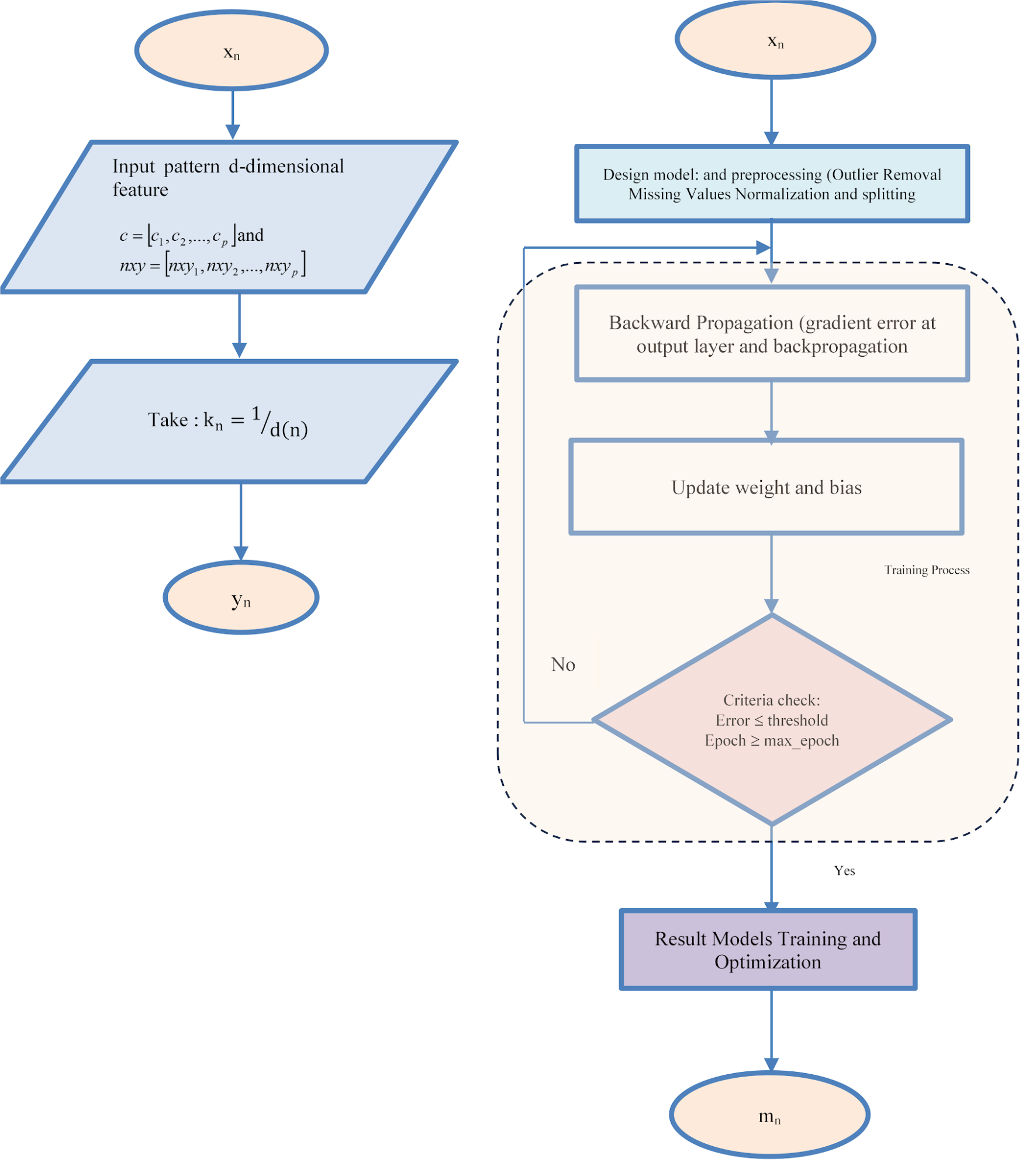
Figure 2. Flowchart k-NN-BP-NN model for very short-term forecasting: (a) k-NN process; (b) BP-NN process
The procedure is described in Figure 2. We test our model using previously described databases based on meteorology data, during the process of 1 hour ahead 20-minute intervals. The description of the data preprocessing steps procedure k-NN-BP-NN model for maximizing power forecasting based on meteorological data follows:
Stage-1: The algorithm computes the distance between each data parameter to identify the nearest neighbors.
Stage-2: Determine the optimal value of  is selected to identify the number of nearest neighbors
Stage-3: Determine the final estimation. Where the system generates the final estimated value after the training process
Stage-4: Training, testing, and validation of data using a Backpropagation NN method
Stage-5: The proposed k-NN-BP-NN model is used to forecast future power output at the PV station.
- Performance Evaluation
To improve the effectiveness of the maximum prediction hybrid method, it is validation using the forecasting error evaluation methods described in Eq. (8) and Eq. (9) for RMSE and MAE:
| 
| (8) |
| 
| (9) |
Where, 
 is the predicted at hour
  , and
, and  is the measured (actual) data at hour .
- k-NN Decomposition Model
In the previous section, the details of k-NN and decomposition method are considered. The advantage of the k-NN as a regression tool is further discussed. A hybrid model consisting of k-NN and decomposition is then introduced to overcome the drawbacks of k-NN. This approach is trying to decipher patterns of the basic time series into sub patterns and combined with three components, namely, the trend (T), seasonal (S), cyclical (C) and error (R) component. The decomposition method is based on the assumption that the existing data are a combination of several components, are simply described as follows. Eq. (10):
| 
| (10) |
- RESULTS AND DISCUSSION
- The proposed model Machine Learning (k-NN-Multilayer BP-NN)
This segment explains the verification simulation and performance simulations explained from applying the model to maximise the prediction of electricity generated by PV power generation systems directly using historical weekly datasets from several PV power plants. Preliminary research on the design for maximising power prediction in PV systems has been conducted. Simulations, evaluations, and analyses were carried out to maximise the output in the form of electrical power using several input variables consisting of P, GI, T, H, and WS. The hybrid model was constructed based on a different training dataset division approach, using a different training dataset duration of 70% of the entire dataset that had been constructed.
Overall, after conducting the simulation, the results showed that the values produced using random training and a larger overall training dataset in the time period. Therefore, by conducting simulations by training the dataset from several input variables and based on the clearness index value in a large amount of data for a short period, namely weekly, the hybrid modelling was able to produce maximum production power predictions for the PV generation system. Furthermore, maximising predictions with machine learning that combines model produces optimal values. To maximise short-term forecasting using machine learning with a combination method designed for k-NN multilayer BP-NN, as described in Figure 3.
Stage 1. If the validation test using the k-NN method is successful and the output is in the form of values from several variables, the results become input values for the next model, where the combination model testing must be in accordance with the designed function. If it is still not in accordance, one or more changes must be made again through recalculation.
Stage 2. The process of maximising electricity forecasting in PV generation systems using machine learning with k-NN multilayer BP-NN hybrid modelling is carried out in two stages: (Stage 1) k-NN design model with the determine numerical value calculations by calculating the average (weight of the nearest component values; and then (Stage 2) Artificial Neural Network modelling, namely, multilayer back propagation neural network (BP-NN) for maximising electricity power forecasting. In this research, the development of a machine learning model that combines k-NN with multilayer BP-NN is very flexible and adaptive in data processing and has a very high accuracy value. As a supporter of simulation and analysis using MATLAB software, which has been developed. Where the MATLAB software is equipped with several features regarding backpropagation neural network modelling.
Figure 3. Design of PV System Output Power Algorithm with machine learning based on clearness index
- Comparison using Machine Learning (k-NN-Multilayer BP-NN) Algorithm
The machine learning model was initially built using a variable dataset using a combination of k-NN-Multilayer BP-NN methods. The training and testing simulation processes were carried out periodically in accordance with the research database required to maximise forecasting. For the input variable values from the machine learning combination model results, several input variable values are available to perform pre-training and pre-testing simulations explain in Figure 4. Then, in the next stage, each input value is divided into two parts of the dataset, namely the training dataset and the testing dataset, which then perform the testing process using a combination model by performing iterations until reaching the predetermined target value and having the smallest error value. By implementing this combined model design, the simulation results for maximising electricity forecasting for PV generation systems are improved with high accuracy analyzed relative to another model.
For the simulation process with multilayer BP-NN, it begins using a learning approach driven by multiple variables and based on simulation patterns for very short-term forecasting, and is expected to be in line with the target, namely to maximise electricity power prediction in PV generation systems for the next day. In the following simulation, the k-NN multilayer BP-NN combination model was trained on a simulated dataset using 500 iterations were used in the learning period. As an initial stage, a k-NN model was built based on the data. The k-NN model database contains pre-training data, which is divided into a training dataset and a validation dataset. The second stage is to conduct a validation test using the BPNN-based model. The BP-NN simulation process is based on the training data. The testing and training processes are carried out according to the target and obtain high accuracy values to obtain forecasting results. For the simulation process of the forecasting model using machine learning k-NN-BP-NN during data processing using a training data pattern with 16 hidden layers with an error value of 0.01, with a learning rate limited to 0.1 and fixed 100 epochs.
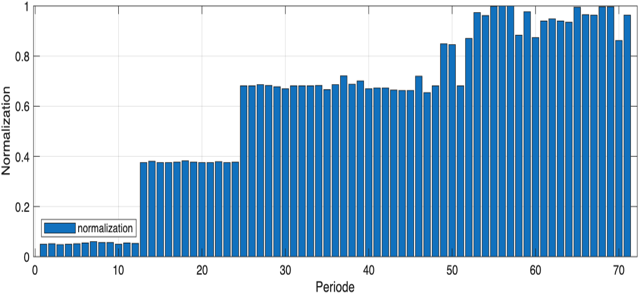
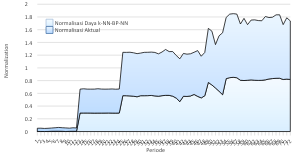
Figure 5 shows a evaluated between the measurement data and the machine learning combination model for electrical power data: (a) The PV power output curve was normalized to improve the learning performance and prediction accuracy of the machine learning model, and (b) The figure shows a comparison between the actual power normalization data and the predicted results using the k-NN-BP-NN method. Both curves have relatively similar trend patterns, indicating that the model is able to track changes in PV power characteristics in each observation period. However, there are several differences in values in certain periods that indicate prediction errors due to PV power fluctuations, changes in weather conditions, or the model's limitations in fully capturing system dynamics. Figure 6 illustrates the comparison of PV station estimation. There is excellent agreement between the variable data and the measurement data, k-NN -BP-NN and k-NN decomposition for very short-term electrical power prediction. Method k-NN BP-NN Model shows prediction results that are closer to actual measurement data. The prediction curve is able to follow increasing trends and changes in power better than the k-NN Decomposition method. This capability is achieved because k-NN-BP-NN performs a learning process on nonlinear relationships from historical data, allowing for more effective correction of prediction errors.
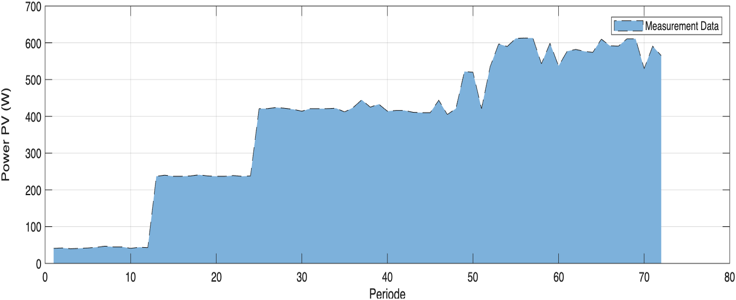
Figure 4. Power electric photovoltaic dataset for simulation
|
(a) |
|
(b) |
Figure 5. (a) Normalized electrical power curve model and (b) actual value and combination model k-NN multilayer BP-NN
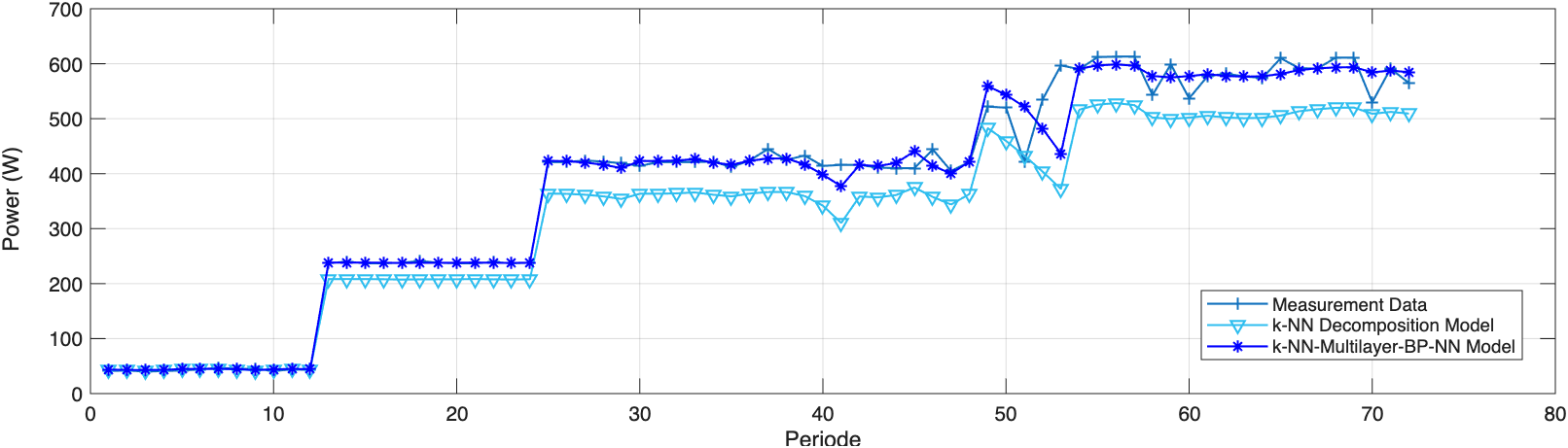
Figure 6. Comparison of very short-term maximization forecasting of the combination model machine learning using k-NN-Multilayer BP-NN, k-NN Decomposition model and measurement data
- Result of Very Short-Term PV Power Forecasting Model
To validate the performance of the development combination machine learning method using the k-NN-Multilayer-BP-NN hybrid model, error evaluation measurements were conducted using mean absolute error (MAE) and root mean square error (RMSE). To evaluate the accuracy of the model with actual data in maximising electricity forecasting in PV, the error values were evaluated using the MAE and RMSE formulas. Figure 7 explains the maximisation of hourly electricity forecasting using k-NN-Multilayer-BP-NN machine learning. Error evaluation for maximising forecasting based on Eq. (7) and Eq. (8). Figure 8 shows the results of the error evaluation calculation of the MAE and RMSE coefficients between the actual data measurements and the simulation results (7) and equation (8), as illustrated in Figure 7.
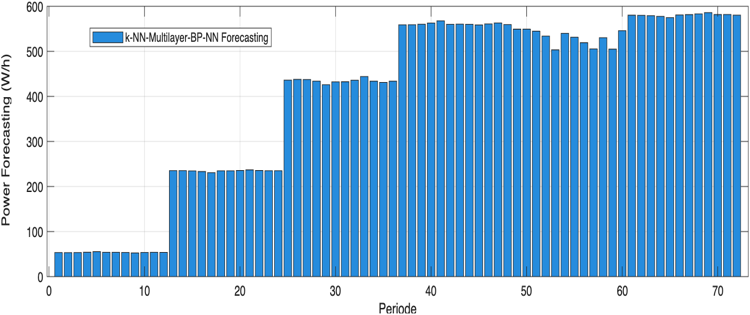
Figure 7. Simulation of electrical power for very short-term prediction using a machine learning k-NN Multilayer-BP-NN model
- Analysis of Forecasting Error using machine learning Algorithm
Figure 8 shows the results of error evaluation calculations of the MAE and RMSE coefficients between actual data measurements and machine learning modelling simulation results for very short-term prediction using a combination machine learning model. Meteorological data variables, such as solar radiation intensity, temperature, and weather conditions, play a key role in predicting the output power of PV stations, as they directly impact the power output of solar panels. Solar radiation intensity is a key factor, determining the amount of energy received by PV modules, while temperature influences the efficiency of electrical energy conversion. Rapid weather changes, such as cloud cover movements, also cause power fluctuations, which impact the models prediction performance. The calculation of the error evaluation values using the RMSE and MAE formulas utilises several input values from several variable indicators for electricity forecasting in the PV power generation system, which can see that the calculation error performance evaluation results improve in Table 1.
The absolute values obtained in this simulation have a ratio value for each hourly electricity forecast and are divided by the number value featured with variable m. The error evaluation indicator with the machine learning model, namely k-NN-Multilayer-BP-NN, with MAE is 1.5 W and for RMSE is 27.44 W. The machine learning model that hybridises the k-NN and Multilayer-BP-NN methods shows excellent forecasting simulation and has better accuracy value in comparison with other methods. The proposed hybrid k-NN-BP-NN model demonstrated better forecasting performance compared with the baseline method. The RMSE value decreased from 63.75 W in the k-NN Decomposition model to 27.44 W in the proposed model (k-NN-BP-NN). In addition, the MAE value was also reduced, indicating that the hybrid approach improved prediction accuracy and stability for very short-term PV power forecasting. This can occur due to high PV power fluctuations due to sudden weather changes, such as cloud movement, variations in solar irradiation intensity, or noise in the measurement data. MAE represents the average error in general, while RMSE is more sensitive to large errors due to the quadratic process in its calculation. Therefore, a high RMSE value indicates that although most predictions have small errors, there are certain conditions with significant prediction deviations, causing the error distribution to be uneven or tend to be skewed.
Table 1. Error statistical indicator value of the electrical power forecasting using machine learning models.
Error Indicators Value Model | k-NN-Decomposition Model | Machine Learning (k-NN-Multilayer BP-NN) model |
RMSE | 63.75 | 27.44 |
MAE | 8.0 | 1.5 |
Figure 8. Performance Evaluation for MAE and RMSE coefficient between actual data and machine learning (k-NN-Multilayer-BP-NN)
- CONCLUSION
The machine learning method with hybrid k-NN and multilayer BP-NN models is very innovative because this model was developed to increase forecasting accuracy, especially to optimize the performance of forecasting electricity generated by photovoltaic (PV) energy systems, and has been introduced in very short-term forecasting for the one hours ahead.This hybrid model has improve forecasting accuracy the estimation of electricity generated by photovoltaic power plants in the very short term for one day ahead, as determined by the clearness index. This research proposes a new modelling for improve forecasting accuracy electricity prediction using machine learning with a hybrid combination of k-NN and Multilayer BP-NN models. The input variables used to improve forecasting accuracy short-term electricity power prediction using the k-NN-Multilayer-BP-NN model based on the clearness index data are new in this proposal. Variable-component meteorological data is essential and functions as the primary input to the model used in machine learning models that combine k-NN, multilayer BP-NN models to forecast the electrical power produced by PV generation systems, yielding better results and higher accuracy than other prediction models. The results show a good agreement between the actual measurement data and the short-term electrical power prediction results. The hybrid k-NN-BP-NN model produces predictions that are closer to the actual data and is able to follow the power change trend better than the k-NN Decomposition method. For the evaluation of error indicators using machine learning with a hybrid model (k-NN Multilayer BP-NN), the MAE was 1.5 W and the RMSE was 27.44 W. The k-NN-Multilayer BP-NN Machine Learning model demonstrated significant performance improvement compared to the k-NN Decomposition model. The RMSE value was reduced by 56.96%, while the MAE value decreased by 81.25%. These results indicate that the hybrid model is capable of providing better and more stable short-term electrical power prediction accuracy than the k-NN Decomposition method. A hybrid model combining the k-NN and multilayer BP-NN methods significantly improves PV power prediction performance. The k-NN method is used to select historical data with patterns similar to current conditions, while the multilayer BP-NN functions to learn nonlinear relationships and make corrections to the initial prediction results. The combination of these two methods produces predictions that are more accurate, stable, and closer to the actual data. This is evidenced by lower error values and the model's ability to follow the pattern of PV power changes according to the target analyzed using a mathematical approach. Further research can be conducted using larger datasets, adding other meteorological variables, and developing real-time prediction implementations to improve model accuracy and reliability. Therefore, the effectiveness of the proposed machine learning combination model (k-NN Multilayer BP-NN) is better than other methods. The proposed PV power prediction model has the potential to assist grid operators and PV plant managers in maintaining system stability, optimizing energy management, and anticipating power fluctuations due to weather changes. Improved prediction accuracy can also improve operational efficiency and reliability of PV grid integration.
ACKNOWLEDGEMENT
The researcher sincerely thanks the Department of Electrical Engineering at the researcher’s university (Surabaya State University) and the transmission and distribution laboratory for their support and motivation, valuable advice, and provision of research equipment and MATLAB software to complete this research
REFERENCES
- A. Jia, K. Mallick, D. Upadhyaya, T. Hu, Z. Szantoi, B. Bhattacharya, M. Sekhar, D. Skokovic, J. A. Sobrino, L. Ruiz, G. Boulet,”Deriving a Clear-Sky Soil Moisture Index From Ecostress Land Survace Temperature,” Remote Sensing of Environment, vol. 329, pp. 114945, 2025, https://doi.org/10.1016/j.rse.2025.114945.
- A. P. Renold, N. Sinha, and X. Z. Gao, “Hybrid Machine Learning Approach for Improved Short-Term PV Power Forecasting Accuracy,” Results in Engineering, vol. 28, pp. 107374, 2025, https://doi.org/10.1016/j.rineng.2025.107374.
- A. N. Sharkawy, M. M. Ali, H. H. H. Mousa, A. S. Ali, G. T. A. Jaber, and H. S. Hussein, “Solar PV Power Estimation and Upscaling Forecast Using Different Artificial Neural Networks Types: Assessment, Validation, and Comparison,” IEEE Access, vol. 11, pp. 19279-19300, 2023, https://doi.org/10.1109/ACCESS.2023.3249108.
- A. Maged, E M. Abo-Zahhad, M. H. Salim, S. Haridy, A. Rashwan, I. Mokhtar, Y. Chen, E. H. Abdelhamed, and M. H. Salim, “Double Stacking Ensamble Learning for Solar Irradiance Prediction in Data Scarce Regions to Support Building Energy Design,” Energy and Building, Energy and Buildings, pp. 117479, 2026, https://doi.org/10.1016/j.enbuild.2026.117479.
- A. Ghennioui, M. Abraim, F. Abdi and H. Ghennioui, “Hybrid Deep Learning Architectures for Solar Irradiance Forecasting in two Different Moroccan Environments: a time series perspective,” Results in Engineering, vol 30, pp. 110487, 2026, https://doi.org/10.1016/j.rineng.2026.110487.
- B. Arseven and S. M. Cinar, “A Novel Hybrid Solar Radiation Forecasting Algorithm Based on Discrete Wavelet Transform and Multivariate Machine Learning Models Integrated with Clearness Index Clusters,” Journal of Atmospheric and Solar Terrestrial Physics, vol. 267, pp. 106417, 2025, https://doi.org/10.1016/j.jastp.2025.106417.
- C. Yeung, J. Wang, Y. Du, J. Cao, Q. Z, Z. Du, Y. Fan, Y. Ding, and L. Cai, “Clearness Index Cluster Analysisi For Photovoltaic Weather Classification Based on Solar Irradiation Measurement data: theory and application,” Energy 360, Vol. 2, pp. 100010, 2024, https://doi.org/10.1016/j.energ.2024.100010.
- C. Zhang, H. Long, Z. Zhang, and J. Cao, “Practicaly-Enhanced Behind-the meter PV Power Generation Disaggregation Based on Synchronization and transferability Fused LSTM Framework,” Energy and AI, vol. 23, pp. 100675, 2026, https://doi.org/10.1016/j.egyai.2026.100675.
- C. I. Otuka, D. Cai, C. C. Okwuoma, S. Luo Z. Yang, O. Bamisile, C. D. Ukwuoma, N. O. Otuka, and Q. Huang, “Experimental Review and Recent Advances in deep learning Techniques for Solar Irradiance Forecasting and Prediction,” Solar Energy, vol. 304, pp. 114175, 2026, https://doi.org/10.1016/j.solener.2025.114175.
- D. Abdulai, S. Gyamfi, F. A. Diawuo, and P. Acheampong, “Data Analytics For Prediction Of Solar PV Power Generation and System Performance: A Real Case of Bui Solar Generating Station, Ghana,” Scientific African, Vol. 21, pp. e01894, 2023, https://doi.org/10.1016/j.sciaf.2023.e01894.
- D. M. Teferra, L. M. H. Ngoo, and G. N. Nyakoe, “Fuzzy-Based Prediction of Solar PV and Wind Power Generation For Microgrid Modeling Using Particle Swarm Optimization,” Heliyon, vol. 9, Issue 1, pp. e12802, 2023, https://doi.org/10.1016/j.heliyon.2023.e12802.
- E. Wittmann, C. B. Lutz, S. Bennett, V. Christlein, J. Hauch, and C. J. Brabec, “PV Polaris-Automated PV System Orientation Prediction,” IEEE Photonics Journal, vol. 17, Issue. 3, 2025, https://doi.org/10.1109/JPHOT.2025.3568887.
- F. V. Mucomole, C. A. S. Silva, and L. L. Magaia, “Photovoltaic Modeling of Clear Sky Index Correlations at Different Surface Elevation Measurement Stations at Short-Measurement Scale,” Solar Energy Advances, vol. 6, pp. 100129, 2026, https://doi.org/10.1016/j.seja.2026.100129.
- F. Wang, J. Li, Z. Zhen, C. Wang, H. Ren, and H. Ma, “Cloud Feature Extraction and Fluctuation Pattern Recognition Based Ultrashort-Term Regional PV Power Forecasting,” IEEE Transactions on Industry Applications, vol. 58, no. 5, pp. 6752-6767, 2022, https://doi.org/10.1109/TIA.2022.3186662.
- H. Wen, Y. Du, X. Chen, E. Lim, H. Wen, and L. Jiang, “Improved Power Quality in a Solar PV Plant Integrated Utility Grid by Employing a Novel Adaptive Current Regulator,” IEEE Transactions on Industrial Informatics, vol. 17, no. 2, pp. 4308-4319, 2021, https://doi.org/10.1109/JSYST.2019.2958819.
- H. Xiao, W. Zheng, H. Zhou, and W. Pei, “Ultra-Short-Term Photovoltaic Power Prediction Based on Improved Temporal Convolutional Network and Feature Modeling,” CSEE Journal of Power and Energy Systems, vol. 11, no. 5, pp. 2024-2035, 2024, https://doi.org/10.17775/CSEEJPES.2023.06130.
- H. Zhang, J. Shi, and C. Zhang, “A Hybrid Ensembled Double-input-fuzzy-modules based Precise Prediction of PV Power Generation,” Energy Reports, vol. 8, pp. 1610-1621, 2022, https://doi.org/10.1016/j.egyr.2022.02.298.
- J. Yang, G. li, and M. Niu, “Decreasing temporal Convolutional Method Integrated with Fourier Transform For Precise Solar PV and Wind Power Generation Prediction,” Sustainable Energy Technologies and Assessments, vol. 82, pp. 104553, 2025, https://doi.org/10.1016/j.seta.2025.104553.
- J. Yang, H. He, X. Zhao, J. Wang, T. Yao, and H. Cao, “Day-Ahead PV Power Forecasting Model Based on Fine-Grained Temporal Attention and Cloud-Coverage Spatial Attention,” IEEE Transactions on Sustainable Energy, vol. 15, no. 2, pp. pp. 1062-1073, 2023, https://doi.org/10.1109/TSTE.2023.3326887.
- J. Yang, J. Liu, Y. Xiang, S. Zhang, and J. Liu,” Data Driven Optimal Dynamic Dispatch for Hydro-PV-PHS Integrated Power Systems Using Deep Reinforcement Learning Approach,” CSEE Journal of Power and Energy Systems, vol. 9, no. 3, 2023, https://doi.org/10.17775/CSEEJPES.2021.07210.
- J. Yang, W. Jiang, J. Zhao, and L. Chen, “FE-ConvGRU: A Novel Deep Learning Framework for Ultra-Short-Term PV Power Prediction by Encoding Temporal Geometry and Attention Mechanism,” Energy Reports, vol. 15, pp. 108956, 2026, https://doi.org/10.1016/j.egyr.2025.108956.
- J. Zhang, X. Huang, F. Cheng, Y. Wang, and Y. Tai, “Solar Irradiance Prediction Using K-MTransformer Model Based on data Input From K-means++ Clustering,” Energy, vol. 351, pp. 140771, 2026, https://doi.org/10.1016/j.energy.2026.140771.
- K. Park, J. Yim, H. Lee, M. Park, and H. Kim, “Real-Time Solar Power Estimation Through RNN-Based Attention Models,” IEEE Acceess, vol. 12, pp. 62502-62510, 2023, https://doi.org/10.1109/ACCESS.2023.3233951.
- K. Wang, J. Zhu, Y. Lin, C. Yang, Z. Zhang, Z. Zhao, C. Zhou, L. Wang, and C. Zheng, “A PV Prediction Model Based on Mechanistic Data-Driven Feature Generation with Temporal Cross-Scale Alignment Mechanism,” Electric Power Systems Research, vol. 255, pp. 112755, 2023, https://doi.org/10.1016/j.epsr.2026.112755.
- L. D. Riihimaki, X. Li, Z. Hou, and L. K Berg, “Improving Prediction of Surface Solar Irradiance Variability by integrating observed cloud characteristics and machine learning,” Solar Energy, vol. 225, pp. 275-285, 2021, https://doi.org/10.1016/j.solener.2021.07.047.
- L. Xu, Y. Feng L. Liu, P. Ding, X. Wang, and Y. Deng, “Hourly solar irradiance estimation and building-surface solar potential assessment via remote sensing and machine learning for data-scarce mountainous regions,” Energy Reports, vol. 15, pp. 109017, 2026, https://doi.org/10.1016/j.egyr.2025.109017.
- M. Fathi, S. Allahyari, A. Ahmadi, A. Zahedi, and S. Asiaei, “Enhaced Global Solar Irradiance and Temperature Forecasting for Rooftop PV Power Generation Prediction Using Multi-Step LSTM and GRU based Hybrid Models,” Energy Conversion and Management: X, Vol. 28, pp. 101351, 2025, https://doi.org/10.1016/j.ecmx.2025.101351.
- N. S. K. Hussain, C. K. To, and T. Hilal, “WBML-PV: Window-Based Machine Learning for Ultra-Short-term Photovoltaic Power Forecasting,” IFAC Journal of Systems and Control, vol. 34, pp. 100342, 2025, https://doi.org/10.1016/j.ifacsc.2025.100342.
- M. Walters and G. K, Venayagamoorthy, “Situational Awareness Indices of Solar PV Power Generation Under Temporal Weather Conditions for Near Real-time Planning and Operation,” Applied Energy, vol. 402, pp. 126855, 2025, https://doi.org/10.1016/j.apenergy.2025.126855.
- M. Jebali, N. Bailek, H. Harrouch, B. Zerouali, H. Guesmi, A. Kuriqi, R. Triki, I. Abidi, and C. A. G. Santos, “Enhancing Prediction of Inclined Solar Irradiance Trough an Advanced Hybrid Deep Learning Model for Solar Energy System Optimization,” Physics and Chemistry of the Earth, pp. 104419, 2026, https://doi.org/10.1016/j.pce.2026.104419.
- M. Li, Y. Jiang, G. Cao, T. Xu, and R. Guo, “Hybrid CEEMDAN-FELM-based machine learning model for accurate solar irradiance forecasting and techno-economic design of renewable hydrogen systems,” Sustainable Compting: Informatics and Systems, vol. 50, pp. 101321, 2026, https://doi.org/10.1016/j.suscom.2026.101321.
- N. A. Kadhim, A. A. Obed, A. J. Abid, H. Kotb, and A. Emara, “Optimal PV Reconfiguration Under Partial Shading Based on White Shark Optimization,” IEEE Access, vol. 12, pp. 27385-27398, 2024, https://doi.org/10.1109/ACCESS.2024.3367833.
- N. Jittratorn, W. Chi, C. M. Huang, and H. T. Yang, “Ultrashort-Term PV Power Forecasting Based on Weather Classification and Dynamic Cloud Tracking: Deterministic and Probabilistic Modeling,” Energy Conversion and Management X, vol. 30, pp. 101713, 2026, https://doi.org/10.1016/j.ecmx.2026.101713.
- N. Koshkarboy, S. Mekhilef, A. Saymbetov, N. Kuttybay, M. Nurgaliyev, G. Dosymbetova, S. Orynbassar, E. Yershov, A. Kapparova, B. Zholamanov, and A. Bolatbek, “Adaptive Control Systems For Dual Axis Tracker Using Clear Sky Index and Output Power Forecasting Based on ML in Overcast Weather Conditions,” Energy and AI, vol 18, pp. 100432, 2024, https://doi.org/10.1016/j.egyai.2024.100432.
- P. K. Ray, B. Subudhi, G. Putrus, M. Marzband, and Z. Ali, “Forecasting Global Solar Insolation Using The Ensemble Kalman Filter Based Clearness Index Model,” CSEE Journal of Power and Energy Systems, vol. 8, no. 4, pp. 1087-1096, 2022, https://doi.org/10.17775/CSEEJPES.2021.06230.
- Q. Li, T. Ma, S. Zheng, Y. Lu, Z. Deng, and F. Shen, “A Direct Upscaling Probabilistic Forecasting Model For PV Cluster Power Generation Based On Soft DTW-(ClusterGAN-KShape)-AMQWavenet,” Energy Conversion and Management: X, vol. 30, pp. 101618, 2026, https://doi.org/10.1016/j.ecmx.2026.101618.
- Q. Zhang, Z. Zhai, J. Qian, X. Liu, and M. Mao, “Optimization Control of Power Balance for Stability Improvement in Grid-Connected PV System,” CPSS Transactions on Power Electronics and Applications, vol. 8, no. 2, pp. 181-189, 2023, https://doi.org/10.24295/CPSSTPEA.2023.00018.
- R. T. Kumar and C. C. A. Rajan, “Enhancing Grid Stability In Hybrid Renewable Energy Systems Through RNN-Based Grid Voltage Synchonization,” IEEE Power & Energy Society General Meeting (PESGM), 2024. https://doi.org/10.1109/PESGM51994.2024.10689119.
- S. Chen, T. Jing, M. Li, H. H. Lee, and S. Bu, “Improved Satellite-Based Estimation of Direct Normal Solar Irradiance Using Clearness Index With Deep Learning Methods,” Solar Energy, vol 302, pp. 113991, 2025, https://doi.org/10.1016/j.solener.2025.113991.
- S. Riyadi, A. D. Andriyani, and S. N. Sulaiman, “Improving Hate Speech Detection Using Double-Layers Hybrid CNN-RNN Model on Imbalanced Dataset,” IEEE Access, vol. 12, pp. 159660-159668, 2024, https://doi.org/10.1109/ACCESS.2024.3487433.
- S. Wu, H. Guo, X. Zhang, F. Wang, “Short-Term Photovoltaic Power Prediction Based on CEEMDAN and Hybrid Neural Networks,” IEEE Journal of Photovoltaics, vol. 14, no. 6, pp. 960-969, 2024, https://doi.org/10.1109/JPHOTOV.2024.3453651.
- B. Abderraouf, L. Adel, M. A. J. Gil, H. Salim, F. M. Luigi, and J. C. Rafael, “Evaluating and Analyzing the Performance of PV Power Output Forecasting Using Different Models of Machine Learning Techniques Considering Prediction Accuracy,” International Journal of Renewable Energy Development, vol. 14, no. 1, pp. 158-167, 2025, https://doi.org/10.61435/ijred.2025.60547.
- W. Liang, Y. Liu, and J. Peng, “A Day and Night Operational Quasi-Z Source Multilevel Grid-Tied PV Power System to Achive Active and Reactive Power Control,” IEEE Transactions on Power Electronics, vol. 36, no. 1, 2021. https://doi.org/10.1109/TPEL.2020.3000818.
- Y. Cai, S. Hao, X. Wen, H. Li, X. He, and L. Chen, “Short-Term Power Prediction by Using Least Square Support Vector Machine with Variational Mode Decomposition in a Photovoltaic System,” IEEE Access, vol. 11, pp. 143486-143500, 2023, https://doi.org/10.1109/ACCESS.2023.3343103.
- Y. Cai, Y. Huang, Z. Shu, Z. Liu, H. Zhong, and F. Zhao, “Investigation of Double-PCM Based PV Composite Wall for Power-Generation and Building Indulation: Thermal Characteristics and Energy Consumption Prediction,” Energy and Built Environment, vol. 7, no. 1, pp. 14-27, 2026, https://doi.org/10.1016/j.enbenv.2024.08.002.
- Y. Fu, H. Chai, Z. Zhen, X. Xu, K. Li, M. S. Khah, P. Dehghanian, and J. P. S. Catalao, “Sky Image Prediction Model Based on Convolutional Auto-Encoder for Minutely Solar PV Power Forecasting,” IEEE Transactions on Industry Applications, vol. 57, no. 4, pp. 3272-3281, 2021, https://doi.org/10.1109/TIA.2021.3072025.
- Y. J. K. Musleh, W. Herring, C. D. Rodriguez, A. A. Boden, and T. Rahman, “Subhourly Error Analysis of Decomposition-Transposition Model Pairs For Temperate Climates,” IEEE Journal of Photovoltaics, vol. 15, pp. 164-172, 2025, https://doi.org/10.1109/JPHOTOV.2024.3483262.
- Y. Y. Hong and F. I. Alano, “Hierarchical Energy Management in Islanded Networked Microgrids,” IEEE Access, vol. 10, pp. 8121-8132, 2022, https://doi.org/10.1109/iSPEC59716.2024.10892510.
- Y. Yu, G. Hu, C. Liu, J. Xiong, Z. Wu, and L. Jiang, “Prediction of Solar Irradiance One Hour Ahead Based on Quantum Long Short-Term Memory Network,” IEEE Transactions on Quantum Engineering, vol. 4, pp. 3100815, 2023, https://doi.org/10.1109/TQE.2023.3271362.
- Z. Allal, H. N. Naura, and K. Chahine, “Machine Learning Algorithms for Solar Irradiance Prediction: A Recent Comparative Study,” e-prime Advances in Electrical Engineering, Electronics and Energy, vol. 7, pp. 100453, 2024, https://doi.org/10.1016/j.prime.2024.100453.
- Y. Yang, X. Liu, and Y. Wu, “Review of Solar Spectral Irradiance Modelling at Ground Level: Current Methods and Machine Learning Opportunities,” Energy, vol. 344, pp. 139967, 2026, https://doi.org/10.1016/j.energy.2026.139967.
AUTHOR BIOGRAPHY

| Unit Three Kartini received her bachelor’s (S.T) degree in Electrical Engineering from Institut Technology National Malang (ITN), Malang in 1999, a degree in Electrical Engineering Universitas Indonesia (UI), Jakarta in 2003, a Magister Electrical (M.T) and Ph.D degrees in Electrical Engineering from National Taiwan University of Technology (NTUT), Taipei in 2017, respectively. In January of 2003, she joined Universitas Negeri Surabaya (UNESA) as an Electrical Engineering faculty member. At present, her research interests include power system control and stability, forecasting, reliability, and analysis of power systems. https://sinta.kemdiktisaintek.go.id/authors/profile/6010049 ORCID: https://orcid.org/0000-0003-4792-9231 Email: unitthree@unesa.ac.id |
|
|

| L. Endah Cahyaningrum received his bachelor’s (S.T) degree in Electrical Education Engineering from Universitas Negeri Malang, Malang in 2013, a master's degree in Electrical Education Engineering from Universitas Negeri Malang, Malang in 2015, and a Magister Education Electrical (M.Pd)., respectively. In June of 2019, he joined Universitas Negeri Surabaya as a faculty of engineering member. At present, her research focuses on Electronic System and vocational. https://sinta.kemdiktisaintek.go.id/authors/profile/5992700 ORCID: https://orcid.org/0000-0002-4742-4383 Email: endahningrum@unesa.ac.id |
|
|

| Muhamad Nur Adiwana received his bachelor’s (S.T) degree in Electrical Engineering from Universitas Negeri Surabaya, Surabaya in 2018, a master's degree in Electrical Engineering from Universitas Negeri Surabaya, Surabaya in 2024, and a Magister Electrical (M.T)., respectively. In June of 2025, he joined Polytechnic State Surabaya as a faculty of engineering member. At present, her research focuses on forecasting, renewable energy, and reliability. https://sinta.kemdiktisaintek.go.id/authors/profile/6964313 Email: mochnuradiwana@gmail.com |
Unit Three Kartini (Maximization Very Short-Term Forecasting of Power Photovoltaic System Using Machine Learning Based on Clearness Index Model)