A mathematical model of malaria transmission dynamics with multi-stage infection and dual treatment pathways
DOI:
https://doi.org/10.12928/bamme.v6i1.16070Keywords:
herbal treatment, dual treatment pathways, malaria dynamics, mathematical modelling, multi-stage infectionAbstract
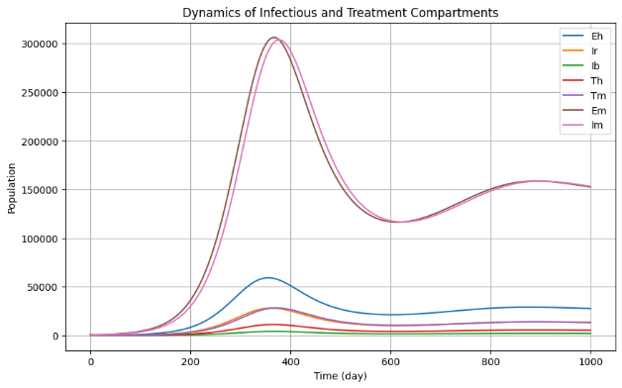
Malaria remained a complex global public health challenge due to the interplay between biological transmission and human treatment-seeking behavior. This study developed a deterministic mathematical model incorporating two levels of infection severity (mild and severe) and dual treatment pathways, namely herbal and medical treatment. The model was formulated as a system of nonlinear ordinary differential equations and analyzed using the Next Generation Matrix method to derive the basic reproduction number , , while local stability was examined using the Routh–Hurwitz criterion. The results showed that the disease-free equilibrium was locally asymptotically stable when , indicating the eventual elimination of the disease. Sensitivity analysis revealed that mosquito mortality and transmission rates were the most influential parameters affecting disease spread. Numerical simulations further demonstrated that increasing early-stage treatment, particularly herbal treatment for mild infections, significantly reduced and limited progression to severe cases. These findings highlighted the critical role of early treatment-seeking behavior combined with effective vector control in reducing malaria transmission and supporting long-term elimination strategies.
References
Adhikari, B., Phommasone, K., Pongvongsa, T., Koummarasy, P., Soundala, X., Henriques, G., Sirithiranont, P., Parker, D., Von Seidlein, L., White, N., Day, N., Dondorp, A., Newton, P., Cheah, P., Pell, C., & Mayxay, M. (2019). Treatment-seeking behaviour for febrile illnesses and its implications for malaria control and elimination in Savannakhet Province, Lao PDR (Laos): a mixed method study. BMC Health Services Research, 19. https://doi.org/10.1186/s12913-019-4070-9
Aisyah, D. N., Sitompul, D., Diva, H., Tirmizi, S. N., Hakim, L., Surya, A., Puspadewi, R. T., Prameswari, H. D., Adisasmito, W., & Manikam, L. (2024). The changing incidence of Malaria in Indonesia: A 9-year analysis of surveillance data. Advances in Public Health, 2024(1). https://doi.org/10.1155/adph/2703477
Aldila, D. (2022). Dynamical analysis on a Malaria model with relapse preventive treatment and saturated fumigation. Computational and Mathematical Methods in Medicine, 2022. https://doi.org/10.1155/2022/1135452
Anderson, R. M., & May, R. M. (1991). Infectious Diseases of Humans: Dynamics and Control. Oxford University Press. https://doi.org/10.1093/oso/9780198545996.001.0001
Andrade, M. V., Noronha, K., Diniz, B. P. C., Guedes, G., Carvalho, L. R., Silva, V. A., Calazans, J. A., Santos, A. S., Silva, D. N., & Castro, M. C. (2022). The economic burden of malaria: a systematic review. Malaria Journal, 21(1), 1–10. https://doi.org/10.1186/s12936-022-04303-6
Brauer, F., Castillo-Chavez, C., & Castillo-Chavez, C. (2012). Mathematical models in population biology and epidemiology (Vol. 2). Springer.
Chitnis, N., Cushing, J. M., & Hyman, J. M. (2006). Bifurcation analysis of a mathematical model for malaria transmission. SIAM Journal on Applied Mathematics, 67(1), 24–45. https://doi.org/10.1137/050638941
Chitnis, N., Hyman, J., & Cushing, J. (2008). Determining important parameters in the spread of malaria through the sensitivity analysis of a mathematical model. Bulletin of Mathematical Biology, 70, 1272–1296. https://doi.org/10.1007/s11538-008-9299-0
Haile, G. T., Rao, K. P., & Legesse, F. (2025). Sensitivity analysis of a mathematical model for malaria transmission accounting for infected ignorant humans and relapse dynamics. Frontiers Appl. Math. Stat., 10. https://doi.org/10.3389/fams.2024.1487291
Hethcote, H. W. (2000). The mathematics of infectious diseases. SIAM Review, 42(4), 599–653. https://doi.org/10.1137/S0036144500371907
Jaleta, S. F., Duressa, G. F., & Deressa, C. T. (2025). A mathematical modeling and optimal control analysis of the effect of treatment-seeking behaviors on the spread of malaria. Frontiers in Applied Mathematics and Statistics, 11. https://doi.org/10.3389/fams.2025.1552384
Kotepui, M., Kotepui, K. U., Milanez, G. D., & Masangkay, F. R. (2020). Global prevalence and mortality of severe Plasmodium malariae infection: A systematic review and meta-analysis. Malaria Journal, 19(1), 1–13. https://doi.org/10.1186/s12936-020-03344-z
Kuddus, M. A., & Rahman, A. (2021). Modelling and analysis of human-mosquito malaria transmission dynamics in Bangladesh. Math. Comput. Simul., 193, 123–138. https://doi.org/10.1016/j.matcom.2021.09.021
Macdonald. G, M. G. (1957). The epidemiology and control of malaria.
Mandal, S., Sarkar, R., & Sinha, S. (2011). Mathematical models of malaria - a review. Malaria Journal, 10(1), 202. https://doi.org/10.1186/1475-2875-10-202
Ngwa, G. A., & Shu, W. S. (2000). A mathematical model for endemic malaria with variable human and mosquito populations. Mathematical and Computer Modelling, 32(7–8), 747–763. https://doi.org/10.1016/S0895-7177(00)00169-2
Perko, L. (2013). Differential equations and dynamical systems (Vol. 7). Springer Science & Business Media.
Philothra, B., Alona, I., Situmorang, E., Limbardon, P., & Salsalina, V. (2023). Treatment-seeking behavior for malaria among communities in Indonesia: a systematic review. Narra J, 3. https://doi.org/10.52225/narra.v3i3.428
Ross, R. (1911). The prevention of malaria. John Murray.
Sachs, J., & Malaney, P. (2002). The economic and social burden of malaria. Nature, 415(6872), 680–685. https://doi.org/10.1038/415680a
Smith, D. L., Battle, K. E., Hay, S. I., Barker, C. M., Scott, T. W., & McKenzie, F. E. (2012). Ross, macdonald, and a theory for the dynamics and control of mosquito-transmitted pathogens. PLoS Pathogens, 8(4), e1002588. https://doi.org/10.1371/journal.ppat.1002588
Tangpukdee, N., Krudsood, S., Thanachartwet, V., Duangdee, C., Paksala, S., Chonsawat, P., Srivilairit, S., Looareesuwan, S., & Wilairatana, P. (2007). Predictive score of uncomplicated falciparum malaria patients turning to severe malaria. The Korean Journal of Parasitology, 45 4, 273–282. https://doi.org/10.3347/kjp.2007.45.4.273
Tumwiine, J., Mugisha, J., & Luboobi, L. (2007). A mathematical model for the dynamics of malaria in a human host and mosquito vector with temporary immunity. Appl. Math. Comput., 189, 1953–1965. https://doi.org/10.1016/j.amc.2006.12.084
Van den Driessche, P., & Watmough, J. (2002). Reproduction numbers and sub-threshold endemic equilibria for compartmental models of disease transmission. Mathematical Biosciences, 180(1–2), 29–48.
White, N. J. (2017). Malaria parasite clearance. Malaria Journal, 16(1), 1–14. https://doi.org/10.1186/s12936-017-1731-1
World Health Organization. (2023). World Malaria Report 2023. https://www.who.int/teams/global-malaria-programme/reports/world-malaria-report-2023
Downloads
Published
Issue
Section
License
Copyright (c) 2026 Panca Dewi Fitriyana, Budi Priyo Prawoto

This work is licensed under a Creative Commons Attribution-ShareAlike 4.0 International License.
Authors who publish with this journal agree to the following terms:
- Authors retain copyright and grant the journal right of first publication with the work simultaneously licensed under Creative Commons Attribution License that allows others to share the work with an acknowledgement of the work's authorship and initial publication in this journal.
- Authors are able to enter into separate, additional contractual arrangements for the non-exclusive distribution of the journal's published version of the work (e.g., post it to an institutional repository or publish it in a book), with an acknowledgement of its initial publication in this journal.
- Authors are permitted and encouraged to post their work online (e.g., in institutional repositories or on their website) prior to and during the submission process, as it can lead to productive exchanges, as well as earlier and greater citation of published work (See The Effect of Open Access).