Geographically weighted panel regression using Haversine distance for mapping sustainable development goals
DOI:
https://doi.org/10.12928/bamme.v6i1.16002Keywords:
adaptive kernel, geographically weighted panel regression, GWR, Haversine distance, SDGsAbstract
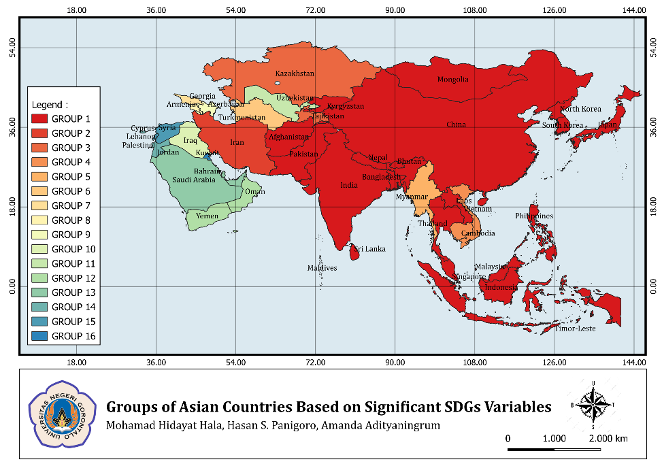
The Sustainable Development Goals (SDGs) vary widely across Asian countries, indicating that the factors driving SDGs achievement may vary by location. Global models may miss these local variations, so this study used Geographically Weighted Panel Regression (GWR Panel), a method that estimates separate regression coefficients for each geographical location. The GWR Panel in this study was used to capture spatially varying SDGs determinants across 46 Asian countries from 2015 to 2024. This study also compares four Adaptive Kernel functions (Gaussian, Exponential, Bisquare, Tricube) with Haversine distances, as kernel choice directly affects which neighboring countries influence each local coefficient estimate, where applying the incorrect kernel to spatially heterogeneous data can lead to biased local estimates. The best kernel was selected using Cross-Validation (CV). The Adaptive Exponential Kernel produced the lowest CV value (81.686), compared to Adaptive Gaussian (83.128), Bisquare (84.485), and Tricube (85.095), confirming it as the most accurate kernel for this data. The results identified 16 distinct country groups, demonstrating that SDGs determinants vary across Asia. Education, gender, economic growth, infrastructure, environment, institutions, and partnerships are universally important. Meanwhile, water, health, hunger, and climate show the greatest regional variation. SDGs policies should be adjusted to local contexts.
References
Afifah, P. N., Permata, S. A., & Saputra, W. A. (2025). Evaluasi model regresi GWR dan NBR untuk analisis kriminalitas di Banten: Tantangan sampel terbatas. Teorema: Teori dan Riset Matematika, 10(2), 167. https://doi.org/10.25157/teorema.v10i2.19317
Arora, N. K., Mishra, I., & Arora, P. (2023). SDG 14: Life below water-viable oceans necessary for a sustainable planet. Environmental Sustainability, 6(4), 433–439. https://doi.org/10.1007/s42398-023-00299-0
Arum, P. R., & Alfian, S. (2022). Pemodelan pertumbuhan ekonomi di Jawa Barat menggunakan metode geographically weighted panel regression. J Statistika: Jurnal Ilmiah Teori dan Aplikasi Statistika, 15(2), 219–227. https://doi.org/10.36456/jstat.vol15.no2.a5506
Asadikia, A., Rajabifard, A., & Kalantari, M. (2022). Region-income-based prioritisation of sustainable development goals by gradient boosting machine. Sustainability Science, 17(5), 1939–1957. https://doi.org/10.1007/s11625-022-01120-3
Bhatia, M. (2025). Appraising the progress of Asian nations towards achieving sustainable development goals. Pune International Centre Research Programme. https://pure.jgu.edu.in/id/eprint/9261/1/AED%202025.pdf
Brunsdon, C., Fotheringham, A. S., & Charlton, M. (1999). Some notes on parametric significance tests for geographically weighted regression. Journal of Regional Science, 39(3), 497–524. https://doi.org/10.1111/0022-4146.00146
Cai, R., Yu, D., & Oppenheimer, M. (2014). Estimating the spatially varying responses of corn yields to weather variations using geographically weighted panel regression. Journal of Agricultural and Resource Economics, 39(2), 230–252. http://www.jstor.org/stable/44131327
Dewi, N. L. A. C., Hayati, M. N., & Fauziyah, M. (2025). Pemodelan GWR menggunakan fungsi pembobot adaptive box-car pada angka kesakitan DBD di pulau Kalimantan tahun 2023. VARIANSI: Journal of Statistics and Its Application on Teaching and Research, 7(01), 55–65. https://doi.org/10.35580/variansiunm355
Caraka, R. E. (2017). Pengantar Spasial Data Panel. In Spatial Data Panel (pp. 1–58). Wade Group.
Caraka, R. E., & Yasin, H. (2017). Geographically Weighted Regression (GWR). In Mobius. SAGE Publications, Inc.
Çelik, S., Öztürk, Ö. F., Akkucuk, U., & Şaşmaz, M. Ü. (2025). Global sustainability performance and regional disparities: A machine learning approach based on the 2025 SDG index. Sustainability, 17(16), 7411. https://doi.org/10.3390/su17167411
Comber, A., Brunsdon, C., Charlton, M., Dong, G., Harris, R., Lu, B., Lü, Y., Murakami, D., Nakaya, T., Wang, Y., & Harris, P. (2023). A route map for successful applications of geographically weighted regression. Geographical Analysis, 55(1), 155–178. https://doi.org/10.1111/gean.12316
Del-Aguila-Arcentales, S., Alvarez-Risco, A., & Yáñez, J. A. (2023). Innovation and its effects on compliance with Sustainable Development Goals and competitiveness in European Union countries. Journal of Open Innovation: Technology, Market, and Complexity, 9(3), 100127. https://doi.org/10.1016/j.joitmc.2023.100127
Dvulit, Z., Maznyk, L., Horbal, N., Brych, L., Skrzypek-Ahmed, S., Szymoniuk, B., & Dluhopolska, T. (2024). Modeling the integrated influence of social, ecological, and economic components on achieving sustainable development goals: A cross-country analysis. Sustainability, 16(22), 9946. https://doi.org/10.3390/su16229946
Faricha, F. A. R., Widodo, E., & Oktia Putri, A. (2025). Analisis demand kebutuhan alat panen agroindustri di sumatra dengan pendekatan geographically weighted regression: Egrek Digital Merah Putih. Matrik : Jurnal Manajemen dan Teknik Industri Produksi, 26(1), 69–76. https://doi.org/10.30587/matrik.v26i1.10191
Filho, W. L., Wolf, F., Salvia, A. L., Beynaghi, A., Shulla, K., Kovaleva, M., & Vasconcelos, C. R. P. (2020). Heading towards an unsustainable world: some of the implications of not achieving the SDGs. Discover Sustainability, 1(1), 2. https://doi.org/10.1007/s43621-020-00002-x
Fotheringham, A. S., Brunsdon, C., & Charlton, M. (2002). Geographically Weighted Regression: The Analysis of Spatially Varying Relationships. Wiley. https://books.google.co.id/books?id=GFjFX-3dH68C
Geniaux, G. (2026). Top-down scale approaches for multiscale GWR with locally adaptive bandwidths. Journal of Geographical Systems. https://doi.org/10.1007/s10109-025-00481-4
Geniaux, G., & Martinetti, D. (2018). A new method for dealing simultaneously with spatial autocorrelation and spatial heterogeneity in regression models. Regional Science and Urban Economics, 72, 74–85. https://doi.org/10.1016/j.regsciurbeco.2017.04.001
Gujarati, D. N. (2022). Basic Econometrics. Prentice Hall.
He, X., Mai, X., & Shen, G. (2020). Poverty and physical geographic factors: An empirical analysis of Sichuan Province using the GWR model. Sustainability, 13(1), 100. https://doi.org/https://doi.org/10.3390/su13010100
Herwanto, R., Susanto, F., Dwi, R., Prayoga, M. H., Marta Dinata, R., & Wamiliana, W. (2024). Haversine geo-spasial data android model untuk optimasi rute kebersihan lingkungan terdekat. Jurnal Pepadun, 5(1), 83–92. https://doi.org/10.23960/pepadun.v5i1.201
Hsiao, C. (2014). Analysis of Panel Data. Cambridge University Press. https://books.google.co.id/books?id=7LIkBQAAQBAJ
Hussein, M. S., & Tawfiq, A. F. (2021). Suggested method for treatment of outliers in panel data. Turkish Online Journal of Qualitative Inquiry, 12(9), 6548–6553.
Kusumawardani, R., Astuti, S. P., & R, Z. D. (2021). Ekonometrika Suatu Pengantar. Gerbang Media Aksara.
Leung, Y., Mei, C.-L., & Zhang, W.-X. (2000). Statistical tests for spatial nonstationarity based on the geographically weighted regression model. Environment and Planning A: Economy and Space, 32(1), 9–32. https://doi.org/10.1068/a3162
Lutfiani, N., Sugiman, & Mariani, S. (2019). Pemodelan Geographically Weighted Regression (GWR) dengan fungsi pembobot Kernel Gaussian dan Bi-square. UNNES Journal of Mathematics, 8(1), 82–91.
Maharadja, A. N., Maulana, I., & Dermawan, B. A. (2021). Penerapan metode regresi linear berganda untuk prediksi kerugian negara berdasarkan kasus tindak pidana korupsi. Journal of Applied Informatics and Computing, 5(1), 95–102. https://doi.org/10.30871/jaic.v5i1.3184
Mar’ah, Z., & Sifriyani, S. (2023). Geographically Weighted Panel Regression (GWPR) for Covid-19 case in Indonesia. BAREKENG: Jurnal Ilmu Matematika dan Terapan, 17(2), 0879–0886. https://doi.org/10.30598/barekengvol17iss2pp0879-0886
Marsono, M. (2025). Faktor-faktor yang mempengaruhi deforestasi Indonesia dengan menggunakan geographically weighted regression. Reliability: Journal of Industrial Statistics, 1(1), 33–44.
Martha, S., Yundari, Y., Rizki, S. W., & Tamtama, R. (2021). Penerapan Metode Geographically Weighted Panel Regression (GWPR) Pada Kasus Kemiskinan di Indonesia. BAREKENG: Jurnal Ilmu Matematika dan Terapan, 15(2), 241–248. https://doi.org/10.30598/barekengvol15iss2pp241-248
McMillen, D. P. (2001). One hundred fifty years of land values in Chicago: A nonparametric approach. SSRN.
Mentari, N., Ampa, A. T., Ihwal, M., Ruslan, R., Yahya, I., & Arisona, D. C. (2026). Pemodelan Geographically Weighted Regression (GWR) pada Indeks Pembangunan Manusia di Pulau Papua. Journal of Biology, Chemistry, Mathematics and Physics Education, 3(1), 1–12. https://doi.org/10.61761/biochamp.3.1.1-12
Miftahuddin, Y., Umaroh, S., & Karim, F. R. (2020). Perbandingan metode perhitungan jarak Euclidean, Haversine, dan Manhattan dalam penentuan posisi karyawan. Jurnal Tekno Insentif, 14(2), 69–77. https://doi.org/10.36787/jti.v14i2.270
Monica. (2025). Regional disparities and international spillover in achieving the sustainable development goals (SDGs) across the globe. Discover Sustainability, 6(1), 993.
Mudjiningsih, L. A. S., Prihanta, W., & Safitri, F. (2023). Upaya peningkatan hasil belajar bahasa indonesia materi kosakata baru melalui model pembelajaran PBL dengan games tournaments pada Kelas 2 SDN Junrejo 2 Batu. Pendas: Jurnal Ilmiah Pendidikan Dasar, 8(1), 4760–4773. https://doi.org/10.23969/jp.v8i1.8441
Nabilla, V. H., Indonesia, Dony Permana, & Fadhilah Fitri. (2023). Comparison of Haversine and Euclidean Distance Formula for Calculating Distance Between Regencies in West Sumatra. UNP Journal of Statistics and Data Science, 1(3), 120–125. https://doi.org/10.24036/ujsds/vol1-iss3/39
Nasri, R., Gusriani, N., & Anggriani, N. (2023). Geographically weighted panel regression (GWPR) model for poverty data in West Java province 2019-2021. Jurnal Diferensial, 5(2), 106–116. https://doi.org/10.35508/jd.v5i2.12213
Natural Earth. (2025). Admin 0 – Countries (1:10m Cultural Vectors). https://naturalearthdata.com/
Pratama, A., Suyitno, S., & Purnamasari, I. (2021). Pemodelan persentase penduduk miskin di Provinsi Kalimantan Timur menggunakan model Geographically Weighted Panel Regression. Jurnal MSA (Matematika dan Statistika Serta Aplikasinya ), 9(2). https://doi.org/10.24252/msa.v9i2.21021
Puspitaningtyas, A. (2025). Model firm value pada perusahaan sektor teknologi yang terdaftar di Bursa Efek Indonesia periode 2018-2023. JISOSEPOL: Jurnal Ilmu Sosial Ekonomi dan Politik, 3(2), 475–486. https://doi.org/10.61787/rdv2dr16
Sachs, J. D., Lafortune, G., Fuller, G., & Guilherme, I. (2025). Financing Sustainable Development to 2030 and Mid-Century. Sustainable Development Report 2025. Dublin University Press. https://www.tara.tcd.ie/items/da339e6f-bd95-4f35-9058-258627e836fd
Sartika, E. (2021). Pemodelan tingkat pengangguran di Jawa Barat dengan analisis Geographically Weighted Regression (GWR). Sigma-Mu, 12(2), 30–43. https://doi.org/10.35313/sigmamu.v12i2.2583
Sifriyani, Budiantara, I. N., Mardianto, M. F. F., & Asnita. (2024). Determination of the best geographic weighted function and estimation of spatio temporal model – Geographically weighted panel regression using weighted least square. MethodsX, 12, 102605. https://doi.org/10.1016/j.mex.2024.102605
Silvia, A., & Nastasi, S. (2022). Inequality and social security in the Asia-Pacific region. United Nations Development Programme. https://www.undp.org/publications/inequality-and-social-security-asia-pacific-region
Syapitri, H., Amila, & Aritonang, J. (2021). Buku Ajar Metodologi Penelitian Kesehatan. Ahlimedia Book. https://books.google.co.id/books?id=7_5LEAAAQBAJ
Taek, Y., Bekti, R. D., & Suryowati, K. (2023). Penerapan model geograpgically weighted regression (GWR) menggunakan fungsi pembobot adaptive Kernel Gaussian dan adaptive Kernel Bisquare pada tingkat pengangguran terbuka di Pulau Papua. Jurnal Statistika Industri dan Komputasi, 8(2), 84–101. https://doi.org/10.34151/statistika.v8i2.4459
United Nations Department of Economic and Social Affairs. (2024). The Sustainable Development Goals Report 2024. United Nations. https://doi.org/10.18356/9789213589755
Veness. (2011). Calculate distance, bearing and more between latitude/longitude points. Movable Type Scripts. Information Design & Management, Welsh Prose.
Warsito, B., Yasin, H., Ispriyanti, D., & Hakim, A. R. (2018). The step construction of geographically weighted panel regression in air polluter standard index (APSI) data. E3S Web of Conferences, 73, 12006. https://doi.org/10.1051/e3sconf/20187312006
Wati, D. C., Lina, I. R., & Anggraeni, A. S. (2023). Analisis Geographically Weighted Panel Regression di bidang Infrastruktur, sosial, kesehatan, kependudukan, dan pendidikan terhadap produk domestik regional bruto di Nusa Tenggara Timur. ESTIMASI: Journal of Statistics and Its Application, 230–244.
Wati, D. C., & Utami, H. (2020). Model Geographically Weighted Panel Regression (GWPR) dengan Fungsi Kernel Fixed Gaussian pada Indeks Pembangunan Manusia di Jawa Timur. Jurnal Matematika Thales, 2(1). https://doi.org/10.22146/jmt.49230
Yu, D. (2010). Exploring spatiotemporally varying regressed relationships: The geographically weighted panel regression analysis. International Archives of the Photogrammetry, Remote Sensing and Spatial Information Sciences - ISPRS Archives, 38.
Yu, D., Zhang, Y., Meng, J., Wang, X., He, L., Jia, M., Ouyang, J., Han, Y., Zhang, G., & Lu, Y. (2023). Seeing the forest and the trees: Holistic view of social distancing on the spread of COVID-19 in China. Applied Geography, 154, 102941. https://doi.org/10.1016/j.apgeog.2023.102941
Yu, D., Zhang, Y., Wu, X., Li, D., & Li, G. (2021). The varying effects of accessing high-speed rail system on China’s county development: A geographically weighted panel regression analysis. Land Use Policy, 100, 104935. https://doi.org/10.1016/j.landusepol.2020.104935
Yurevna, R. Z. (2025). Achieving SDG 1 in Central Asia: A comprehensive approach to ending poverty. European Journal of Economics and Management Sciences, 4, 3–8. https://doi.org/10.29013/EJEMS-24-4-3-8
Downloads
Published
Issue
Section
License
Copyright (c) 2026 Mohamad Hidayat Hala, Hasan S. Panigoro, Amanda Adityaningrum

This work is licensed under a Creative Commons Attribution-ShareAlike 4.0 International License.
Authors who publish with this journal agree to the following terms:
- Authors retain copyright and grant the journal right of first publication with the work simultaneously licensed under Creative Commons Attribution License that allows others to share the work with an acknowledgement of the work's authorship and initial publication in this journal.
- Authors are able to enter into separate, additional contractual arrangements for the non-exclusive distribution of the journal's published version of the work (e.g., post it to an institutional repository or publish it in a book), with an acknowledgement of its initial publication in this journal.
- Authors are permitted and encouraged to post their work online (e.g., in institutional repositories or on their website) prior to and during the submission process, as it can lead to productive exchanges, as well as earlier and greater citation of published work (See The Effect of Open Access).