Clustering of productivity in the food, plantation, and farm sectors in Mamasa Regency using K-Means clustering analysis
DOI:
https://doi.org/10.12928/bamme.v6i1.15064Keywords:
Applied mathematics, ecludian distance, K-Means clustering, mamasa, productivityAbstract
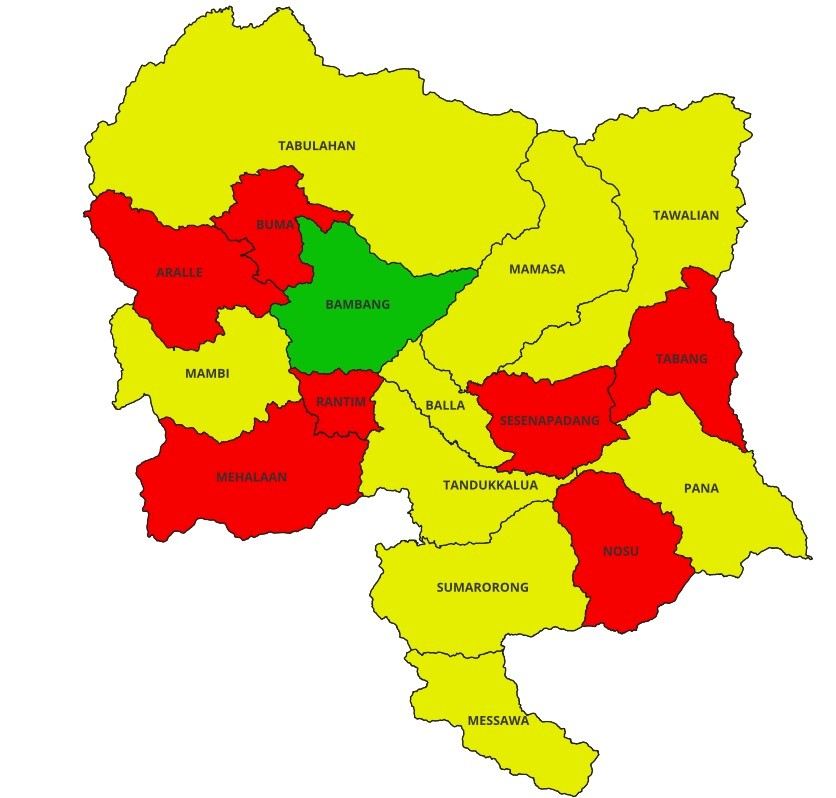
The productivity of the food, plantation, and farm sectors is the main driver of the economy in Mamasa Regency. However, there are significant disparities between subdistricts, requiring targeted development strategies. This study aims to group 17 subdistricts based on the productivity characteristics of the three main sectors using the K-Means Clustering method. The secondary data analyzed includes productivity, production, planted area, and the number of farmers/ranchers for each sector. The research stages include descriptive analysis, identification of leading commodities, and classification of subdistricts based on the productivity of each sector. The analysis results divide the subdistricts into three main clusters with different characteristics. Cluster 1 (High Productivity) is dominated by leading subdistricts, such as Pana for cattle farming, Nosu for Arabica coffee, and Tabulahan for patchouli. Cluster 2 (Medium Productivity) includes subdistricts with balanced performance in several commodities, while Cluster 3 (Low Productivity) consists of subdistricts that still face challenges in land optimization, production, and cultivation efficiency. The implication of this study is cluster-based policy recommendations. Local governments are advised to implement specific strategies, such as developing cattle breeding centers in Pana, processing Arabica coffee in Nosu, and patchouli industry in Tabulahan. For low-productivity clusters, interventions are directed at improving infrastructure, access to inputs, and technological assistance. With this evidence-based strategy, local potential can be optimized, regional disparities reduced, and economic growth in Mamasa Regency can be more inclusive and sustainable.
References
Anderson, D. R., Sweeney, D. J., & Williams, T. A. (2020). Statistics for business and economics. Cengage Learning.
Arifin, B., Rahman, A., Prasetyo, D., & Lestari, S. (2021). Agricultural productivity disparities in Indonesia. Journal of Indonesian Agriculture, 15(2), 45–60.
Chen, X., & Li, Y. (2022). Evidence-based agricultural policy making in developing regions. Journal of Rural Development, 45(2), 112–128.
Fuglie, K., Heisey, P., King, J., & Schimmelpfennig, D. (2020). Agricultural productivity and economic growth. Agricultural Economics, 51(1), 23–38.
Gupta, R., & Kumar, S. (2023). Spatial clustering for agricultural zoning: A case study of Northern India. Agricultural Systems, 195, 103–115.
Han, J., Kamber, M., & Pei, J. (2022). Data mining: Concepts and techniques. Morgan Kaufmann.
Haryanto, A. E. P., & Zulfadhli, M. (2024). Grouping provinces based on Minimum Competency Assessment results to improve education quality in Indonesia. Jurnal Nalar Pendidikan, 12(2), 155–163.
Ismail, F. A., Albarr, A. C., Zulfadhli, M., & Wulandar, S. P. (2024). Pengelompokan kabupaten di Jawa Tengah berdasarkan faktor yang memengaruhi Indeks Pembangunan Manusia tahun 2022 menggunakan analisis cluster. Blantika: Multidisciplinary Journal, 3(1), 67–82.
James, G., Witten, D., Hastie, T., & Tibshirani, R. (2021). An introduction to statistical learning. Springer.
Kumar, A., & Singh, R. (2022). Cluster-based agricultural development in India. Indian Journal of Agricultural Economics, 77(3), 89–104.
Maryudi, A., Santoso, H., Putra, R., & Anwar, M. (2022). Location-specific approaches for agricultural development. Indonesian Journal of Development Studies, 10(1), 34–49.
Porter, M. E. (2021). Competitive advantage of regions. Harvard Business Review Press.
Prasetyo, A., Nugroho, W., Hidayat, R., & Lestari, T. (2022). Regional disparities in agricultural productivity: Evidence from Indonesia. Asian Journal of Agriculture and Development, 19(1), 45–62.
Saputra, R., Widodo, S., Hartono, A., & Lestari, D. (2021). Rice productivity clustering in East Java. Journal of Agricultural Research, 8(2), 112–125.
Sari, D., & Wijaya, K. (2021). Cluster-based mapping for agricultural development planning. Indonesian Journal of Agricultural Research, 14(3), 78–92.
Tan, P. N., Steinbach, M., & Kumar, V. (2021). Introduction to data mining. Pearson Education.
Todaro, M. P., & Smith, S. C. (2020). Economic development. Pearson Education.
Triola, M. F. (2021). Elementary statistics. Pearson Education.
Wahyuni, S., & Fitriani, N. (2022). Plantation commodity mapping in South Sulawesi. Agro Economic Journal, 13(1), 67–82.
Witten, I. H., Frank, E., Hall, M. A., & Pal, C. J. (2023). Data mining: Practical machine learning tools and techniques. Morgan Kaufmann.
Zhao, L., Chen, M., Huang, X., & Li, Y. (2023). Advanced clustering methods for regional analysis. Computers and Electronics in Agriculture, 194, 106–120.
Zulfadhli, M., Iswadi, A., Nurdin, S. Z., Muflikhah, S., Izzaty, N. R., Fatika, I., & Choirunnisa, T. F. (2025). Estimasi proporsi swing voter di kalangan pemilih pemula pada Pemilu 2024: Studi kasus Kota Salatiga dengan metode stratified two-stage cluster sampling. Codeverse: Journal of Emerging Digital Realities, 1(1), 1–7.
Downloads
Published
Issue
Section
License
Copyright (c) 2026 Muhammad Zulfadhli, Kesumaning Dyah Larasati, Rizky Fitria Ramadhanni, Raynaldi Anggiat Samuel Siahaan, Mochamad Fatih Romadlon

This work is licensed under a Creative Commons Attribution-ShareAlike 4.0 International License.
Authors who publish with this journal agree to the following terms:
- Authors retain copyright and grant the journal right of first publication with the work simultaneously licensed under Creative Commons Attribution License that allows others to share the work with an acknowledgement of the work's authorship and initial publication in this journal.
- Authors are able to enter into separate, additional contractual arrangements for the non-exclusive distribution of the journal's published version of the work (e.g., post it to an institutional repository or publish it in a book), with an acknowledgement of its initial publication in this journal.
- Authors are permitted and encouraged to post their work online (e.g., in institutional repositories or on their website) prior to and during the submission process, as it can lead to productive exchanges, as well as earlier and greater citation of published work (See The Effect of Open Access).