Mathematical Model of Social Media Addiction: An Optimal Control Approach
DOI:
https://doi.org/10.12928/bamme.v5i2.14795Abstract
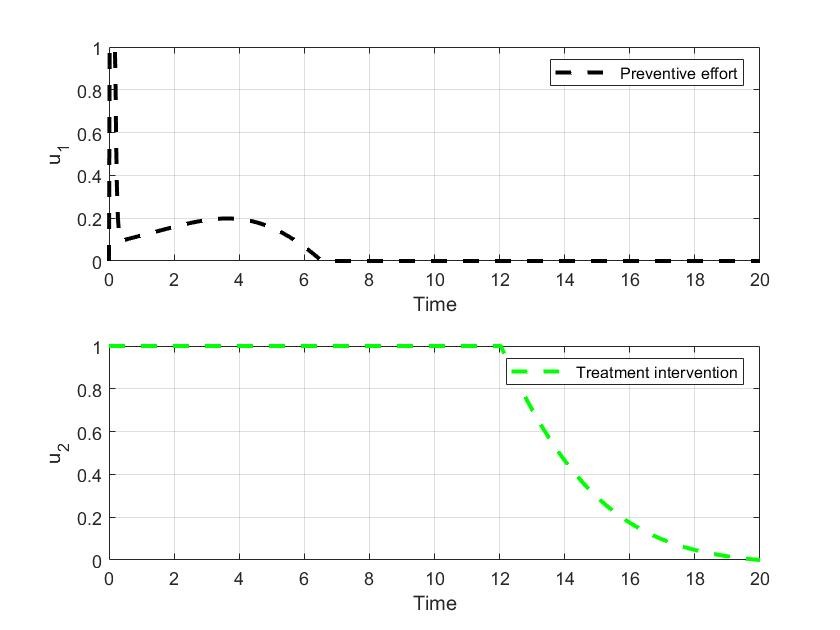
In this study, we developed a deterministic mathematical model to analyze social media addiction, incorporating an optimal control strategy. The basic model captures the dynamics through which individuals become exposed to and eventually addicted to social media platforms. To enhance the model, we introduced two time-dependent control variables: one representing awareness campaigns through advertising and education, and the other representing treatment interventions for individuals suffering from addiction. An optimal control framework was then formulated based on these interventions. By applying Pontryagin’s Minimum Principle, we derived the necessary conditions for optimality and constructed the corresponding optimality system. Numerical simulations of the optimal control problem were conducted using the forward-backward sweep method to assess the effectiveness of the proposed strategies. The results demonstrate that the integrated control strategy—combining public awareness efforts with treatment interventions— substantially reduces the number of individuals exposed to and addicted to social media. Compared to scenarios without intervention, the number of affected individuals was significantly lower. These findings underscore the importance of implementing combined strategies rather than isolated measures. Therefore, this integrated approach is strongly recommended for policymakers and stakeholders as a practical and effective means to mitigate the adverse effects of social media addiction on public health and societal well-being..
Keywords: Social Media Addiction, Mathematical Model, Pontryagin Minimum Principle, Optimal Control.
Downloads
Published
Issue
Section
License
Copyright (c) 2025 Ratna Widayati, Intrada Reviladi, Nur Afandi, Ramya Rachmawati

This work is licensed under a Creative Commons Attribution-ShareAlike 4.0 International License.
Authors who publish with this journal agree to the following terms:
- Authors retain copyright and grant the journal right of first publication with the work simultaneously licensed under Creative Commons Attribution License that allows others to share the work with an acknowledgement of the work's authorship and initial publication in this journal.
- Authors are able to enter into separate, additional contractual arrangements for the non-exclusive distribution of the journal's published version of the work (e.g., post it to an institutional repository or publish it in a book), with an acknowledgement of its initial publication in this journal.
- Authors are permitted and encouraged to post their work online (e.g., in institutional repositories or on their website) prior to and during the submission process, as it can lead to productive exchanges, as well as earlier and greater citation of published work (See The Effect of Open Access).