Optimizing stock allocation and profit in MSMEs: Multiple constraints bounded Knapsack model solved using Grey Wolf Optimizer algorithm
DOI:
https://doi.org/10.12928/bamme.v5i2.14728Keywords:
GWO algorithm, Knapsack problem, MSMEs, Multiple constraints bounded, Stock optimizationAbstract
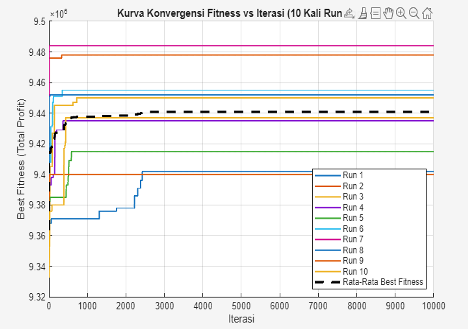
Effective inventory management is a determining factor in the probability and sustainability of micro, small, and medium enterprises (MSMEs). Adjusting the ideal stock of each product type that has to be distributed while taking perishable items, storage capacity constraints, and client demand unpredictability into account is a difficulty. Stock allocation must maximize profit while adhering to intricate constraints and particular item number limitations in the multiple-constraints Knapsack problem. This research aims to apply the Grey Wolf Optimizer (GWO) algorithm to the multiple constraints bounded Knapsack problem for optimal stock allocation while increasing profitability for MSMEs by comparing the ideal value of the simplex technique. The population parameter (Npop) and the maximum iteration (Max Iter) were the two parameters used to test the GWO method. According to sensitivity analysis, the GWO algorithm optimization study was less successful in producing the best outcomes. This resulted from a discrepancy between the simplex method's IDR 9,508,000 profit optimization and GWO's IDR 9,440,000. Nonetheless, the GWO method was almost ideal, as indicated by the deviation percentage of 0.7152%. The study highlights the applicability of metaheuristic optimization for MSME management inventory, offering a near-optimal solution with minimal deviation from analytical results. Limitations include the single-case scope and parameter sensitivity of the GWO algorithm.
References
Ardiansyah, Handayaningsih, S., & Fathurrizki, D. (2025). Grey Wolf Optimizer termodifikasi menggunakan Chaotic Uniform Initialization untuk estimasi Effort Cocomo. Jurnal Teknologi Informasi dan Ilmu Komputer, 12(3), 671–680. https://doi.org/10.25126/jtiik.20258901
Azis, A. I. S., Santoso, , Budy, & Jeffry, J. (2025). Penerapan Grey Wolf Optimizer dalam pelatihan multi layer Perceptron untuk menangani masalah klasifikasi dan regresi. Advances in Computer System Innovation Journal, 2(3), 108–118. https://doi.org/10.51577/acsijournal.v2i3.653
Cacchiani, V., Iori, M., Locatelli, A., & Martello, S. (2022). Knapsack problems — An overview of recent advances. Part II: Multiple, multidimensional, and quadratic Knapsack problems. Computers and Operations Research, 143, 105693. https://doi.org/10.1016/j.cor.2021.105693
Faris, H., Aljarah, I., Al-Betar, M. A., & Mirjalili, S. (2018). Grey wolf optimizer: a review of recent variants and applications. Neural Computing and Applications, 30(2), 413–435. https://doi.org/10.1007/s00521-017-3272-5
Iqbal, M., Zarlis, M., Tulus, T., & Mawengkang, H. (2019). Pendekatan Pengembangan Metaheuristik dalam optimisasi kombinatorial. Prosiding Seminar Nasional Riset Information Science (SENARIS), 1, 1193. https://doi.org/10.30645/senaris.v1i0.135
Junaidi, M. (2024). UMKM Hebat, Perekonomian Nasional Meningkat. https://djpb.kemenkeu.go.id/kppn/curup/id/data-publikasi/artikel/2885-umkm-hebat,-perekonomian-nasional-meningkat.html
Lestari, V., Kamsyakawuni, A., & Santoso, K. A. (2019). Implementasi algoritma Grey Wolf Optimizer (GWO) di Toko Citra Tani Jember. Majalah Ilmiah Matematika dan Statistika, 19, 65-74.
Mirjalili, S., Mirjalili, S. M., & Lewis, A. (2014). Grey Wolf Optimizer. Advances in Engineering Software, 69, 46–61. https://doi.org/10.1016/j.advengsoft.2013.12.007
Munthe, A., M. Yarham, & Siregar, R. (2023). Peranan usaha mikro kecil menengah terhadap perekonomian Indonesia. Jurnal Ekonomi Bisnis, Manajemen dan Akuntansi, 2(3), 593–614. https://doi.org/10.61930/jebmak.v2i3.321
Nahor, K. E. B., Zebua, O., & Hakim, L. (2023). Penentuan lokasi dan kapasitas kapasitor bank pada jaringan distribusi penyulang americano untuk meminimalkan rugi-rugi daya dengan metode Grey Wolf Optimizer (GWO). Electrician : Jurnal Rekayasa dan Teknologi Elektro, 17(1), 100–107. https://doi.org/10.23960/elc.v17n1.2376
Nilasari, L. F., Santoso, K. A., & Riski, A. (2019). Penerapan Dragonfly Optimization Algorithm (DOA) pada permasalahan multiple constraints bounded Knapsack. Majalah Ilmiah Matematika dan Statistika, 19(1). https://doi.org/10.19184/mims.v19i1.17264
Nugroho, A. Y. (2021). Sistem dan Teknik Manajemen Inventory. Gemilang Press Indonesia.
Prasha, A. A., Rachmadi, C. O., Sari, A. P., Raditya, N. G., Mutiara, S. L., & Yusuf, M. (2024). Implementasi algoritma Greedy dan dynamic programming untuk masalah penjadwalan interval dengan model Knapsack. Format: Jurnal Ilmiah Teknik Informatika, 13(2), 166. https://doi.org/10.22441/format.2024.v13.i2.005
Qiu, Y., Yang, X., & Chen, S. (2024). An improved grey wolf optimization algorithm solving to functional optimization and engineering design problems. Scientific Reports, 14(1), 1–24. https://doi.org/10.1038/s41598-024-64526-2
Santoso, K. A., Kurniawan, M. B., Kamsyakawuni, A., & Riski, A. (2022). Hybrid cat-particle swarm optimization algorithm on bounded Knapsack problem with multiple constraints. Proceedings of the International Conference on Mathematics, Geometry, Statistics, and Computation (IC-MaGeStiC 2021), 96, 244–248. https://doi.org/10.2991/acsr.k.220202.045
Sapoetra, Y. A., & Habibi, A. R. (2023). Multidimensional Knapsack 0-1 solution with algorithm evolution Pso-Ga. Sinkron, 8(4), 2406–2413. https://doi.org/10.33395/sinkron.v8i4.12887
Szkaliczki, T. (2025). Solution methods for the multiple-choice Knapsack problem and their applications. Mathematics, 13(7). https://doi.org/10.3390/math13071097
Wu, Y. (2023). Comparison of dynamic programming and greedy algorithms and the way to solve 0-1 knapsack problem. Applied and Computational Engineering, 5(1), 631–636. https://doi.org/10.54254/2755-2721/5/20230666
Yosviansyah, M. N., & Rizal, Y. (2024). Optimasi persediaan bahan baku dan produksi usaha Ganepo Putri Yose dengan menggunakan algoritma Grey Wolf Optimizer. MATHunesa: Jurnal Ilmiah Matematika, 12(1), 94-100.
Downloads
Published
Issue
Section
License
Copyright (c) 2025 Mufarrida Dalilah, Hendra Cipta

This work is licensed under a Creative Commons Attribution-ShareAlike 4.0 International License.
Authors who publish with this journal agree to the following terms:
- Authors retain copyright and grant the journal right of first publication with the work simultaneously licensed under Creative Commons Attribution License that allows others to share the work with an acknowledgement of the work's authorship and initial publication in this journal.
- Authors are able to enter into separate, additional contractual arrangements for the non-exclusive distribution of the journal's published version of the work (e.g., post it to an institutional repository or publish it in a book), with an acknowledgement of its initial publication in this journal.
- Authors are permitted and encouraged to post their work online (e.g., in institutional repositories or on their website) prior to and during the submission process, as it can lead to productive exchanges, as well as earlier and greater citation of published work (See The Effect of Open Access).