TGT vs STAD: Comparing vocational students’ performance between two cooperative learning models
DOI:
https://doi.org/10.12928/bamme.v5i1.11012Keywords:
cooperative learning, mathematics achievement, STAD, TGT, vocational high schoolAbstract
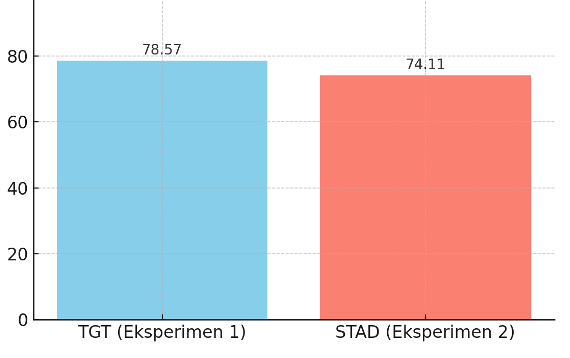
Various factors – such as low interest, motivation, and poor problem-solving skills – contribute to vocational high school students' low mathematics learning outcomes. The cooperative learning models of Teams Games Tournament (TGT) and Student Team Achievement Division (STAD) are the alternative teaching strategies proven to improve student learning outcomes. This study aims to compare the effects of the two models on the mathematics learning outcomes of eleventh-grade students at SMK Negeri 1 Salam – a vocational high school in Indonesia. The research uses a quantitative approach with a true experimental design of the posttest-only control group design type. We randomly selected two classes from a homogeneous population, which applied the TGT model to one class and the STAD model to the other. They used a learning outcome test that experts had validated and tested for reliability. Data were analyzed using the independent sample t-test and one-tailed test. The research results show a significant difference in the influence between the TGT and STAD models on mathematics learning outcomes, with the average score of the TGT group being higher (78.57) compared to the STAD group (74.11). One-tailed tests show that the TGT model has a significantly greater impact than STAD. Thus, the TGT model is considered more effective in improving the mathematics learning outcomes of vocational school students because it can create a competitive, enjoyable learning atmosphere and encourage active student participation.
References
Adhia, H. (2015). Peningkatan hasil belajar matematika siswa kelas XII TKR SMK Adzkia Padang dengan model STAD. LEMMA, 11(1).
Amelia, E. E. (2020). Penerapan model pembelajaran kooperatif tipe STAD untuk peningkatan hasil belajar siswa pada mata pelajaran matematika di SMK PGRI Kota Mojokerto. Educatif: Journal of Education Research, 2(3), 90–95.
Anggraeni, D. A. (2019). Peningkatan hasil belajar dan jiwa kompetitif siswa SMK menggunakan team game tournament. Tajdidukasi, 9(2), 50–56. https://doi.org/10.31763/tajdidukasi.v9i2.28
Aqshal, H., Yuli, F., Nugroho, S., Cahya, L. E., & Fendi, N. (2022). Efektivitas model pembelajaran kooperatif terhadap hasil belajar peserta didik SMK kompetensi keahlian teknik instalasi tenaga listrik menggunakan studi meta analisis dan observasi lapangan. Jurnal Pendidikan Teknik Elektro, 11(3), 501–513.
Asih, J. L., & Prihatnani, E. (2021). Perbandingan hasil belajar trigonometri dan penerapan STAD dan TGT ditinjau atas tingkat kecemasan. Jurnal Cendekia: Jurnal Pendidikan Matematika, 05(01), 259–273.
Bahri, H. A., & Rifai, H. (2020). Penerapan model pembelajaran TGT dengan alat peraga Ultaphygo untuk meningkatkan hasil belajar matematika siswa. Pepatudzu: Media Pendidikan dan Sosial Kemasyarakatan, 16(2), 110. https://doi.org/10.35329/fkip.v16i2.1767
Chairhany, S. (2020). Meningkatkan motivasi hasil belajar matematika melalui model pembelajaran kooperatif teams-games-tournament siswa kelas XI Akuntansi SMK Negeri 1 Tembilahan. Jurnal Pendidikan, 1(3). https://doi.org/10.46963/asatiza.v1i3.119
Ferdiansyah, F., Ardiana, N., & Elindra, R. (2025). Analisis faktor-faktor rendahnya minat belajar matematika siswa kelas X SMK Negeri 1 Angkola Timur. Mathematic Education Journal MathEdu, 8(1).
Golzar, J., & Noor, S. (2022). Simple random sampling. IJELS, 2.
Hidayat, R., Yanti Siregar, E., & Elindra, R. (2022). Analisis faktor-faktor rendahnya kemampuan pemecahan masalah matematis siswa di SMK Swasta Teruna Padangsidimpuan. Mathematic Education Journal MathEdu, 5(3).
Mertens, D. M. (2015). Research and evaluation in education and psychology: Integrating diversity with quantitative, qualitative, and mixed methods. SAGE Publications, Inc.
Muijs, D. (2004). Doing Quantitative Research in Education with SPSS (1st ed.). Sage Publication.
Noviawan, A., Hanggorokasih, G. B., Ningsih, R. A., & Arifin, S. (2022). Analisis faktor penyebab rendahnya minat belajar siswa terhadap mata pelajaran matematika di SMK Negeri Pringkuku. Bachelor thesis. STKIP PGRI Pacitan.
Nurhanifah, T., Meilantifa, & Kholifah, S. (2024). Meningkatkan minat belajar matematika melalui teknik pembelajaran kooperatif STAD pada materi statistika di kelas X Kuliner 5 SMK Negeri 8 Surabaya. JMER: Journal of Mathematics Education Research, 2(2), 2829–6001.
Olken, F. (1993). Random sampling from databases. PhD thesis. University of California Berkeley.
Purwaningrum, D., & Sumardi, D. (2016). Efek strategi pembelajaran ditinjau dari kemampuan awal matematika terhadap hasil belajar matematika kelas XI IPS. Jurnal Managemen Pendidikan, 11(2), 155–167.
Rizky, A., Zahari, C. L. (2024). Perbandingan model pembelajaran kooperatif tipe STAD dengan TGT dalam meningkatkan motivasi dan hasil belajar siswa. Jurnal Penelitian Pendidikan dan Pembelajaran, 10(1), 9–19. https://doi.org/10.21093/twt.v11i1.8209
Rofi’ah, S. (2021). Penerapan model pembelajaran kooperatif tipe STAD (student teams-achievement divisions) untuk meningkatkan hasil belajar siswa. LEARNING: Jurnal Inovasi Penelitian Pendidikan dan Pembelajaran, 1(2), 145-153.
Sari, J. P., Werang, M. K. K., & Indria, S. (2023). Analisis faktor kesulitan belajar matematika siswa di SMK Negeri 66 Jakarta. Prosiding Diskusi Panel Nasional Pendidikan Matematika (Vol. 9). Universitas Indraprasta PGRI.
Setiyani, A., & Suhendri, H. (2017). Pengaruh model pembelajaran kooperatif tipe Teams Game Tournament terhadap kemampuan berpikir kreatif matematika. Prosiding Diskusi Panel Nasional Pendidikan Matematika (Vol. 9). Universitas Indraprasta PGRI.
Singh, A. S., & Masuku, M. B. (2014). Sampling techniques & determination of sample size in applied statistics research: An overview. International Journal of Economics, Commerce and Management, 11(11).
Wahartojo, S., Budiyono, & Usodo, B. (2016). Eksperimentasi model pembelajaran PBL, model pembelajaran kooperatif tipe TGT, dan STAD ditinjau dari tingkat aktivitas metakognisi. Jurnal Elektronik Pembelajaran Matematika, 947–960.
Downloads
Published
Issue
Section
License
Copyright (c) 2025 Aulia Cahya Pratiwi, Uswatun Khasanah

This work is licensed under a Creative Commons Attribution-ShareAlike 4.0 International License.
Authors who publish with this journal agree to the following terms:
- Authors retain copyright and grant the journal right of first publication with the work simultaneously licensed under Creative Commons Attribution License that allows others to share the work with an acknowledgement of the work's authorship and initial publication in this journal.
- Authors are able to enter into separate, additional contractual arrangements for the non-exclusive distribution of the journal's published version of the work (e.g., post it to an institutional repository or publish it in a book), with an acknowledgement of its initial publication in this journal.
- Authors are permitted and encouraged to post their work online (e.g., in institutional repositories or on their website) prior to and during the submission process, as it can lead to productive exchanges, as well as earlier and greater citation of published work (See The Effect of Open Access).