Developing an RME-based 3D storybook with AR technology to enhance spatial ability
DOI:
https://doi.org/10.12928/bamme.v5i1.10880Keywords:
ADDIE, augmented reality, realistic mathematics education, spatial ability, storybookAbstract
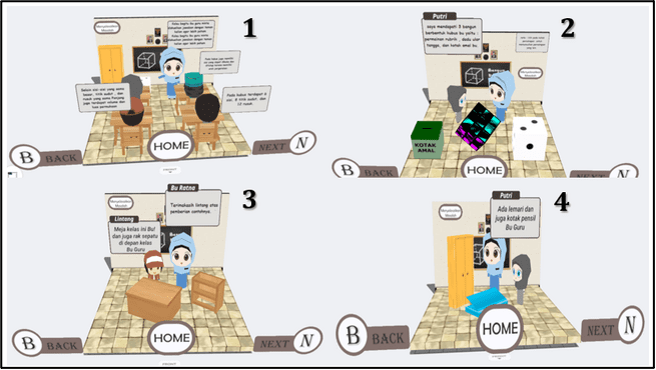
This research aims to develop a 3D storybook using realistic mathematics education (RME) approach and augmented reality (AR) technology to enhance students' spatial ability. We used the ‘Analysis, Design, Development, Implementation, and Evaluation’ (ADDIE) development model and involved 34 eighth-grade students of SMP N 15 Yogyakarta – a public junior high school in Indonesia. During the development, we underwent several interviews, observations, asking experts’ validation to the content and the media, asking students’ response to the product, and tests related to the students' spatial ability. The results suggest that the content validation got an average score of 109 (good criteria), the media validation got an average score of 48.16 (good criteria), and the students response got an average score of 78.36 (very good criteria). At the end of the stage, there are still found an obstacle during the testing of the 3D storybook, namely the time required to load the 3D content. It makes some students encounter difficulty to access it, indicating the need for further development. However, the final product could facilitate the students to exercise their spatial ability using the 3D storybook while learning geometry.
References
Adams, J., Resnick, I., & Lowrie, T. (2023). Supporting senior high-school students’ measurement and geometry performance: Does spatial training transfer to mathematics achievement? Mathematics Education Research Journal, 35(4), 879–900. https://doi.org/10.1007/s13394-022-00416-y
Alam, A., & Mohanty, A. (2023). Learning on the Move: A Pedagogical Framework for State-of-the-Art Mobile Learning. In Lecture Notes in Networks and Systems (Vol. 662, Issue June). Springer Nature Singapore. https://doi.org/10.1007/978-981-99-1414-2_52
AlGerafi, M. A. M., Zhou, Y., Oubibi, M., & Wijaya, T. T. (2023). Unlocking the Potential: A Comprehensive Evaluation of Augmented Reality and Virtual Reality in Education. Electronics (Switzerland), 12(18). https://doi.org/10.3390/electronics12183953
Atit, K., Power, J. R., Pigott, T., Lee, J., Geer, E. A., Uttal, D. H., Ganley, C. M., & Sorby, S. A. (2022). Examining the relations between spatial skills and mathematical performance: A meta-analysis. Psychonomic Bulletin and Review, 29(3), 699–720. https://doi.org/10.3758/s13423-021-02012-w
Aulia, I. M., Prayitno, S., Lu’luilmaknun, U., & Sridana, N. (2023). Analysis of students spatial ability in solving problems of flat side space subjects based on van hieles level of thinking. Jurnal Pijar MIPA, 18(1), 36–41. https://doi.org/10.29303/jpm.v18i1.3186
Bartlett, K. A., & Camba, J. D. (2023). Gender Differences in Spatial Ability: a Critical Review. Educational Psychology Review, 35(1), 1–29. https://doi.org/10.1007/s10648-023-09728-2
Bosco, A., Sanz Diez, P., Filippini, M., & Fattori, P. (2023). The influence of action on perception spans different effectors. Frontiers in Systems Neuroscience, 17, 1–16. https://doi.org/10.3389/fnsys.2023.1145643
Breive, S. (2022). Abstraction and embodiment: exploring the process of grasping a general. Educational Studies in Mathematics, 110(2), 313–329. https://doi.org/10.1007/s10649-021-10137-x
Callow, J. (2020). Visual and verbal intersections in picture books–multimodal assessment for middle years students. Language and Education, 34(2), 115–134. https://doi.org/10.1080/09500782.2019.1689996
Cao, J., Lam, K. Y., Lee, L. H., Liu, X., Hui, P., & Su, X. (2023). Mobile Augmented Reality: User Interfaces, Frameworks, and Intelligence. ACM Computing Surveys, 55(9). https://doi.org/10.1145/3557999
Czok, V., Krug, M., Müller, S., Huwer, J., & Weitzel, H. (2023). Learning Effects of Augmented Reality and Game-Based Learning for Science Teaching in Higher Education in the Context of Education for Sustainable Development. Sustainability, 15(21), 15313. https://doi.org/10.3390/su152115313
Eom, S. (2023). The effects of the use of mobile devices on the E-learning process and perceived learning outcomes in university online education. E-Learning and Digital Media, 20(1), 80–101. https://doi.org/10.1177/20427530221107775
Familoni, B. T., & Onyebuchi, N. C. (2024). Augmented and Virtual Reality in U.S. Education: a Review: Analyzing the Impact, Effectiveness, and Future Prospects of AR/VR Tools in Enhancing Learning Experiences. International Journal of Applied Research in Social Sciences, 6(4), 642–663. https://doi.org/10.51594/ijarss.v6i4.1043
Faqih, K. M. S., & Jaradat, M. I. R. M. (2021). Integrating TTF and UTAUT2 theories to investigate the adoption of augmented reality technology in education: Perspective from a developing country. Technology in Society, 67(October 2021). https://doi.org/10.1016/j.techsoc.2021.101787
Fauzana, R., Dahlan, J. A., & Jupri, A. (2020). The influence of realistic mathematics education (RME) approach in enhancing students’ mathematical literacy skills. Journal of Physics: Conference Series, 1521(3), 1–6. https://doi.org/10.1088/1742-6596/1521/3/032052
Fernández-Batanero, J. M., Montenegro-Rueda, M., & Fernández-Cerero, J. (2022). Use of Augmented Reality for Students with Educational Needs: A Systematic Review (2016–2021). Societies, 12(2). https://doi.org/10.3390/soc12020036
Haas, B., Lavicza, Z., Houghton, T., & Kreis, Y. (2023). Can you create? Visualising and modelling real-world mathematics with technologies in STEAM educational settings. Current Opinion in Behavioral Sciences, 52(June), 101297. https://doi.org/10.1016/j.cobeha.2023.101297
Heuvel-Panhuizen, M. Van den, & Drijvers, P. (2014). Realistic Mathematics Education. In Encyclopedia of Mathematics Education. https://doi.org/10.1007/978-94-007-4978-8_170
Huda, M. B., Suyitno, I., Pratiwi, Y., & Roekhan. (2024). Bibliometric Analysis of Character Education in Senior High School Indonesian Textbooks Based on the Merdeka Curriculum. QALAMUNA: Jurnal Pendidikan, Sosial, Dan Agama, 16(2), 983–996. https://doi.org/10.37680/qalamuna.v16i2.5332
Izard, V., Pica, P., & Spelke, E. S. (2022). Visual foundations of Euclidean geometry. Cognitive Psychology, 136(March 2019). https://doi.org/10.1016/j.cogpsych.2022.101494
Klopfer, E., & Squire, K. (2008). Environmental detectives-the development of an augmented reality platform for environmental simulations. Educational Technology Research and Development, 56(2), 203–228. https://doi.org/10.1007/s11423-007-9037-6
Koumpouros, Y. (2024). Revealing the true potential and prospects of augmented reality in education. Smart Learning Environments, 11(2), 1–26. https://doi.org/10.1186/s40561-023-00288-0
Kusuma, A. P., Aslamia, A. S., Sintiya, H., Rahayu, R. G., & Rahmawati, N. K. (2023). Analysis of Students’ Difficulties in Solving Problems Related to Solid Geometry. Brillo Journal, 2(2), 108–121. https://doi.org/10.56773/bj.v2i2.37
Legi, H., Damanik, D., & Giban, Y. (2023). Transforming Education Through Technological Innovation in The Face of The Era of Society 5.0. Educenter: Jurnal Ilmiah Pendidikan, 2(2), 102–108. https://doi.org/10.55904/educenter.v2i2.822
Lubis, R., Ahmad, M., & Simanullang, S. (2023). Efektivitas Penerapan Model Pembelajaran Realistic Mathematics Education (RME) Terhadap Kemampuan Komunikasi Matematika Siswa. Jurnal MathEdu (Mathematic Education Journal), 6(3), 53–54.
Marougkas, A., Troussas, C., Krouska, A., & Sgouropoulou, C. (2024). How personalized and effective is immersive virtual reality in education? A systematic literature review for the last decade. In Multimedia Tools and Applications (Vol. 83, Issue 6). Springer US. https://doi.org/10.1007/s11042-023-15986-7
Marwanti, E. N. W., & Sumilah, S. (2022). Pengembangan Buku Ajar Berbasis Local Stories Pada Muatan Pelajaran Matematika Kelas 1. Joyful Learning Journal, 11(2), 44–54. https://doi.org/10.15294/jlj.v11i2.56525
Mirza, I. M. M. (2024). Optimalisasi Virtual Reality dan Augmented Reality Dalam Platform Gaming Menuju Masyarakat 5.0. VISUAL IDEAS, 4(1), 1–18. https://doi.org/10.33197/visualideas.vol4.iss1.2024.1732
Muchtar, I. S. M., Hendriani, A., & Fitriani, A. D. (2020). Penerapan Pendekatan RME untuk Meningkatkan Pemahaman. Jurnal Pendidikan Guru Sekolah Dasar, 5(11), 108–119. https://ejournal.upi.edu/index.php/jpgsd/article/view/30023
Munir, N. P., Anas, A., Suryani, L., & Munir, F. S. (2022). The Practicality of Geometry Learning Media based on Augmented Reality. Al-Khwarizmi : Jurnal Pendidikan Matematika Dan Ilmu Pengetahuan Alam, 10(1), 75–84. https://doi.org/10.24256/jpmipa.v9i2.2241
Nur, A., Rohmah, B., Romadhona, E. P., Putri, L. A., & Kartikasari, V. (2022). Pembelajaran Pendidikan Islam Melalui Virtual Reality (VR). Jurnal Tarbiyah Islamiyah, 7(2), 373–385. http://ejournal.stit-ru.ac.id/index.php/raudhah/article/view/450
Paroqi, L. L., Mursalin, M., & Marhami, M. (2020). The Implementation of Realistic Mathematics Education Approach to Improve Students’ Mathematical Communication Ability in Statistics Course. International Journal for Educational and Vocational Studies, 2(10), 879–889. https://doi.org/10.29103/ijevs.v2i10.3311
Pohan, M. Z. (2022). Pengembangan Media Bangun Datar Melalui Tari Mak Inang Berbasis Puzzle Matematika Tahun Pelajaran 2020/2021. Jurnal Ilmiah Mahasiswa Pendidikan, 2(1), 1–11. http://jurnalmahasiswa.umsu.ac.id/index.php/jimedu/article/view/1172
Scavarelli, A., Arya, A., & Teather, R. J. (2021). Virtual reality and augmented reality in social learning spaces: a literature review. Virtual Reality, 25(1), 257–277. https://doi.org/10.1007/s10055-020-00444-8
Szabó, T., Babály, B., Pataiová, H., & Kárpáti, A. (2023). Development of Spatial Abilities of Preadolescents: What Works? Education Sciences, 13(3), 1–24. https://doi.org/10.3390/educsci13030312
Utomo, D. P., Amaliyah, T. Z., Darmayanti, R., Usmiyatun, U., & Choirudin, C. (2023). Students’ Intuitive Thinking Process in Solving Geometry Tasks from the Van Hiele Level. JTAM (Jurnal Teori Dan Aplikasi Matematika), 7(1), 139–149. https://doi.org/10.31764/jtam.v7i1.11528
Zhao, X., Ren, Y., & Cheah, K. S. L. (2023). Leading Virtual Reality (VR) and Augmented Reality (AR) in Education: Bibliometric and Content Analysis From the Web of Science (2018–2022). SAGE Open, 13(3), 1–23. https://doi.org/10.1177/21582440231190821
Zhu, C., Klapwijk, R., Silva-Ordaz, M., Spandaw, J., & de Vries, M. J. (2023). Cognitive and embodied mapping of data: an examination of children’s spatial thinking in data physicalization. Frontiers in Education, 8(December). https://doi.org/10.3389/feduc.2023.1308117
Downloads
Published
Issue
Section
License
Copyright (c) 2025 Syaiful Rochmat, Andriyani, Deny Hadi Siswanto

This work is licensed under a Creative Commons Attribution-ShareAlike 4.0 International License.
Authors who publish with this journal agree to the following terms:
- Authors retain copyright and grant the journal right of first publication with the work simultaneously licensed under Creative Commons Attribution License that allows others to share the work with an acknowledgement of the work's authorship and initial publication in this journal.
- Authors are able to enter into separate, additional contractual arrangements for the non-exclusive distribution of the journal's published version of the work (e.g., post it to an institutional repository or publish it in a book), with an acknowledgement of its initial publication in this journal.
- Authors are permitted and encouraged to post their work online (e.g., in institutional repositories or on their website) prior to and during the submission process, as it can lead to productive exchanges, as well as earlier and greater citation of published work (See The Effect of Open Access).